The quick answer#
A driveway costs $4 to $30 per square foot installed. Which end you land on is almost entirely the material: gravel $4 to $10, asphalt $5 to $12, concrete $6 to $15, pavers $10 to $30. On a typical 2-car driveway at 480 square feet that is $1,920 for gravel and $14,400 for pavers, with everything else in between.
Gravel
$4–$10per sq ft installedAsphalt
$5–$12per sq ft installedConcrete
$6–$15per sq ft installedPavers
$10–$30per sq ft installedThose ranges are wide for a reason. Half of what you pay for a driveway is not the surface at all: it is excavation, base depth, drainage, and getting a truck to the site. A flat, accessible, well-drained rectangle lands near the bottom of every range. A sloped, poorly drained site with a tight approach lands near the top of all four.
Every one of these starts the same way
Work out the base stone before anything else
All four driveway types sit on compacted crushed stone, and on a driveway that base is 8 to 12 inches deep rather than the 4 to 6 a patio takes. Get the tons before you price the surface.
Cost per square foot#
Four materials, four different bargains. Read this table across rather than down: the cheapest install is not the cheapest driveway, and the longest lasting is not automatically the best value.
| Material | Installed, per sq ft | Lifespan | Upkeep |
|---|---|---|---|
| Gravel | $4–$10 | Up to 100 years with a stable base | Regrade and top up as needed; no published rate |
| Asphalt | $5–$12 | 15 to 30 years | Sealcoat every 2 to 3 years, $1 to $2 per sq ft hired |
| Concrete | $6–$15 | 30 to 40 years | Reseal every 2 to 3 years, $1 to $3 per sq ft hired. Minor crack repair $100 to $400 |
| Pavers | $10–$30 | 25 to 75 years | Re-sand joints as needed |
Installed prices cover excavation, base, surface, and labor on an accessible site of normal slope. Gravel stone alone runs $1 to $3 per square foot before base work and grading. Stamped, colored, or bordered concrete runs $10 to $25 per square foot, in line with the QuantiYard concrete patio cost guide.
Why a concrete driveway costs more than a concrete patio
Two reasons, and both are structural. A driveway sits on a deeper base, and it takes a rebar mat at $1 to $3 per square foot rather than the wire mesh a patio gets by with. The slab itself starts at the same 4 inches for cars, going to 5 or 6 only for RVs and heavier vehicles. The concrete calculator will give you the yardage at whatever thickness you pick.
Cost by driveway size#
Driveway sizes are more standard than people expect. A single-car drive is about 10 to 12 feet wide, a double is 20 to 24. Length is whatever the setback gives you.
| Driveway | Area | Gravel | Asphalt | Concrete | Pavers |
|---|---|---|---|---|---|
| 10 × 24 ft | 240 sq ft | $960–$2,400 | $1,200–$2,880 | $1,440–$3,600 | $2,400–$7,200 |
| 12 × 30 ft | 360 sq ft | $1,440–$3,600 | $1,800–$4,320 | $2,160–$5,400 | $3,600–$10,800 |
| 20 × 24 ft | 480 sq ft | $1,920–$4,800 | $2,400–$5,760 | $2,880–$7,200 | $4,800–$14,400 |
| 12 × 50 ft | 600 sq ft | $2,400–$6,000 | $3,000–$7,200 | $3,600–$9,000 | $6,000–$18,000 |
| 24 × 30 ft | 720 sq ft | $2,880–$7,200 | $3,600–$8,640 | $4,320–$10,800 | $7,200–$21,600 |
Each cell applies the per square foot range above to the footprint. Add a turnaround, a parking apron, or a walkway and the area grows faster than the drive itself does, so measure the whole paved surface rather than just the run to the garage.
Where the money goes#
Take one concrete driveway, 20 by 24 feet, 480 square feet, 4 inches thick on 6 inches of compacted base, on a flat and accessible site. This is what an installed quote is actually made of, line by line at published rates.
| Line item | Cost | What it covers |
|---|---|---|
| Grading and site prep | $700–$2,500 | Cut to grade and set the drainage, before any stone arrives |
| Gravel base, 12.4 to 13.3 tons | $124–$667 | 6 inches of crushed stone at $10 to $50 a ton, before delivery |
| Concrete, 5.9 yd³ | $1,015–$1,180 | Ready-mix at $119 to $147 a yard plus the $53 short-load charge |
| Rebar | $480–$1,440 | $1 to $3 per square foot. A driveway takes rebar, not wire mesh |
| Labor: forms, pour, and finish | $1,440–$3,360 | $3 to $7 per square foot, usually the largest line |
| First seal | $480–$1,440 | $1 to $3 per square foot, applied after a month of curing |
| Total of the lines | $4,239–$10,587 | $8.83 to $22.06 per square foot |
Concrete volume is 480 square feet at 4 inches, which is 5.9 cubic yards. Base stone is 6 inches over the same footprint, 8.9 cubic yards, which at 1.4 to 1.5 tons a yard is 12.4 to 13.3 tons. Both figures come straight out of the QuantiYard concrete calculator and gravel calculator. The top of the total runs past the $6 to $15 installed range, because no one job lands at the top of every line.
Notice how little of that is the surface material. The concrete itself is $1,015 to $1,180, about a quarter of the job at the cheap end and about a ninth at the dear end. Everything else is moving dirt, building the base, and paying people to place and finish it. That is why the four materials are closer in total cost than their per-unit prices suggest, and why a site that needs extra excavation or drainage blows past the top of every range at once.
Lifespan and upkeep#
Divide the install cost by the years and the ranking shuffles.
Gravel never really fails, and HomeGuide puts a well-built gravel drive at up to 100 years. It migrates into the lawn, ruts where the tires run, and thins in the middle, and the fix is a load of stone and an afternoon with a rake. No published survey puts a rate on that upkeep, so price it from a load of stone at your local yard; crushed stone runs $10 to $50 a ton. The advantage is that the cost arrives in small pieces you can defer.
That deferred-cost pattern is what makes gravel and concrete hard to compare on install price alone. We ran the two out over a full decade, maintenance included, in our gravel vs. concrete driveway comparison, which is where the gap stops looking so wide.
Asphalt is the shortest-lived hard surface at 15 to 30 years, and it is the one most dependent on upkeep. Sealcoat every 2 to 3 years, at $1 to $2 per square foot hired, and it makes the top of that range. Skip it and water gets into the binder, the surface ravels, and you are repaving early.
Concrete is the long-life default at 30 to 40 years. Resealing every 2 to 3 years keeps it there, at $1 to $3 per square foot hired, and minor crack repair runs $100 to $400. Its weakness is that when it does fail it fails visibly. A cracked or heaved slab cannot be patched invisibly, and the repair is usually a saw and a partial replacement.
Pavers last the longest of the hard surfaces, 25 to 75 years, and they are the only surface here that is genuinely repairable. A cracked paver, a settled patch, or a trench for a utility line comes up and goes back down without a seam showing. Joint sand needs topping up now and then. The catch is the install price, which is double concrete.
What moves the price#
Excavation and disposal#
The first foot of a driveway is dirt going away, not material coming in. A drive that only needs the topsoil stripped is a different job from one cut 18 inches into clay, and the difference shows up in both machine time and haul-off. On the 480 square foot example above, grading and site prep is $700 to $2,500 before a single stone is delivered.
Base depth#
This is the single biggest technical difference between a driveway and a patio. A patio sits on 4 to 6 inches of compacted stone, and a driveway wants more. How much more depends on the surface and the soil. For paver driveways, CMHA, the association ICPI merged into, puts the compacted base at 6 to 8 inches on well-drained soil and says poor drainage or freeze-thaw needs a thicker one. The 2 to 4 inches usually added for that, and the 8 to 12 you see quoted for driveways, come from the earlier ICPI edition of the companion bulletin, and the paver calculator works through both. Treat it as the number for hard conditions rather than the starting point. Base is cheap material and expensive to skip: nearly every failed driveway failed at the base, not at the surface. Run your footprint and depth through the gravel calculator to see what the extra inches cost, then compare that against a repave.
Slope and drainage#
Water is what kills driveways, and a slope decides where it goes. A drive that runs downhill toward a garage needs a trench drain and somewhere to send the water. A drive that pitches into a neighbor's yard needs regrading before anyone paves it. Both are real line items, and neither shows up in a per square foot number. A steep drive also rules out gravel outright, because gravel simply washes downhill.
Reinforcement#
Concrete driveways take a rebar mat, typically #3 or #4 bar on 16 to 18 inch centers. That is a different specification from the welded wire mesh a patio gets, and it is why a driveway slab costs more per square foot than a patio slab of the same finish. Asphalt has no reinforcement, which is part of why it is cheaper and part of why it moves.
Access and site conditions#
A ready-mix truck’s chute only reaches so far. Beyond that you are into wheelbarrows or a pump, and a trailer pump runs $15 a yard with a $125 minimum. The same is true for the paver and asphalt crews: a driveway they can back a truck onto costs less to build than one behind a gate or up a slope.
Pricing a paver driveway
Paver count, base stone, and sand in one pass
Pavers are quoted per piece, so a per square foot estimate is only as good as your paver count. Enter your paver size and joint width, and set the base depth to 8 to 12 inches for a driveway rather than the 6 inch patio default.
A decision framework#
Work through these in order. Most driveways are decided by question two or three, well before budget enters into it.
1. How steep is it?#
Anything over a gentle grade rules out gravel, because stone washes downhill and ends up in the street. On a slope you are choosing between asphalt, concrete, and pavers, and concrete gives the best traction of the three when it is broom finished.
2. What is the climate?#
Hard freeze-thaw cycles are brutal on concrete, which is why asphalt is the northern default: it flexes where concrete cracks. Hot southern sun is brutal on asphalt, which softens and ruts under a parked car. Pavers handle both, because the joints let the surface move without breaking. This one factor explains most of the regional differences you will see in quotes.
3. How long are you staying?#
Under five years, gravel or asphalt makes the case. A driveway rarely returns its cost at sale, and the difference between a $1,920 gravel drive and a $14,400 paver drive is not a difference a buyer pays back. Over twenty years the calculation flips, and concrete or pavers cost less per year of service.
4. Will a utility ever need to come up?#
If a water line, a gas service, or an electrical run passes under the driveway, pavers are worth a hard look. They are the only surface here you can lift, trench under, and put back with no visible repair. That is worth real money on a drive that sits over a service line.
5. What does your own footprint actually come to?#
Measure the whole paved area including the apron and any turnaround, then run it through the gravel calculator for base tons, the concrete calculator for yardage, or the paver calculator for a piece count. Quantities you can check are the only way to tell a fair quote from a padded one.
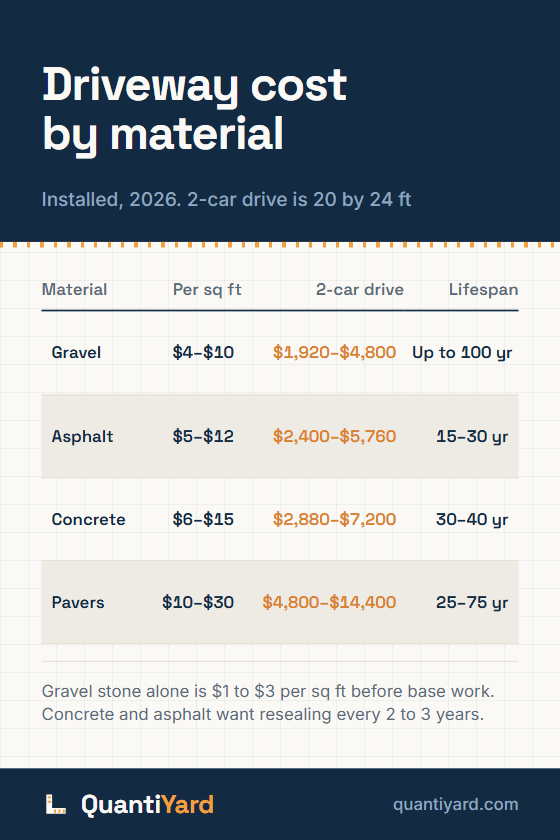
Save the driveway cost chart#
Installed cost per square foot, the total on a 2-car drive, and lifespan for all four materials. Save it and you can hold a quote against it on the spot.
Save to PinterestOpens Pinterest with the chart and link ready to go.
Common questions#
How much does a driveway cost?#
Between $4 and $30 per square foot installed, depending on the material. Gravel runs $4 to $10 installed, or $1 to $3 for the stone alone, asphalt $5 to $12, concrete $6 to $15, and pavers $10 to $30. A typical 2-car driveway at 480 square feet lands anywhere from $1,920 for gravel to $14,400 for pavers.
Is asphalt or concrete cheaper for a driveway?#
Asphalt is cheaper to install, at $5 to $12 per square foot against $6 to $15 for concrete. Concrete lasts longer, 30 to 40 years against 15 to 30, so per year of life the two come out level at the cheap end and concrete is cheaper at the dear end. Both want resealing every 2 to 3 years.
How thick should a concrete driveway be?#
At least 4 inches for cars, and 5 to 6 inches for RVs or anything heavier that parks on it regularly, with the edges thickened to 6 to 8 inches. The rebar and the deeper base, more than the slab, are what make a driveway cost more than a patio.
How long does a gravel driveway last?#
Up to 100 years with a stable base and regular upkeep, on HomeGuide's figures. Gravel does not fail the way a slab does; it migrates, ruts, and thins, and the fix is regrading and new stone. No published survey puts a rate on that upkeep, so price a load of stone locally.