Lawn Fertilizer Calculator
Enter your lawn, the nitrogen rate you want and the first number on the bag. Fertilizer is dosed by nitrogen, not by product, and those two are only the same at 100 percent N.
Updated September 7, 2026 · Estimates for planning, not a quote
Fertilizer is dosed by nitrogen, not by product
Every lawn feeding recommendation you will read is given in pounds of actual nitrogen per 1,000 square feet, and every bag is sold in pounds of product. Those are different numbers, and converting between them is the whole job.
The first number in the NPK analysis is the percentage of the bag that is nitrogen by weight. A 24-0-4 bag is 24 percent nitrogen, so 40 pounds of it contains 9.6 pounds of nitrogen. To put down 1 pound of nitrogen you spread 1 divided by 0.24, which is 4.17 pounds of product.
Scale that to a lawn: 5,000 square feet at 1 pound of nitrogen per 1,000 needs 5 pounds of nitrogen, which is 20.83 pounds of 24-0-4. One 40 pound bag covers it with plenty left, because at this rate a single bag treats 9,600 square feet.
The one pound rule
One pound of actual nitrogen per 1,000 square feet is the maximum for a single application of a quick-release fertilizer. Past that you are not feeding the lawn faster, you are burning it, and the burn shows up as stripes exactly where the spreader passes overlapped. Slow-release and coated products can go higher because the nitrogen is metered out over weeks, and the bag will say so.
A year's feeding is typically 2 to 4 pounds of nitrogen per 1,000 square feet split across three or four applications, weighted toward autumn for cool-season grass. Doing it in one go in spring produces a surge of top growth, a lot of mowing, and a lawn less able to handle summer.
Setting the spreader
Set it from the product rate, which is what this calculator's spreader rate row gives you, not the nitrogen rate. Confusing the two is a factor-of-four error on a 24 percent bag.
Then split it: set the spreader to half the rate and make two passes at right angles to each other. It takes the same amount of product and the same amount of time, and it removes the striping that a single pass leaves wherever the pattern overlapped or fell short. Sweep granules off paths and driveways back onto the grass rather than hosing them, since that is how fertilizer ends up in the storm drain.
Seed and feed are not the same job
A starter fertilizer for new seed is a different analysis, higher in phosphorus, and it goes down with the seed rather than instead of it. Our grass seed calculator gives the seed rate by grass type and whether you are starting a lawn or overseeding, and our sod vs. seed comparison covers which route makes sense before either.
Method and sources
Where these figures come from: The first number in an NPK analysis is the percentage of actual nitrogen by weight, which is what connects a nitrogen rate to a bag of product.
Rates are given in actual nitrogen and bags are sold in product, so pounds of product is the nitrogen figure divided by that percentage. Setting a spreader straight from the nitrogen rate on a 24 percent bag is a factor of four error. Never apply more than 1 pound of actual nitrogen per 1,000 square feet in one quick-release feed. Penn State Extension works the same division in Calculations Used to Determine the Amount of Fertilizer Needed to Treat Turf, updated 1 October 2025: the nitrogen rate divided by the analysis as a decimal.
QuantiYard writes its own formulas and states them in plain language on every page. How these numbers are made covers where the constants come from, how waste factors are chosen, what these calculators deliberately do not do, and how to report an error.
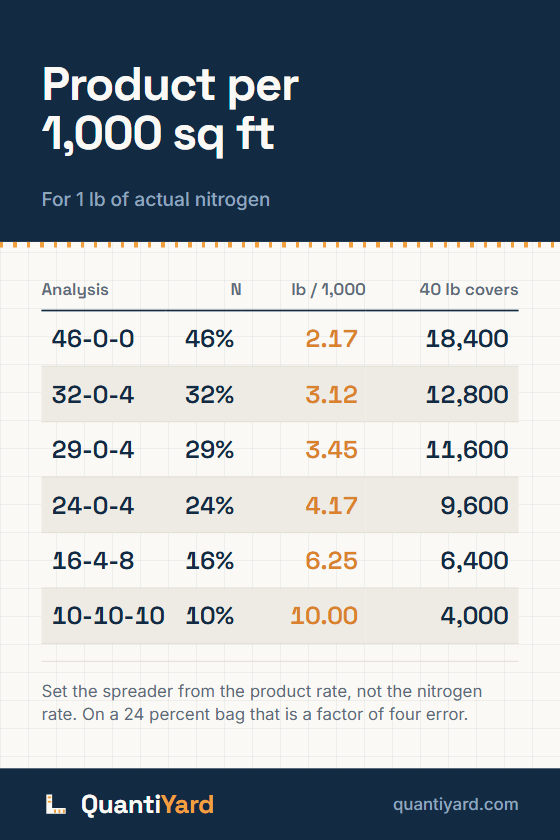
Save the fertilizer chart
How much of each bag to spread for 1 lb of actual nitrogen, across six common analyses. Save it before you set the spreader, because rates are in nitrogen and bags are in product.
Save to PinterestOpens Pinterest with the chart and link ready to go.
Lawn Fertilizer Calculator FAQ
How much fertilizer do I need for 5,000 square feet?
At the standard 1 pound of nitrogen per 1,000 square feet, you need 5 pounds of actual nitrogen. With a 24-0-4 bag, which is 24 percent nitrogen, that is 20.83 pounds of product, so one 40 pound bag covers it. The spreader setting for that is 4.17 pounds per 1,000 square feet, not 1.
What does the first number on a fertilizer bag mean?
It is the percentage of the bag that is nitrogen by weight. A 24-0-4 bag is 24 percent nitrogen, 0 percent phosphorus and 4 percent potassium, so a 40 pound bag holds 9.6 pounds of nitrogen. Every feeding rate is given in pounds of nitrogen, so you divide the nitrogen you want by that percentage to get the product to spread.
Can I put down too much fertilizer?
Yes, and the limit is about 1 pound of actual nitrogen per 1,000 square feet in a single application of a quick-release product. More than that burns the grass, and the damage appears as stripes wherever the spreader overlapped. Slow-release products can go higher because the nitrogen is metered out over weeks. Two passes at half rate in opposite directions is the way to avoid striping.
Cite this page
Built from this page's own title, URL and last-updated date, so a citation cannot drift from what it cites.