Grass Seed Calculator
Enter your lawn size and grass type to get pounds of seed, the seeding rate per 1,000 sq ft, and how many bags to buy.
Updated October 3, 2026 · Estimates for planning, not a quote
How to estimate grass seed
Divide your lawn area by 1,000, then multiply by the seeding rate for your grass type and purpose. A new lawn seeds bare soil and needs the full rate. Overseeding drops seed into turf that already exists, and the purpose selector switches to the overseeding rate for your grass. The calculator starts each grass at the top of its published range; adjust the rate field if your seed label or soil conditions call for more or less.
Seeding rates by grass type
| Grass | New lawn | Overseed |
|---|---|---|
| Kentucky bluegrass | 2–3 | 2–3 |
| Tall fescue | 6–8 / 7–9 | 7–9 |
| Perennial ryegrass | 4–8 | 2–5 |
| Fine fescue | 4–5 | 2–3 |
| Bermuda (hulled) | 1–2 | 1 |
New lawn ranges from Penn State, Ohio State and Cornell turf programs, which differ from each other, and overseeding ranges from Missouri Extension and Penn State. Tall fescue's new-lawn rate is shown twice: 6 to 8 from Penn State and Cornell, 7 to 9 from Missouri Extension; the sources note below shows by how much. Seed blends and coated seed shift these numbers again, so check the bag.
Don't over-apply
More seed does not mean a thicker lawn. Seedlings that come up too dense compete for water and light, grow thin and weak, and are the first to fall to damping-off disease. Stay near the rate and water consistently instead.
Weighing seed against sod? Our sod vs. seed comparison prices both for a 5,000 square foot lawn, lays out the seeding window by grass type, and is clear that seed only works if you can water it two or three times a day for a month.
Method and sources
Where these figures come from: Three university turf programs, which do not agree with each other, and that disagreement is the useful part. Penn State Extension's home lawn tables, in Landschoot's Turfgrass Seed and Seed Mixtures, give Kentucky bluegrass 2 to 3 pounds per 1,000 square feet, turf-type tall fescue 6 to 8, fine fescues 4 to 5 and turf-type perennial ryegrass 4 to 5. Ohio State turfgrass science, in its Turfgrass Establishment Series of August 2023, gives 2 to 3, 8 to 10, 3 to 6 and 7 to 8 for the same four. Cornell's sports field guidance, which is for athletic fields rather than lawns, gives Kentucky bluegrass 1 to 3, tall fescue 6 to 8 and perennial ryegrass 4 to 6. Kentucky bluegrass and fine fescue on this page match Penn State's figures exactly. Tall fescue's new-lawn rate is shown as Penn State's and Cornell's 6 to 8 beside Missouri Extension's 7 to 9. Perennial ryegrass is where the three disagree most, and this page uses 4 to 8, the span of all three, with Penn State and Cornell at the low end and Ohio State at the high end.
Pounds are the area divided by 1,000 times a seeding rate. The rate fills in at the top of this page's range for the grass and purpose you pick, so a default run does not under-seed, and the card also shows pounds at both ends of that range. No single program matches all five rows, and the differences are real rather than rounding: perennial ryegrass alone runs from 4 to 8 pounds per 1,000 square feet across the three, and tall fescue from 6 to 10. Some of that is regional and some is intended use, since Cornell is sizing for a field that gets played on. That is why the rate field stays editable, and why the bag in front of you and your county extension office both outrank this table. Bermuda is covered by none of the three, which are all cool-season northern programs; its 1 to 2 pounds of hulled seed is the rate in UF/IFAS's Bermudagrass for Florida Lawns (revised July 2024) and in Missouri Extension's Managing Lawns and Turfgrass. New lawn and overseeding are separate rates and the purpose selector switches between them. The perennial ryegrass overseeding range is Penn State's 2 to 5 pounds for renovating lawns and other recreational turf. Kentucky bluegrass and tall fescue overseeding, 2 to 3 and 7 to 9 pounds, are Missouri's rates for overseeding a thinned lawn, the same as its new-lawn rates, so Missouri uses 7 to 9 for tall fescue either way. That is why tall fescue defaults to 9 for a new lawn as well as an overseed, while the both-ends figure for a new lawn starts at Penn State's and Cornell's 6. Fine fescue and Bermuda overseeding are trade practice, since none of these sources gives an overseeding rate for either.
QuantiYard writes its own formulas and states them in plain language on every page. How these numbers are made covers where the constants come from, how waste factors are chosen, what these calculators deliberately do not do, and how to report an error.
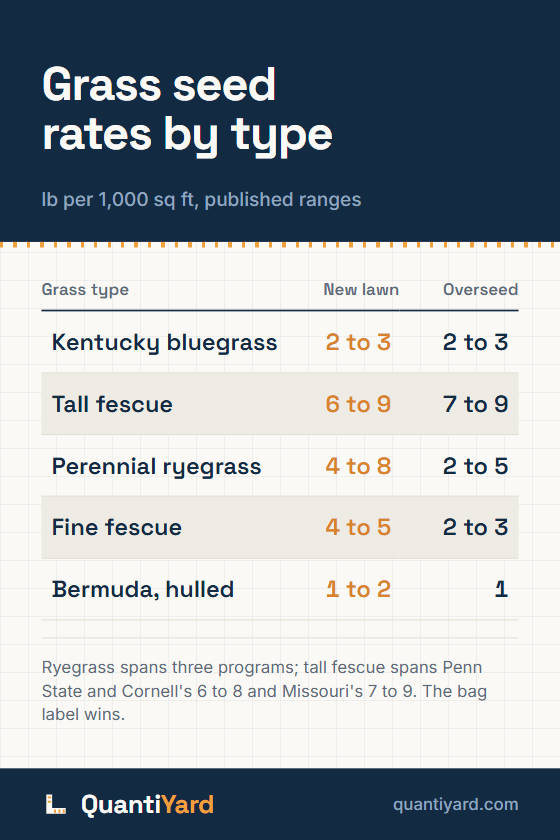
Save the seeding rate chart
Published seeding ranges for five common grasses, new lawn and overseed. Save it to your lawn board before the fall seeding window.
Save to PinterestOpens Pinterest with the chart and link ready to go.
Grass seed FAQ
How much grass seed do I need per 1,000 square feet?
It depends on the grass. For a new lawn, Kentucky bluegrass runs about 2 to 3 pounds per 1,000 square feet, fine fescue 4 to 5, tall fescue 6 to 8 on Penn State's and Cornell's figures or 7 to 9 on Missouri Extension's, and perennial ryegrass 4 to 8 across the three university programs this page cites. Hulled Bermuda needs only 1 to 2. For overseeding a thinned lawn, Missouri Extension gives Kentucky bluegrass 2 to 3 pounds and tall fescue 7 to 9, and Penn State gives perennial ryegrass 2 to 5.
What is the difference between new lawn and overseeding rates?
A new lawn seeds bare soil for complete coverage. Overseeding drops seed into turf that already exists to thicken it. Missouri Extension seeds Kentucky bluegrass at 2 to 3 pounds per 1,000 square feet and tall fescue at 7 to 9 for overseeding a thinned lawn, the same as its new-lawn rates, while Penn State puts perennial ryegrass at 2 to 5 for renovation. Seeding well past the rate wastes seed and crowds seedlings.
When is the best time to plant grass seed?
Early fall is best for cool-season grasses like Kentucky bluegrass, tall fescue, fine fescue, and perennial ryegrass. Late spring into early summer is best for warm-season grasses like Bermuda, once soil temperatures hold above about 65 degrees.
Cite this page
Built from this page's own title, URL and last-updated date, so a citation cannot drift from what it cites.