The quick answer#
Professional sod costs $1.00 to $2.00 per square foot installed and professional seeding costs $0.10 to $0.20. On a 5,000 square foot lawn that is $5,000 to $10,000 against $500 to $1,000. Sod is walkable in 10 to 14 days; a seeded lawn spends 4 to 8 weeks establishing, off limits to traffic.
Sod, installed
$1.00–$2.00per sq ftSeed
$0.10–$0.20per sq ft5,000 sq ft in sod
$5,000–$10,000installedSame lawn in seed
$500–$1,000seeded by a proThat is a difference of about ten times for the same finished lawn, which makes seed look like the obvious answer until you look at the calendar. Seed has one good window a year and missing it costs you a season. Sod goes down any time the ground is workable and you can water it.
Side by side#
| Factor | Sod | Seed |
|---|---|---|
| Cost per square foot | $1.00 to $2.00 installed | $0.10 to $0.20 seeded by a pro |
| Materials only | $0.30 to $0.80 | — |
| Time to walk on it | 10 to 14 days | After the 4 to 8 week establishment period |
| Planting window | Any workable ground | Narrow, and it varies by grass |
| Watering | 1 to 2 times a day for a week, then every other day for 2 weeks | Light, up to 3 to 4 times a day until it germinates |
| Erosion control | Immediate | None until it establishes |
| Variety choice | What the farm grows | The whole catalogue |
| Weed pressure | Low, the turf is already closed | High, bare soil invites everything |
| Deadline | Lay within a day of delivery | None, seed keeps |
Installed sod prices include site preparation and laying. The seeding price is HomeAdvisor's for a professional job; Lawn Love's survey puts lawn seeding at $0.07 to $0.23. Sod materials are HomeGuide's $0.30 to $0.80 per square foot. No published survey itemises a DIY seeding job, so this page compares the two professional prices.
Cost for a 5,000 sq ft lawn#
Five thousand square feet is a common suburban front and back. Hired out, it is $5,000 to $10,000 in sod against $500 to $1,000 in seed. Sod is also the one route with a published DIY breakdown, so here is that.
| Item | Cost |
|---|---|
| Sod, 11 to 14 pallets | $1,430–$5,040 |
| Delivery | $50–$250 |
| Starter fertiliser | $15–$65 |
| Total, DIY | $1,495–$5,355 |
5,000 square feet with the sod calculator's standard 5 percent waste is 5,250 square feet, and HomeGuide puts a pallet at 400 to 500 square feet, so 11 to 14 pallets. A pallet costs $130 to $360 and starter fertilizer $15 to $65 on HomeGuide's figures, plus $50 to $250 per delivery load. Installed, the same lawn is $5,000 to $10,000, so laying it yourself keeps $3,505 to $4,645, before tools and rentals.
If you are sodding
Square feet, pieces, and pallets
Enter the lawn dimensions to get total square footage, the piece count, and how many pallets to order before the truck is booked.
Planting windows#
This is the section that decides more lawns than price does. Seed germinates on soil temperature, so its window is fixed by the calendar and by which half of the grass world you live in.
| Grass | Best window | Second best |
|---|---|---|
| Kentucky bluegrass | Late summer to early fall | Early spring |
| Tall fescue | Late summer to early fall | Early spring |
| Perennial ryegrass | Late summer to early fall | Early spring |
| Fine fescue | Late summer to early fall | Early spring |
| Bermuda, hulled | Late spring to early summer | None, really |
Cool-season grasses want warm soil and cooling air, which is early fall. Warm-season grasses like Bermuda want soil above about 65 degrees, which is late spring. Sod has no equivalent window: it goes down any time the ground is workable and you can keep it wet.
The practical consequence is that a lawn ruined in July is a sod decision, not a seed one, because seeding in midsummer heat mostly fails and waiting until September means two months of mud. That is worth putting a number on: the $4,500 to $9,000 premium for sod on a 5,000 square foot lawn is buying a season, and whether a season is worth that depends on whether you have small children, a dog, a house going on the market, or a slope shedding topsoil into the street.
Seeding rates matter as much as timing, and they are not intuitive. Tall fescue wants 6 to 8 pounds per 1,000 square feet for a new lawn on Penn State's and Cornell's figures, and Missouri Extension puts it at 7 to 9 for a new lawn or an overseed, while Kentucky bluegrass wants 2 to 3 for either job, because bluegrass seed is tiny and spreads by rhizome once established. The grass seed calculator fills in the top of the published range for your grass and your purpose, and both numbers are far enough apart that guessing wastes either money or a season.
If you are seeding
Pounds and bags by grass type
Pick the grass and whether it is a new lawn or an overseed to get the pounds you need and the bag count at your bag size.
Watering demand#
Both need a lot of water and they need it differently, and this is where most failures happen on either route.
Sod is a rooted mat laid on soil it is not attached to yet. HomeGuide's schedule is 1 to 2 waterings a day for the first week, then every other day for another 2 weeks, enough that the soil under the sod is damp rather than the sod itself, because that is where the roots have to grow into. The roots take hold in 10 to 14 days: lift a corner, and if it peels up easily, it is not rooting yet. They stabilize in 4 to 6 weeks, and that is when mowing starts.
Seed is the opposite problem. The seed bed cannot dry out at all during germination, and a hot afternoon will dry the top half inch in a couple of hours. That means light watering up to 3 to 4 times a day until it germinates, as University of Minnesota Extension puts it, which is less total water than sod takes but far more attention, and it is why seeding without an irrigation system or a very reliable habit is a coin flip. The straw or pellet cover exists mostly to buy hours between waterings.
The 24 hour rule on sod
Sod is a live crop that was cut from a field and stacked on a pallet, and it starts heating inside the stack. Penn State Extension says it deteriorates rapidly, within 24 to 48 hours in warm weather, and University of Minnesota Extension says it should be laid within a day of delivery. Every square foot of site preparation has to be finished before the truck arrives, not after. This is the single most common way a sod job goes wrong, and ordering short is the second, because a second delivery means a second delivery fee and a visible seam between two batches.
Erosion and slopes#
On flat ground this section does not matter. On a slope it decides the whole thing.
Sod is erosion control the moment it is laid. It is a continuous mat with roots already in it, so rain runs over it rather than through it, and it holds a slope from day one. On anything steeper than about 3:1, sod is often the only route that does not require a second attempt.
If a slope is the reason you are sodding, measure it properly rather than off the plan. A slope has more surface than its footprint, the same way a roof does, and the sod calculator takes the actual area you enter and adds the 10 percent waste an irregular lawn wants rather than the 5 a rectangle takes. Ordering short on a slope means a second delivery fee and a visible seam across the most visible part of the yard.
Seed on a slope needs help. Bare seeded soil sheds seed and topsoil in the first hard rain, and the standard answer is an erosion control blanket, which is straw or coconut fibre netting pinned down over the seed. That adds roughly $0.15 to $0.40 per square foot, which narrows the cost gap but does not close it. Below about 4:1 a straw mulch cover is usually enough.
Variety choice#
This is the argument for seed that nobody makes and it is a good one. A sod farm grows what sells at scale, which in the north means Kentucky bluegrass blends and in the south means Bermuda, zoysia, or St. Augustine. That is a handful of options, and none of them may be the right grass for a shaded north-facing yard or a lawn nobody intends to irrigate.
Seed opens the entire catalogue. Fine fescue for dry shade, turf-type tall fescue for heat and drought tolerance with a deep root system, a bluegrass and ryegrass blend for a lawn that repairs itself, or a low-input mix that wants mowing half as often. If your yard has a real problem, shade, drought, traffic, poor soil, seed is how you address it, because the right grass matters more than the establishment method.
Which one you need#
Sod when#
The lawn is on a slope. You have a deadline, a house sale, an event, a yard that has to be usable this month. It is the wrong time of year to seed and you are not waiting until fall. You have children or a dog who will use the yard the week it is finished. The area is small enough that ten times the price is a few hundred dollars rather than several thousand. Or the site is bare soil next to a street or a storm drain, where waiting a season means the topsoil ends up somewhere else.
Seed when#
It is late summer or early fall and you live where cool-season grass grows. The lawn is large, because the multiple is what it is and 10,000 square feet of sod is a serious number. You need a specific grass that no local farm grows. You are overseeding rather than starting over, which halves the rate again. Or you can water reliably several times a day until it germinates, which is the actual gate on whether seeding works.
The middle answer#
Sod the parts people see and use, seed the rest. A sodded front yard and a seeded back is a common split, and so is sodding a slope or a strip along the drive and seeding the flat. On the 5,000 square foot lawn, sodding 1,500 square feet and seeding the other 3,500 lands somewhere near $1,850 to $3,700, which is a genuinely different budget from either pure route. Our landscaping and mulch cost guide puts both against the rest of a yard budget.
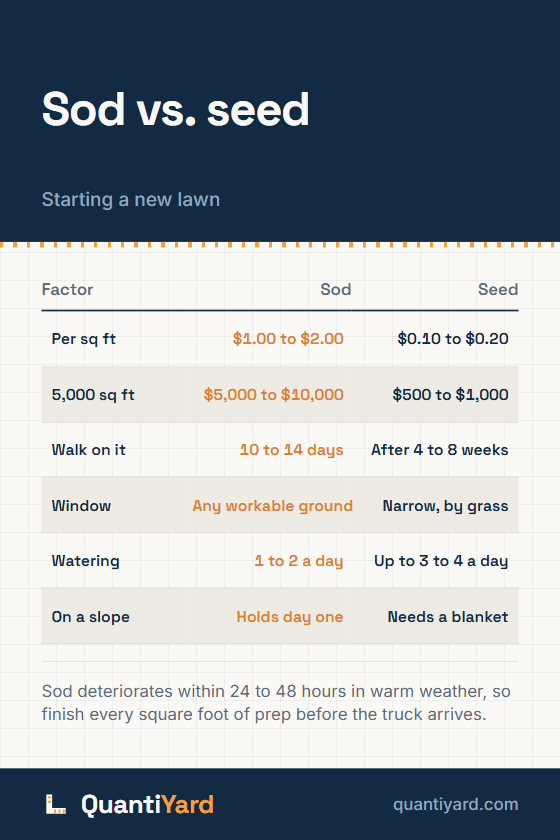
Save the sod vs. seed chart#
Cost, time to a usable lawn, planting window, watering, and slope behavior side by side. Save it before you book a pallet or buy a bag.
Save to PinterestOpens Pinterest with the chart and link ready to go.
Common questions#
Is sod or seed cheaper?#
Seed, by about ten times. Sod is $1.00 to $2.00 per square foot installed and seed is $0.10 to $0.20, so a 5,000 square foot lawn is $5,000 to $10,000 in sod against $500 to $1,000 in seed. Laying sod yourself narrows it: 11 to 14 pallets, delivery and starter fertilizer come to $1,495 to $5,355, which keeps $3,505 to $4,645 against an installed price.
How long does it take for grass seed to grow?#
Penn State Extension calls the first 4 to 8 weeks after seeding the critical period, when the lawn needs light, frequent watering and no traffic, and mowing starts when the grass is a third taller than the height you mean to keep it. Sod is walkable in 10 to 14 days and roots in 4 to 6 weeks on HomeGuide's figures. That gap is what you are paying for, and whether it is worth it usually comes down to whether there are children, a dog, a house sale, or a slope involved.
When is the best time to plant grass seed?#
Late summer to early fall for cool-season grasses, which is Kentucky bluegrass, tall fescue, perennial ryegrass, and fine fescue. Early spring is the second-best window. Warm-season grasses like Bermuda want the opposite: late spring to early summer, once the soil is above about 65 degrees. Sod has no equivalent window and goes down any time the ground is workable.
How much seed do I need for 5,000 square feet?#
It depends on the grass. Tall fescue wants 6 to 8 pounds per 1,000 square feet for a new lawn on Penn State's and Cornell's figures, or 7 to 9 on Missouri Extension's, so 30 to 45 pounds, which is 2 bags of 25 pounds. Kentucky bluegrass wants only 2 to 3 pounds per 1,000, because the seed is much smaller and it spreads by rhizome once established. Missouri Extension seeds both at the same rate to overseed a thinned lawn as to start a new one.