The quick answer#
Bulk mulch costs $20 to $80 per cubic yard in 2026, plus a $50 to $100 delivery fee per trip. Bags cost $2 to $15 each, and it takes 14 two cubic foot bags to make a yard. Sod runs $1.00 to $2.00 per square foot installed, and grass seed runs $0.10 to $0.20.
Bulk mulch, plus delivery
$20–$80per cubic yardBagged mulch
$2–$15per 2 cu ft bagSod, installed
$1.00–$2.00per sq ftGrass seed
$0.10–$0.20per sq ftThose four numbers cover most of what a homeowner spends on a yard. The rest is gravel, edging, and plants, and plants are the one line nobody can put a range on because a shrub is $15 and a tree is $400. What follows prices the material, which is the part you can actually calculate before you go shopping.
Start with the volume
Cubic yards and bags for your beds
Enter each bed's dimensions and the depth you want to get cubic yards, and the bag count if you are going bagged.
Mulch: bulk versus bagged#
This is the decision that matters most, and the published prices do not settle it on their own. A cubic yard is 27 cubic feet and a standard mulch bag is 2 cubic feet, so it takes 14 bags to make a yard once you round up. HomeAdvisor puts bags at $2 to $15 each, which is $28 to $210 for a yard, and bulk at $20 to $80 per cubic yard plus a $50 to $100 delivery fee per trip. Fixr's survey puts bulk delivered at $80 to $175 a yard with the fee included. The ranges overlap so far that neither route wins at every price.
| Factor | Bulk | Bagged |
|---|---|---|
| Cost per cubic yard | $20–$80 | $28–$210 |
| Delivery fee | $50–$100 | None |
| Minimum order | 1 to 3 yards | None |
| Cheaper when | Bags cost above the break-even | Bags cost below it |
| Handling | Wheelbarrow from the pile | Carry each bag |
HomeAdvisor's figures. Its bags hold 1.5 to 2 cubic feet; this table prices 2 cubic foot bags at 14 to the yard. The delivery fee is a flat charge per trip whatever the load, which is what makes small jobs lean toward bags.
The bag price decides it. Bulk is cheaper whenever a bag costs more than the yard price plus the delivery fee spread over the order, divided by 14. On a one yard order, that break-even is $5.00 a bag at the low end of bulk prices, $20 a yard with a $50 fee, and $12.86 at the high end, $80 a yard with a $100 fee. On a three yard order it falls to $2.62 and $8.10, because the fee is shared across more yards. One yard delivered is $70 to $180 all in, against $28 to $210 in bags you carry home yourself. Three yards delivered is $110 to $340, and the same volume is 42 bags at $84 to $630. Price a bag and a delivered yard locally, run the division, and the answer for your order falls out.
The depth question comes before the price question
Mulch is sold by volume, so depth drives the bill directly. Three inches is the standard for a bed and is what suppresses weeds; two inches saves a third of the cost and lets weeds through; four inches is a waste on most beds and can suffocate shallow roots. On a 300 square foot bed with the usual 10 percent allowance, 2 inches takes 2.04 cubic yards against 3.06 at 3 inches, a difference of 1.02 cubic yards, or $20 to $82 of bulk mulch. Pick the depth first, then price it.
Cost to mulch common beds#
These figures are at 3 inches deep with a 10 percent allowance, which is what the mulch calculator uses by default. Bulk cost is the yardage at $20 to $80, before the delivery fee, and bagged is the bag count at $2 to $15.
| Bed size | Cubic yards | Bags of 2 cu ft | Bulk cost | Bagged cost |
|---|---|---|---|---|
| 100 sq ft | 1.02 | 14 | $20–$82 | $28–$210 |
| 200 sq ft | 2.04 | 28 | $41–$163 | $56–$420 |
| 300 sq ft | 3.06 | 42 | $61–$245 | $84–$630 |
| 500 sq ft | 5.09 | 69 | $102–$407 | $138–$1,035 |
| 800 sq ft | 8.15 | 110 | $163–$652 | $220–$1,650 |
Yardage and bag counts come from the mulch calculator at 3 inches deep with 10 percent waste. Bulk cost excludes the $50 to $100 delivery fee, which lands once per trip regardless of how many yards are on the truck.
The bag counts here come from the actual volume, so they run a little under 14 to the yard. At 800 square feet, 8.15 cubic yards, bulk is $213 to $752 including the delivery fee, against $220 to $1,650 in 110 bags. The break-even bag price at that size is $1.87 at the low end of bulk prices and $6.59 at the high end, so bulk wins against any bag above $6.59, bags win below $1.87, and between the two it depends on what your local yard charges. Bulk also saves you handling 110 bags. Run your own beds through the mulch calculator first, because irregular beds almost always come out smaller than people guess.
Sod and seed per square foot#
Lawn is the other big-area line, and here the choice is not bulk against bagged but instant against cheap. Sod is roughly ten times the cost of seed and gives you a lawn the same afternoon.
| Lawn | Sod, materials | Sod, installed | Seed |
|---|---|---|---|
| Per square foot | $0.35–$0.85 | $1.00–$2.00 | $0.10–$0.20 |
| 1,000 sq ft | $350–$850 | $1,000–$2,000 | $100–$200 |
| 2,000 sq ft | $700–$1,700 | $2,000–$4,000 | $200–$400 |
| 5,000 sq ft | $1,750–$4,250 | $5,000–$10,000 | $500–$1,000 |
Sod materials are priced per pallet, and a pallet covers 400 to 500 square feet on HomeGuide’s figures. Seed is HomeAdvisor's seeding price, $0.10 to $0.20 per square foot; Lawn Love's survey puts lawn seeding at $0.07 to $0.23. Neither figure covers grading or new topsoil, which is the line that actually decides whether either one takes.
A pallet of sod covers 400 to 500 square feet and costs $130 to $360 on HomeGuide's figures, plus $50 to $250 per delivery load. Sod also has a hard deadline: it has to go down within 24 hours of delivery or it starts cooking on the pallet, so the site preparation has to be finished before the truck arrives. Work out your pallet count with the sod calculator before you order, because ordering short means a second delivery fee and ordering long means throwing away sod that will not keep. The sod cost guide breaks installed pricing down by grass type and lawn size.
Sizing the lawn
Pallets, pieces, and square feet
Enter the lawn dimensions to get total square footage, sod piece count, and the number of pallets to order.
Seed is a tenth of the price and asks for patience instead of money. A cool-season lawn seeded in early fall is usable the following spring; the same lawn sodded is usable in three weeks. The grass seed calculator works out the pounds from the grass type and whether you are starting a new lawn or overseeding an existing one, and those two rates are far apart: tall fescue wants 7 pounds per 1,000 square feet for a new lawn and 3.5 to overseed.
Gravel and edging#
Gravel is priced like mulch, by the cubic yard, but it weighs far more and is usually sold by the ton as well. Crushed stone runs 1.4 to 1.5 tons to the cubic yard as delivered, so the two prices are not directly comparable until you convert.
| Material | Unit | Cost |
|---|---|---|
| Crushed stone or gravel | per cubic yard | $15–$75 |
| River rock, decorative | per cubic yard | $45–$140 |
| Decomposed granite | per cubic yard | $40–$100 |
| Plastic or poly edging | per linear foot | $1–$3.50 |
| Metal edging | per linear foot | $5–$11 |
| Landscape fabric | per square foot | $0.15–$0.45 |
Bulk stone is often quoted by the ton rather than the yard. Crushed stone runs 1.4 to 1.5 tons per cubic yard, so a $55 yard is roughly $37 to $39 a ton for the same material. Ask which unit a quote is in before comparing two suppliers.
Gravel beds cost more up front than mulch and then cost nothing for years, which is the whole argument for them. A 300 square foot bed at 3 inches deep is 3.06 cubic yards either way, so $46 to $230 in crushed stone against $61 to $245 in bulk mulch. By the yard the stone is no dearer; what puts gravel ahead up front is the landscape fabric under it, $45 to $135 on that bed. After that the gravel bed only wants a leaf blower. The gravel calculator converts yards to tons for you, which matters because most stone yards quote by weight and deliver by weight.
Edging is the line most people underprice because it is sold by the foot and beds have a lot of feet. A single 300 square foot bed 10 feet wide has 80 linear feet of perimeter, which is $80 to $280 in plastic edging or $400 to $880 in metal. Metal lasts decades and holds a crisp line; plastic heaves out of the ground after a few freeze cycles and is the most commonly redone item in any yard.
Annual refresh versus one-time install#
The number that decides a landscaping budget is not the install, it is the yearly one. Mulch is a subscription. Gravel and hardscape are a purchase.
| Item | How often | Cost each time |
|---|---|---|
| Mulch top-up, 500 sq ft of beds | Every year | $51–$204 |
| Gravel top-up, same beds | Every 5 to 7 years | $50–$120 |
| Lawn overseeding, 5,000 sq ft | Every year or two | $500–$1,000 |
| Edging replacement, plastic | Every 3 to 5 years | $80–$280 |
| Edging replacement, metal | Every 20 years or more | $400–$880 |
A yearly top-up is about 1.5 inches rather than a full 3, so roughly half the volume of the original application. That is what most beds actually need after a year of decomposition. Overseeding is HomeAdvisor's reseeding price for a 5,000 square foot lawn. Mulch top-ups are before the delivery fee.
Over ten years, 500 square feet of mulched bed costs $561 to $2,243 before delivery fees: the first full application at $102 to $407, then nine yearly top-ups at $51 to $204. The same beds in gravel cost $151 to $607 up front, crushed stone plus landscape fabric, and maybe two top-ups at $50 to $120, so $251 to $847 all in. Comparing the same end of each price range, gravel comes in under half the ten-year cost. The ranges are wide enough that cheap mulch can still undercut expensive stone, so price both locally before deciding on cost alone. What mulch buys for that premium is soil: it breaks down into the bed, feeds the plants, and holds moisture, which is exactly what gravel does not do. Around shrubs and perennials, mulch earns its keep. Around a downspout, a side yard, or anything you would rather never think about again, gravel is the better buy.
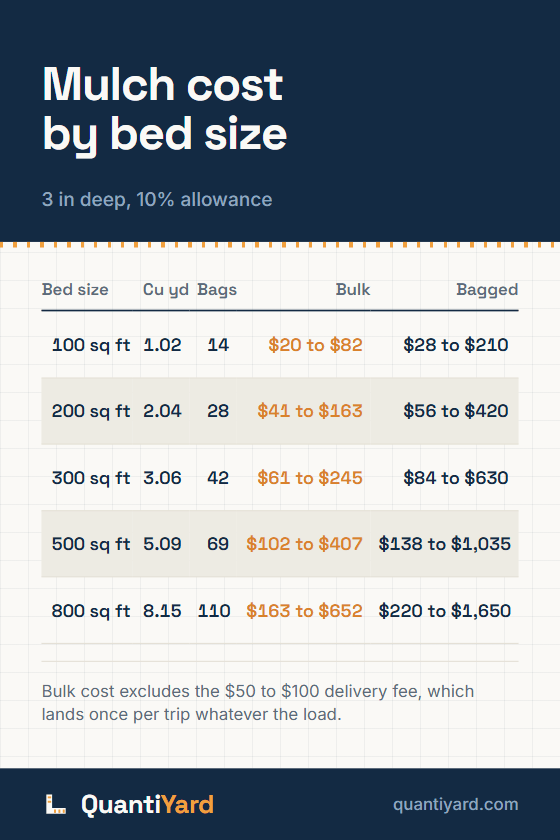
Save the mulch cost chart#
Five bed sizes with the yardage, the bag count, and both prices side by side. Save it and you can settle bulk against bagged standing in the driveway.
Save to PinterestOpens Pinterest with the chart and link ready to go.
Common questions#
How much does a cubic yard of mulch cost?#
Bulk mulch runs $20 to $80 per cubic yard in 2026 on HomeAdvisor's figures, plus a $50 to $100 delivery fee per trip, and Fixr puts it at $80 to $175 a yard delivered. In 2 cubic foot bags at $2 to $15 each, a yard takes 14 bags, so $28 to $210. Bulk wins when a bag costs more than the yard price plus the fee spread over the order, divided by 14.
How much mulch do I need for a 300 square foot bed?#
At the standard 3 inches deep with a 10 percent allowance, a 300 square foot bed takes 3.06 cubic yards, or 42 bags of 2 cubic feet. That is $61 to $245 in bulk mulch before the delivery fee, or $84 to $630 in bags. Depth drives this directly: dropping to 2 inches cuts it to 2.04 cubic yards but stops suppressing weeds properly.
Is sod or seed cheaper?#
Seed is roughly a tenth the cost. Sod runs $1.00 to $2.00 per square foot installed and seed runs $0.10 to $0.20, so a 5,000 square foot lawn is $5,000 to $10,000 in sod against $500 to $1,000 in seed. What sod buys is time: a usable lawn in about three weeks instead of a full season, and no erosion while it establishes.
Is gravel cheaper than mulch in the long run?#
Yes, by more than half when you compare the same end of each price range. Five hundred square feet of bed costs $102 to $407 for the first mulch application and $51 to $204 a year to top up after that, so $561 to $2,243 over a decade before delivery fees. The same beds in gravel are $151 to $607 up front, crushed stone plus fabric, and $251 to $847 over ten years with a couple of top-ups. Mulch earns the difference back around plants, because it breaks down into the soil and holds moisture, which gravel does not do.