Gravel & Aggregate Calculator
Enter the area and depth to get cubic yards and tons of gravel, crushed stone, sand, or decomposed granite, with a waste allowance built in.
Updated October 3, 2026 · Estimates for planning, not a quote
How to estimate gravel and aggregate
Multiply length by width by depth, all in feet, to get cubic feet, then divide by 27 for cubic yards. Because suppliers sell by weight, this calculator also converts to tons using an average density for the material you pick.
Choosing a depth
A gravel driveway base typically runs 4–6 inches; walkways and paths usually need only 2–3 inches; a decorative top-dressing layer is often just 1–2 inches over a compacted base.
Putting a slab on top of that base? Our concrete patio cost guide covers what the gravel base and the pour together cost per square foot, installed and DIY.
Note that a driveway is a different animal from a patio. It carries vehicle loads, so it wants a deeper compacted base than a patio does, and skimping there is what kills most driveways. The driveway cost guide compares gravel, asphalt, concrete, and pavers per square foot and by size, and shows what the extra base depth actually costs.
Using stone in a planting bed rather than under a slab? Our landscaping and mulch cost guide prices gravel against mulch over ten years, which is the comparison that actually decides a bed.
Ordering stone for a retaining wall? More than three times as much gravel goes behind a wall as under it. Our retaining wall cost guide covers both figures and why the drainage package is the cheapest insurance on the job.
Deciding between a gravel drive and a poured one? Our gravel vs. concrete driveway comparison runs the ten-year cost for both and works through snow, slope, drainage, and resale, which is what actually settles it once price stops being the differentiator.
Using stone as a bed cover rather than a base? Our mulch vs. rock comparison covers weed suppression, heat, soil pH, and the seven-odd tons a single 500 square foot bed represents once you convert the volume.
Need the weight rather than the volume? Our material weight chart lists pounds per cubic yard and cubic yards per ton for every material this calculator carries, using these exact densities, plus the moisture and compaction effects that move a delivered load off the average.
Method and sources
The densities are the working averages quarries and landscape suppliers convert by when they turn a cubic yard into a ton: 1.4 to 1.5 for crushed gravel as delivered, which is the range HomeGuide Gravel Prices publishes, 1.35 sand, 1.30 river rock, 1.50 decomposed granite. They are averages rather than constants, and moisture and stone size move all four. Two state highway agencies publish tables worth checking them against, and neither is quoting landscape stone, so read them as a bracket rather than a match. WSDOT Design Manual Exhibit 620-1, revised September 2024, gives crushed surfacing top course at 2,850 lb per cubic yard as it sits in the truck and 3,700 lb once it is compacted on the road, which is 1.43 tons against 1.85 for the same stone. The MoDOT maintenance conversion tables put loose crushed granite or limestone at 2,410 to 2,590 lb per cubic yard and the same stone compacted at 3,060 to 3,300. This page uses 2,800 to 3,000 lb for crushed stone, as delivered, and shows tons at both ends; the low end sits 50 lb under the lightest truck-measure row WSDOT publishes.
Volume is length by width by depth divided by 27. On anything approaching a full load, the weight ticket from your supplier is the figure that settles it, and asking them for their own density before ordering is worth the phone call.
QuantiYard writes its own formulas and states them in plain language on every page. How these numbers are made covers where the constants come from, how waste factors are chosen, what these calculators deliberately do not do, and how to report an error.
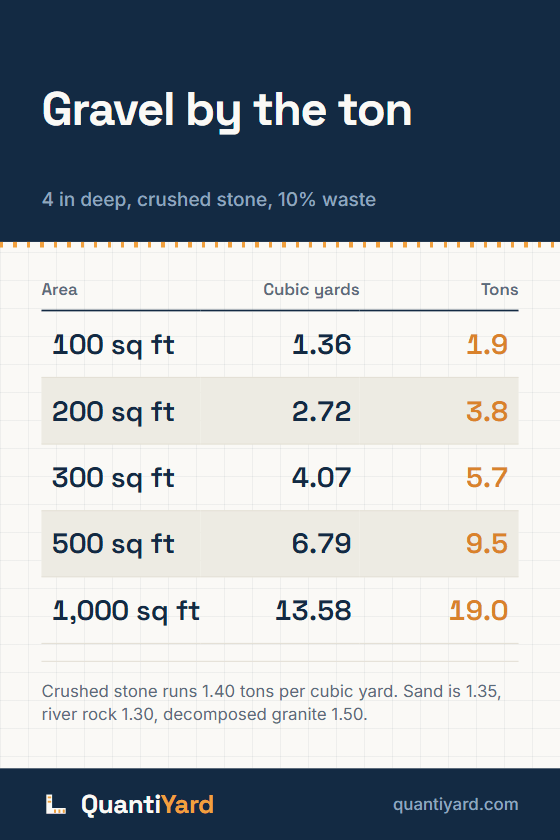
Save the gravel chart
Cubic yards and tons for five common areas at 4 inches deep. Save it and you can size a delivery without doing the conversion twice.
Save to PinterestOpens Pinterest with the chart and link ready to go.
Gravel calculator FAQ
How many tons of gravel do I need per cubic yard?
Crushed gravel weighs 1.4 to 1.5 tons per cubic yard as delivered. Sand runs lighter at about 1.35, river rock about 1.3, and decomposed granite about 1.5. These are averages. Ask your supplier for their exact density on large orders.
How deep should a gravel driveway base be?
A typical gravel driveway uses 4 to 6 inches of compacted base, sometimes with an additional 2-inch top-dressing layer of decorative stone. Paths and walkways usually only need 2 to 3 inches.
Should I order gravel by the ton or by the yard?
Most quarries and landscape suppliers price by the ton; some smaller loads are quoted by the cubic yard. This calculator gives you both.
Cite this page
Built from this page's own title, URL and last-updated date, so a citation cannot drift from what it cites.