Excavation & Fill Dirt Calculator
The pile is always bigger than the hole. Enter your dig and get cubic yards in the ground, loose yards once it is out, truck loads, and what it weighs.
Updated September 5, 2026 · Estimates for planning, not a quote
What swell is, and why it matters
Soil in the ground is packed. Decades or centuries of weight have squeezed most of the air out of it. Dig it and you break that structure up, air gets in between the particles, and the same dirt takes up more room. That increase is swell, and it is the reason the pile beside a hole is always visibly bigger than the hole.
loose yards = in place yards × (1 + swell)
A 20 by 30 foot area dug 2 feet deep is 1,200 cubic feet, or 44.44 cubic yards in the ground. In topsoil at 25 percent swell that is 55.56 loose cubic yards sitting on your lawn, and 6 loads in a 10 yard truck rather than the 5 the in-place number suggests.
Get this wrong on a hauling job and you order too few trucks, which usually means a second trip and a second mobilization charge.
Swell by material
The stickier and finer the soil, the more it swells, because there is more structure to break up. The published working figures:
- Sand and gravel: about 15 percent. Granular material was never that tightly packed to begin with.
- Topsoil and mixed fill: about 25 percent.
- Clay: about 30 percent, and heavy wet clay can go higher.
The material select fills the swell field for you, and it stays editable if your ground is not typical.
The same factor, read backwards
Bringing fill in works out to the same arithmetic. Fill is delivered loose and gets compacted into place, and it loses roughly the same volume going down that it gained coming up. So to end up with 44.44 compacted cubic yards you order about 55.56 loose yards, which is what the second mode on this calculator reports.
The one thing that does not follow is the settling. Fill placed loose and not compacted in layers will keep settling for months, and anything sitting on top of it goes down with it. Place fill in 6 to 8 inch lifts and compact each one.
Weight, and why it is not the loose number
Swell changes volume, not mass. That 44.44 cubic yards of topsoil weighs the same whether it is in the ground or in a pile, so weight is always figured from the in-place volume:
tons = in place yards × tons per cubic yard
| Material | Typical density | Tons per yd³ | Swell |
|---|---|---|---|
| Topsoil | 82 lb/ft³ | 1.11 | 25% |
| Clay | 104 lb/ft³ | 1.40 | 30% |
| Sand | 100 lb/ft³ | 1.35 | 15% |
| Gravel | 104 lb/ft³ | 1.40 | 15% |
| Mixed fill | 93 lb/ft³ | 1.26 | 25% |
Tons per cubic yard is the density converted, not a separate figure: lb/ft³ × 27 ÷ 2,000. Sand at 100 lb/ft³ gives 1.35 and gravel at 104 gives 1.40, the same values the gravel calculator uses, so the two pages agree.
Every one of those is a dry figure. Moisture is the biggest single variable in soil weight, and it moves in one direction: wet is heavier. Clay after a week of rain can run 30 percent above the number in that table, which matters because a dump truck hits its legal weight limit long before it fills its bed. If a hauler quotes you by the ton rather than the load, the weather on the day is part of the price.
Truck loads
Loads are figured on loose yards, because that is the state the material is in when it goes in the truck. A tandem axle dump truck usually holds 10 to 14 cubic yards and a single axle 5 to 8, but the bed capacity is only half the story: heavy wet material fills the truck's weight rating first. Set the capacity field to what your hauler actually quotes.
Backfill and base
If the hole is getting a base rather than dirt back, the gravel calculator converts area and depth into tons of crushed stone. For a driveway excavation specifically, the driveway cost guide itemises what the excavation and haul-off line actually costs against the rest of the job.
The densities behind these tonnages are listed alongside every other material on our material weight chart, together with the moisture and compaction swings that explain why two loads of the same spoil weigh differently.
Method and sources
Where these figures come from: Densities derived from typical dry unit weights in pounds per cubic foot, times 27 divided by 2,000. The page prints that table so the arithmetic can be checked.
In-place volume is length by width by depth divided by 27. Swell is applied to get the loose volume, which is what goes in the truck, so truck loads come off the loose figure and tons come off the in-place one. Every density is a dry figure, and wet clay runs about 30 percent heavier.
QuantiYard writes its own formulas and states them in plain language on every page. How these numbers are made covers where the constants come from, how waste factors are chosen, what these calculators deliberately do not do, and how to report an error.
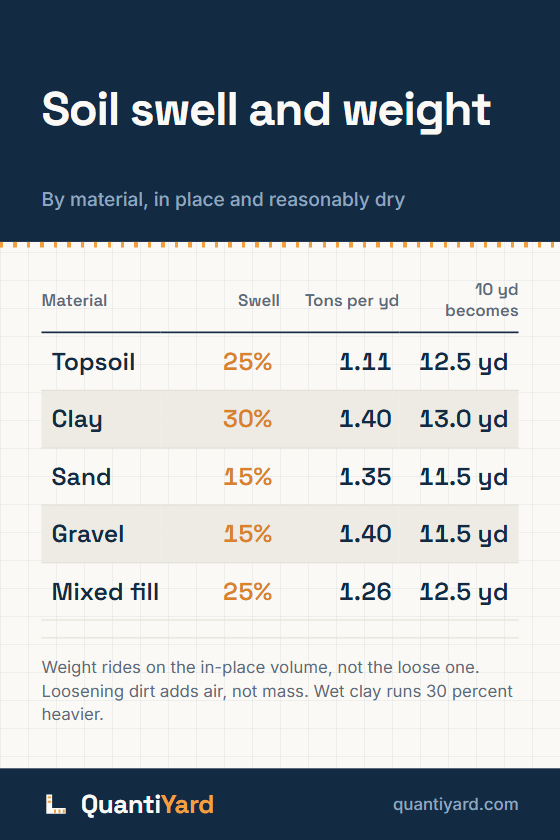
Save the soil swell chart
Swell percentage, weight per cubic yard, and what a 10 yard hole turns into, for five kinds of dirt. Save it before you book a truck.
Save to PinterestOpens Pinterest with the chart and link ready to go.
Excavation calculator FAQ
What is soil swell?
The increase in volume when soil is dug out. In the ground it is packed and has almost no air in it. Break it up and air gets between the particles, so the same dirt takes up more room. Topsoil swells about 25 percent, clay about 30, and sand about 15. It is why the pile is always bigger than the hole.
Why does the dirt not fit back in the hole?
Because it swelled on the way out and it does not go back to its original density on the way in without compacting. A 10 cubic yard hole in clay produces 13 loose cubic yards of spoil. Backfill it loose and you have 3 yards left over, and the fill will settle for months afterwards.
How much does a cubic yard of dirt weigh?
Roughly 1.11 tons for topsoil, 1.40 for clay, 1.35 for sand, and 1.26 for mixed fill, measured in place and reasonably dry. Wet soil weighs far more, and clay in particular can gain 30 percent after rain. Weight does not change with swell: loosening the dirt adds air, not mass.
How many cubic yards does a dump truck hold?
A tandem axle dump truck typically holds 10 to 14 cubic yards, and a single axle holds 5 to 8. Heavy wet material hits the truck's weight limit before it fills the bed, so a load of wet clay is often smaller than a load of dry topsoil in the same truck.
Cite this page
Built from this page's own title, URL and last-updated date, so a citation cannot drift from what it cites.