French Drain Calculator
Enter your trench and pipe size to get the drainage stone in both yards and tons, the pipe, and the fabric to wrap it in.
Updated October 3, 2026 · Estimates for planning, not a quote
How to size a French drain
The stone is the whole job. A French drain is a trench full of washed stone with a perforated pipe near the bottom, wrapped in fabric so soil cannot wash into the voids. Water gets into the stone from all sides, finds the pipe, and the pipe carries it somewhere else.
Volume is length times width times depth, and this calculator takes the pipe's own volume out of it, because a 4 inch pipe running 50 feet displaces about 4.4 cubic feet of stone you would otherwise have bought. Then it converts to tons at the same crushed stone density the gravel calculator uses, because stone yards quote by weight.
Depth, width and slope
A typical yard drain is 12 inches wide and 18 inches deep. Wider moves more water; deeper intercepts water lower in the soil profile, which is what you want against a foundation. The number that is not on this page is slope, and it is the one that decides whether the drain works: aim for about 1 percent, or 1 inch of fall for every 8 feet of run, and confirm you have somewhere lower to daylight the pipe before you start digging. A drain with no outfall is a trench that stores water.
Wrap the stone, not the pipe
Sock-wrapped pipe is sold everywhere and it is the wrong tool for most yard drains. Fabric tight against the perforations silts up at exactly the points water needs to enter, and once it does the drain is finished and you cannot clean it. Wrapping the whole stone envelope instead gives the silt a much larger surface to fail across, and the stone keeps working.
Use washed stone. Crusher run and unwashed gravel carry fines, and fines are what fill the voids between stones and turn a drain into a buried pile of damp rock.
What this does not size
Not the outfall, not the catch basins, and not how much water your lot actually produces. Those are drainage design rather than quantity, and on a wet basement they are worth a professional. This page tells you what to order once the trench is decided. For the excavation itself, our excavation calculator gives the spoil volume after swell, which is the pile you have to put somewhere.
Method and sources
Stone is the trench, a rectangular prism, less the pipe, a cylinder of pi times radius squared times length. A cubic yard is 27 cubic feet. All three are definitions.
Subtracting the pipe matters because that is stone you do not buy. Fabric width wraps up both sides and across the bottom with 6 inches of overlap each side to fold over the top. The tons row converts the volume at the same 1.4 to 1.5 tons a cubic yard for crushed stone, as delivered, that the gravel calculator uses, which is a published range rather than a definition, and that page says so.
QuantiYard writes its own formulas and states them in plain language on every page. How these numbers are made covers where the constants come from, how waste factors are chosen, what these calculators deliberately do not do, and how to report an error.
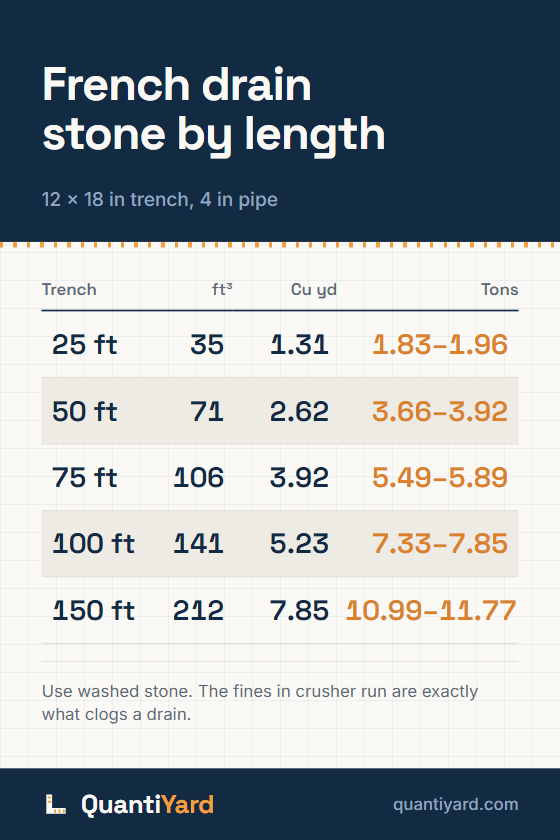
Save the drain stone chart
Stone for five trench lengths at 12 in wide by 18 in deep, in cubic yards and tons, with the pipe already taken out. Save it before you book a delivery.
Save to PinterestOpens Pinterest with the chart and link ready to go.
French Drain Calculator FAQ
How much gravel do I need for a French drain?
A 50 foot trench 12 inches wide and 18 inches deep holds 75 cubic feet, and a 4 inch pipe running through it displaces about 4.4, leaving 70.6 cubic feet of stone. That is 2.62 cubic yards, or 3.66 to 3.92 tons of crushed stone at 1.4 to 1.5 tons a yard. Order by the ton if the yard quotes by weight, since the two units are not interchangeable without the density.
Should the fabric wrap the pipe or the stone?
The stone. Fabric tight against a perforated pipe silts up at the holes, and once the perforations block the drain cannot be cleaned. Wrapping the whole stone envelope gives silt a far larger area to fail across and keeps the stone free to drain. Sock-wrapped pipe is sold everywhere but it is the wrong choice for most yard drains.
How much slope does a French drain need?
About 1 percent, which is roughly 1 inch of fall for every 8 feet of run. More important than the exact figure is having somewhere lower for the pipe to daylight. A drain with no outfall is a trench that stores water rather than moving it, and no amount of stone fixes that.
Cite this page
Built from this page's own title, URL and last-updated date, so a citation cannot drift from what it cites.