The quick answer#
A cubic yard of gravel weighs about 2,800 to 3,000 lb, or 1.4 to 1.5 tons, as delivered. Sand is 2,700 lb, topsoil is 2,220, and bark mulch is under 800. That spread is the whole reason a yard and a ton are not interchangeable: one cubic yard of mulch and one cubic yard of gravel fill the same space and differ by more than 2,000 lb.
Gravel, crushed stone
2,800–3,000 lbper cubic yard, as deliveredSand
2,700 lbper cubic yardTopsoil
2,220 lbper cubic yardBark mulch, dry
450–800 lbper cubic yardThe figures in the first table are not sourced from a chart somewhere. They are the exact constants the calculators on this site use, read out of the tools themselves, so a number here and a number on the gravel calculator can never disagree. The second table covers materials this site has no calculator for, and those rows are marked and sourced separately.
The weight chart#
Cubic yards per ton is just the reciprocal, and it is the number you want when a supplier quotes by weight and you measured by volume.
| Material | lb per cu yd | Tons per cu yd | Cu yd per ton | What moves it |
|---|---|---|---|---|
| Gravel, crushed stone | 2,800–3,000 | 1.40–1.50 | 0.67–0.71 | As delivered. Grading and stone size move it; well-graded packs denser. |
| Sand | 2,700 | 1.35 | 0.74 | Moisture. Damp sand is heaviest of the three. |
| River rock | 2,600 | 1.30 | 0.77 | Rounded stone leaves more void space than crushed. |
| Decomposed granite | 3,000 | 1.50 | 0.67 | The fines fill the voids, so it packs hard. |
| Topsoil | 2,220 | 1.11 | 0.90 | Organic content and moisture. Screened runs lighter. |
| Clay | 2,800 | 1.40 | 0.71 | Water. Wet clay gains about 30 percent. |
| Mixed fill | 2,520 | 1.26 | 0.79 | Whatever is in it, which is the point of the name. |
These are the exact values used by the gravel calculator (gravel, sand, river rock, decomposed granite) and the excavation calculator (topsoil, clay, mixed fill), reasonably dry. Pounds per cubic yard is tons times 2,000. Crushed stone is HomeGuide’s published 1.4 to 1.5 tons per cubic yard as delivered. The soils are in place, derived from dry densities in pounds per cubic foot: 104 for clay, 100 for sand, 82 for topsoil, 93 for mixed fill, each times 27 and divided by 2,000.
Why gravel and clay weigh about the same
Clay lands on 1.40 tons per cubic yard and delivered gravel on 1.4 to 1.5, which looks like a coincidence and is not quite. Crushed stone is dense rock with air between the pieces; clay is lighter material with almost no air in it. The two arrive at nearly the same figure by opposite routes, which is worth remembering when you are looking at a full truck and trying to guess what is in it.
Materials with no calculator#
These rows are not site constants, because no QuantiYard tool computes with them. Concrete and asphalt are sourced; pea gravel, bark mulch and compost are general industry figures with no published source found, and the sources note says so.
| Material | lb per cu yd | Tons per cu yd | Notes |
|---|---|---|---|
| Concrete, cured | 3,780–4,185 | 1.89–2.09 | Normal-weight concrete, 140 to 155 lb per cubic foot (FHWA). |
| Asphalt concrete, compacted | 3,100–4,320 | 1.55–2.16 | Laid and rolled, 115 to 160 lb per cubic foot (MoDOT). |
| Asphalt, loose or milled | 2,700 | 1.35 | MoDOT puts loose asphalt concrete at 2,480 to 3,460. |
| Pea gravel | 2,700 | 1.35 | Rounded and uniform, so it packs looser than crushed stone. |
| Bark mulch, dry | 450–800 | 0.23–0.40 | Pine bark nuggets sit at the bottom of the range. |
| Compost | 1,000–1,400 | 0.50–0.70 | Varies with how finished and how wet it is. |
Ranges rather than single figures where the material genuinely varies that much. Concrete weight is for cured concrete in place, not for the mixed load in the truck, and it is not a figure the concrete calculator uses: that tool works in volume and bag yield, not weight.
Concrete is the one worth pausing on. At 3,780 to 4,185 lb a cubic yard, a single yard is about two tons, and a modest slab is a load most pickups have no business carrying. The concrete calculator gives the volume and the bag count for a pour, and at about two tons a yard the weight alone is a strong argument for a ready-mix truck wherever one can reach.
Why the same material varies#
Every figure above is a dry average, and real deliveries miss it in both directions. Three things account for almost all of the spread, and knowing the rough size of each one is what keeps you from ordering by the wrong unit.
Moisture, roughly 20 percent on stone and 30 on clay#
The biggest of the three by a distance. Water fills the voids between particles and adds weight without adding volume, so a rained-on pile of gravel that measured 2,835 lb dry can weigh 3,375 lb wet, which is 19 percent on a material that drains well. Clay is the extreme case because it holds water rather than shedding it, and the excavation calculator flags that wet clay runs about 30 percent heavier. This is what puts a truck over its weight limit before the bed is full.
Compaction, 15 to 25 percent#
The same material weighs more per cubic yard once it is compacted, because compaction is the removal of air. This is the flip side of swell: dig a yard of topsoil out of the ground and it becomes about 1.25 loose yards of the same mass. Which state a figure describes matters: the soils on this page are in place, and gravel is as delivered.
Grading and particle size, the smallest effect#
Well-graded material, meaning a mix of particle sizes, packs denser than uniform material, because the small pieces fill the voids between the large ones. That is why decomposed granite at 3,000 lb outweighs river rock at 2,600 even though both are stone: the granite arrives with its own fines and the river rock is uniform and rounded. Expect this to move a figure by less than moisture or compaction will, but it is the reason two loads of the same nominal stone can weigh differently.
Converting yards to tons
Cubic yards and tons for your area and depth
Enter the area and depth to get both units at once, using the densities in the table above, so a supplier quoting by weight and a plan measured by volume line up.
Ordering by the yard or the ton#
Most quarries and landscape suppliers price stone by the ton and soil and mulch by the yard, which means a single project routinely gets quoted in both units. Convert before you compare, not after.
A worked example. A 500 square foot bed at 3 inches deep is 4.63 cubic yards of material. In gravel that is 6.48 tons; in mulch it is closer to 1.4 tons for the same volume. If one supplier quotes $40 a ton and another quotes $55 a yard, the gravel is $259 against $255 and the two are effectively the same price, which you cannot see until you convert.
The other reason to know the weight is haulage. A half-ton pickup should not carry a cubic yard of anything dense: one yard of gravel is 2,800 to 3,000 lb, which is over the payload of most light trucks before you count the driver. Soil and mulch are the ones you can move yourself. Stone almost always wants delivery, and the gravel calculator gives the tonnage that decides how many trips that is.
For a slab rather than a bed, the same logic applies with bigger numbers. The concrete calculator works in cubic yards and bag counts, and at about two tons a yard the weight is what rules out doing a driveway in bags however cheap they look per unit.
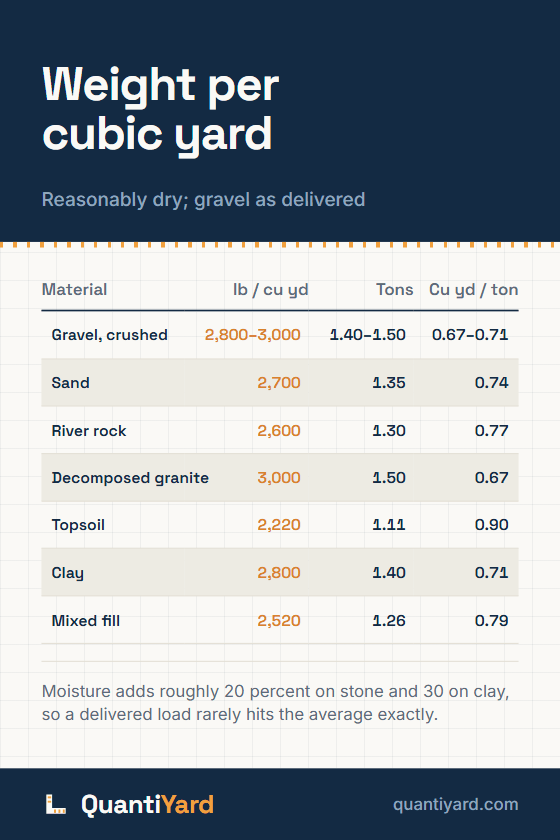
Save the weight chart#
Pounds per cubic yard, tons per cubic yard and cubic yards per ton for seven materials. Save it and you can convert a supplier's ton quote at the counter.
Save to PinterestOpens Pinterest with the chart and link ready to go.
Common questions#
How much does a cubic yard of gravel weigh?#
About 2,800 to 3,000 lb, or 1.4 to 1.5 tons, as delivered and reasonably dry. That is the range the gravel calculator uses. Wet gravel weighs more: a load that measured 2,835 lb dry can reach 3,375 lb after rain, which is about 19 percent. Rounded river rock is lighter at 2,600 lb because uniform stone leaves more void space than crushed.
How many cubic yards are in a ton?#
It depends entirely on the material, because a ton is a weight and a yard is a volume. A ton of gravel is 0.67 to 0.71 cubic yards, a ton of sand is 0.74, and a ton of topsoil is 0.90. For bark mulch a ton is more than 2 cubic yards. Convert before comparing two quotes, since suppliers price stone by the ton and soil and mulch by the yard.
Why do two loads of the same material weigh differently?#
Moisture, compaction and grading, in that order of size. Water fills the voids and adds roughly 20 percent on stone and 30 on clay without adding volume. Compaction removes air and adds roughly 15 to 25 percent, which is why in-place and loose figures differ. Grading matters least: well-graded material packs denser than uniform material because the fines fill the gaps between the larger pieces.
How much does a cubic yard of concrete weigh?#
About 3,780 to 4,185 lb, or 1.89 to 2.09 tons, cured and in place, because normal-weight concrete runs 140 to 155 lb per cubic foot (FHWA). That is about two tons per yard, which is why a ready-mix truck beats bags on anything it can reach rather than in bags. This is a sourced figure rather than a site constant, since the concrete calculator works in volume and bag yield rather than weight.