Concrete Calculator
Enter your pour and get the ready-mix cubic yards and the bag count for slabs, footings, walls, and round columns, with a waste allowance built in.
Updated October 3, 2026 · Estimates for planning, not a quote
How to figure concrete for your project
Concrete is ordered by volume, so every estimate comes down to measuring the space you're filling and converting it to cubic yards (for ready-mix delivery) or to bags (for smaller jobs you mix yourself).
Slabs, footings, and walls
These are all rectangular volumes. Multiply length by width by thickness, with every measurement in feet, to get cubic feet, then divide by 27 to reach cubic yards. The one that trips people up is thickness: a 4-inch slab is only 0.33 feet thick, so this calculator lets you enter thickness in inches and handles the conversion.
Round columns and post holes
For a cylinder (a column, a footing tube, or a deck-post hole), the volume is π × radius² × height. Enter the diameter and the calculator halves it for you.
Digging footings for a deck? Our deck building cost guide covers what the footings, framing, railings, and permits each run, and why hole depth is set by your local frost line rather than by preference.
Setting fence posts instead? Our fence installation cost guide covers what corner, line, and gate posts each run per hole, and why the concrete line item is bigger than it looks on a long fence run.
Bags vs. ready-mix
An 80 lb bag of concrete mix yields about 0.6 cubic feet, a 60 lb bag about 0.45, and a 40 lb bag about 0.30. Because a full cubic yard is 27 cubic feet, that's roughly 45 bags of the 80 lb mix per yard, which is why hand-mixing stops making sense much past a yard, and a ready-mix truck takes over. See the full concrete bag yield chart for all three bag sizes and common slab sizes, or our bagged vs. ready-mix comparison guide for the cost and labor tradeoffs, including short load fees on small ready-mix orders.
Pricing out a slab rather than just sizing it? Our concrete patio cost guide breaks down installed and DIY prices per square foot, including where a short-load fee and site access change the number.
Always add for waste
Subgrade is never perfectly level, footings over-dig, and some mix is lost to spillage and the wheelbarrow. A 5–10% waste allowance covers it. Running short in the middle of a pour is the expensive mistake, so round up rather than down.
Method and sources
Where these figures come from: Bag yields as printed by the mix manufacturers: 0.60 cubic feet per 80 lb bag, 0.45 per 60 lb, 0.30 per 40 lb.
Volume is length by width by thickness divided by 27 for a slab, footing or wall, and pi times radius squared times height divided by 27 for a round column. The waste allowance is applied to the volume, not to the bag count, so a part bag still costs a whole bag. Quikrete prints the same three yields on its own data sheet for Concrete Mix, product number 1101.
QuantiYard writes its own formulas and states them in plain language on every page. How these numbers are made covers where the constants come from, how waste factors are chosen, what these calculators deliberately do not do, and how to report an error.
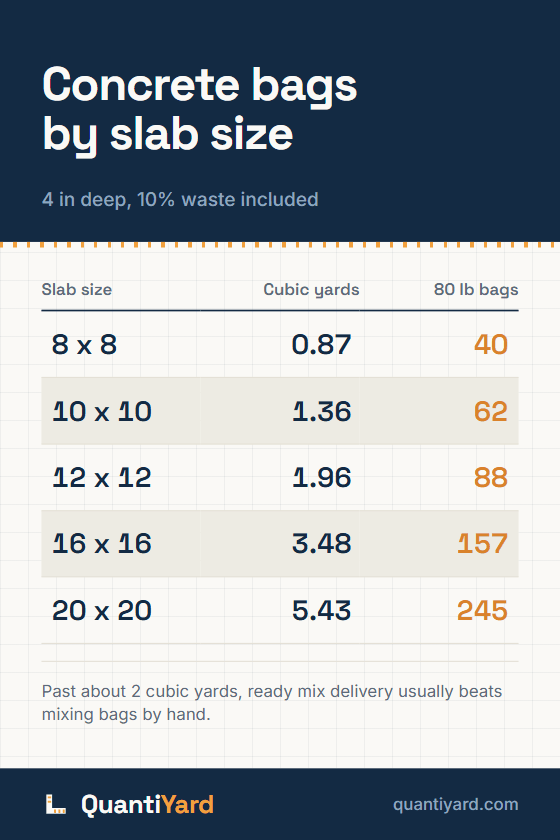
Save the concrete bag chart
Bags and cubic yards for five slab sizes at 4 inches deep, sized for Pinterest. Save it to your project board and the numbers are with you at the yard.
Save to PinterestOpens Pinterest with the chart and link ready to go.
Concrete calculator FAQ
How much concrete do I need for a slab?
Multiply the slab's length, width, and thickness in feet to get cubic feet, then divide by 27 to get cubic yards. A 10 ft by 10 ft slab poured 4 inches thick is 10 × 10 × 0.333 = 33.3 cubic feet, or about 1.23 cubic yards. Add 5 to 10 percent for waste.
How many 80 lb bags of concrete are in a cubic yard?
An 80 lb bag of concrete mix yields about 0.6 cubic feet. A cubic yard is 27 cubic feet, so a cubic yard takes roughly 45 bags of 80 lb mix. A 60 lb bag yields about 0.45 cubic feet (60 per yard) and a 40 lb bag about 0.30 cubic feet (90 per yard). The bag yield chart has the full breakdown by slab size.
Should I order ready-mix or use bags?
If a plant will sell a short load, ready-mix usually costs less than bags even at 1 cubic yard, which is 45 bags of 80 lb mix, and it is far less labor. Bags win when the plant will not sell a short load, when a truck cannot reach the pour, or for a scatter of small holes like fence posts.
How much extra concrete should I order for waste?
Add 5 to 10 percent to your calculated volume. Uneven subgrade, spillage, over-excavated footings, and slab edges all consume a little more than the ideal figure. Running short mid-pour is far more costly than a small amount left over, so round up.
Cite this page
Built from this page's own title, URL and last-updated date, so a citation cannot drift from what it cites.