The quick answer#
Where a plant will deliver a short load, ready-mix usually costs less than bags even at 1 cubic yard, and it takes a fraction of the labor. Bags win when the plant will not sell a short load, when a truck cannot reach the pour, or when the job is a scatter of small holes.
Bagged mix, materials
$6.47per 80 lb bagOne cubic yard, bagged
$29145 bags of 80 lb mixReady-mix, delivered
$110–$150per cubic yard, full loadShort load charge
$40–$60per cubic yardNeither option is a straight upgrade over the other. Ready-mix is cheaper per yard, and a short load charge narrows that gap without closing it. Where it can flip is a plant that sells no short loads and sets a minimum order instead. Bags cost more per cubic foot of concrete, but you buy exactly the volume you need, work at your own pace, and never need a truck to reach the pour.
Before you compare prices
Find out how much concrete your job actually needs
Enter your slab, footing, or column dimensions to get cubic yards and bag counts for all three bag sizes, with a waste allowance built in.
Bagged vs. ready-mix at a glance#
Five things change between the two approaches: what you pay per yard, how much physical work is involved, what you need on hand, how much time pressure you're under once the mix is wet, and whether there's a minimum order standing between you and a delivery.
| Factor | Bagged mix | Ready-mix |
|---|---|---|
| Cost per yard | About $291 in materials (45 bags of 80 lb mix at $6.47) | $110 to $150 delivered for a full load, plus $40 to $60 a yard for a short load |
| Labor | Full manual mixing and placing, all of it on you or your crew | The truck does the mixing; your crew only places and finishes |
| Equipment needed | Wheelbarrow or mixing tub, hoe, a portable mixer helps, hose, finishing tools | Truck access (chute reach or a pump), enough hands to place fast, finishing tools |
| Working time | Flexible. Mix and place one batch at a time, at your own pace | Fixed. The load has to be placed as soon as it arrives |
| Minimum order | None. Buy exactly the bags your job needs | A full truck is about 10 cubic yards; short-load trucks deliver as little as 1 yard |
The bag price is one market on one day: $6.47 for Quikrete 80 lb Concrete Mix at both Home Depot and Lowe’s in Atlanta on October 3, 2026, so check yours. Ready-mix pricing is for standard mix delivered locally, before any pump, additive, or weekend surcharge.
Where bags still win#
On price alone, a short load usually wins. One cubic yard delivered as a short load runs $150 to $210: $110 to $150 for the concrete plus $40 to $60 for the short load on HomeAdvisor’s figures, with HomeGuide’s $119 to $147 plus $53 landing inside that. The same yard in bags is 45 bags at $6.47, about $291, before you count a day of mixing.
So the old rule of thumb, bags under a yard and a truck over it, only holds where the plant will not sell a short load. Bags win in three cases: when the plant sells no short loads and its minimum order would have you paying for concrete you do not need, when a truck cannot reach the pour, and when the job is a scatter of small holes. A 1.5 yard job at the top of a steep, narrow driveway a truck can’t reach stays bagged regardless of the math, because there’s no way to get concrete to the pour.
Why 45 bags is the number, not a round figure
An 80 lb bag of concrete mix yields about 0.60 cubic feet. A cubic yard is 27 cubic feet, and 27 divided by 0.60 comes out to exactly 45 bags. That's the same conversion the concrete calculator uses to turn your pour dimensions into a bag count, and the same one behind the full concrete bag yield chart for 60 and 40 lb bags too.
Short loads and minimum orders#
Ready-mix plants price a full truck, which is about 10 cubic yards. Anything less is a short load and costs more per yard: $53 a yard extra on HomeGuide’s figures, $40 to $60 on HomeAdvisor’s, and HomeGuide adds $8 a yard for a Saturday delivery. Some suppliers run short-load trucks that mix on site and deliver anywhere from 1 to 11 yards.
That surcharge is real, but it is small next to the gap between a delivered yard and 45 bags. Where it bites is a plant that will not sell a short load at all and sets a minimum order instead. Then a 1.5 yard job pays for every yard of that minimum, used or not, and bags can come out ahead.
Always ask a plant whether it sells short loads, what it charges for one, and whether it has a minimum order, before comparing a quote to bagged material cost.
Who bagged mix suits#
Bagged concrete makes the most sense when the job is small, scattered, or awkward for a truck to reach. Fence post holes are the clearest example: each hole takes a fraction of a bag, so a whole fence line rarely adds up to a full yard, and the holes are usually spread out along a property line a truck can't drive beside anyway. Run your post spacing through the fence calculator to get an exact bag count before you buy.
Deck footings behave the same way. A dozen holes at 12 inches across and 42 inches deep is about 1.2 cubic yards of concrete in total, but it is spread across a dozen spots a truck chute will never reach. The fence calculator handles those holes too, since a footing and a post hole are the same cylinder math.
- Post holes, mailbox footings, and other small, spread-out pours
- Repairs, patches, and setting a single deck footing
- Sites a truck can't reach: tight side yards, steep driveways, gated backyards
- Jobs you want to do in stages over a weekend instead of all at once
- Anyone without a crew on hand to place a full truckload before it sets
Who ready-mix suits#
Ready-mix wins once the pour is large enough, continuous enough, or time-sensitive enough that hand-mixing stops being practical. A single slab needs to go in as one continuous pour to avoid a cold joint where an old batch meets a new one, and that gets harder to manage in bags past a yard or so.
- Driveways, patios, and slabs, wherever a truck can reach and the plant sells the volume you need
- Foundation walls and footings that need to pour in one continuous run
- Jobs where a crew is already on site and ready to place and finish fast
- Sites with clear truck access, or where a pump can reach the pour
- Anyone who'd rather pay for delivery than spend a full day mixing by hand
Sizing either option
Get your exact cubic yards and bag count
Enter your pour dimensions to see cubic yards for a ready-mix quote and bag counts for all three bag sizes side by side, with a cost estimate either way.
A decision framework#
Instead of a flat recommendation, work through these in order. The answers usually point you to one option well before you get to price.
1. Can a truck actually reach the pour?#
If the answer is no, the decision is already made. A pump truck extends reach but adds its own cost and still needs staging room nearby. No access means bagged mix regardless of volume.
2. How much volume does the job need?#
Run your dimensions through the concrete calculator to get cubic yards. Then ask a plant whether it sells a short load at that volume. If it does, the truck usually wins on price; if it only sells a minimum order, price that minimum against the bags.
3. Do you have the labor and the time?#
Ready-mix trades money for a hard deadline: once the truck arrives, the clock is running. Bagged mix trades a lower ceiling on daily volume for the freedom to stop, rest, and pick back up. If you're working alone or on evenings and weekends, that flexibility is often worth more than the per-yard savings.
4. Does the pour need to be continuous?#
A single monolithic slab wants one pour. A row of separate post holes doesn't care if hole four goes in an hour after hole one. Continuous pours push toward ready-mix; independent, spread-out pours push toward bags.
Most jobs answer themselves after the first two questions. It’s the plants that sell a minimum order and no short loads, on a job of a yard and a half with good truck access and a free Saturday, where the last two questions actually decide it.
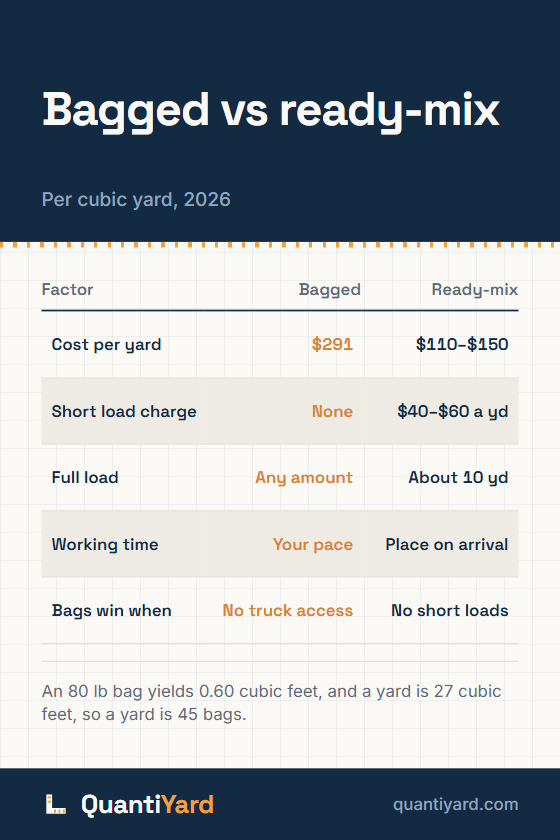
Save the bagged vs. ready-mix chart#
Cost per yard, minimum order, short load fee, and working time for both routes. Save it before you call a plant for a quote.
Save to PinterestOpens Pinterest with the chart and link ready to go.
Common questions#
Is it cheaper to use bagged concrete or ready-mix?#
Usually ready-mix, if the plant will sell you a short load: one cubic yard delivered runs $150 to $210 against about $291 for 45 bags of 80 lb mix. Bags win when the plant will not sell a short load, when a truck cannot reach the pour, or for a scatter of small holes, and they let you work at your own pace.
How many bags of concrete equal one cubic yard?#
45 bags of 80 lb mix. An 80 lb bag yields about 0.60 cubic feet, and a cubic yard is 27 cubic feet, so 27 divided by 0.60 is 45 bags. A 60 lb bag takes 60 bags per yard, and a 40 lb bag takes 90. The full bag yield chart breaks down all three sizes.
What is a short load fee?#
A surcharge on any order smaller than a full truck, which is about 10 cubic yards. HomeGuide prices it at $53 a cubic yard and HomeAdvisor at $40 to $60. Some plants do not sell short loads at all and set a minimum order instead.
Can I mix a full cubic yard of concrete by hand?#
You can, but 45 bags of 80 lb mix is roughly 3,600 lb of material to load, mix, and place, which is a full day of hard labor for one person and a long day even with help.