Bag yield by weight#
Bag yield is fixed by the manufacturer and doesn't change by brand: it's a function of weight and mix density. Heavier bags simply pack more mix, and yield scales with weight almost exactly.
40 lb bag
0.30cubic feet60 lb bag
0.45cubic feet80 lb bag
0.60cubic feet| Bag weight | Yield | Share of 1 cubic yard |
|---|---|---|
| 40 lb | 0.30 ft³ | 1.1% |
| 60 lb | 0.45 ft³ | 1.7% |
| 80 lb | 0.60 ft³ | 2.2% |
A cubic yard is 27 cubic feet. Yields are for standard concrete mix (not mortar mix or fast-setting mix, which pack differently); check the bag label if you're using a specialty mix.
Bags per cubic yard#
This is the number worth memorizing before you're standing in the aisle doing math on your phone. Divide 27 cubic feet by the bag's yield to get bags per yard.
| Bag weight | Cubic feet per bag | Bags per cubic yard |
|---|---|---|
| 40 lb | 0.30 ft³ | 90 |
| 60 lb | 0.45 ft³ | 60 |
| 80 lb | 0.60 ft³ | 45 |
These figures are the raw conversion, before any waste allowance. Add 5 to 10 percent to your volume before dividing by bag yield, since actual jobs never pour perfectly to the calculated number.
Skip the manual math
Get your exact bag count and cost
Enter your slab, footing, wall, or column dimensions and get cubic yards, bag counts for all three bag sizes, and a cost estimate with waste built in.
Bags by common slab size#
Here's the bag count for five common slab sizes at a standard 4 inch thickness, with a 10 percent waste allowance already included, the same allowance the concrete calculator defaults to.
| Slab size | Area | Cubic yards | 40 lb bags | 60 lb bags | 80 lb bags |
|---|---|---|---|---|---|
| 8 × 8 ft | 64 sq ft | 0.87 | 79 | 53 | 40 |
| 10 × 10 ft | 100 sq ft | 1.36 | 123 | 82 | 62 |
| 12 × 12 ft | 144 sq ft | 1.96 | 176 | 118 | 88 |
| 16 × 16 ft | 256 sq ft | 3.48 | 313 | 209 | 157 |
| 20 × 20 ft | 400 sq ft | 5.43 | 489 | 326 | 245 |
Cubic yards and 80 lb bag counts match the QuantiYard concrete calculator's own reference chart. Your slab thickness, local waste conditions, and bag brand can shift these slightly; treat this as a planning figure, not a final order.
How to use this chart#
Work out volume first, bags second. Multiply length by width by thickness, all in feet, to get cubic feet. A 4 inch slab is 0.333 feet thick. Add your waste allowance, typically 5 to 10 percent, then divide by the yield of the bag size you're using and round up, since a supplier won't sell a fraction of a bag.
A 12 by 12 foot slab at 4 inches: 12 × 12 × 0.333 = 48 cubic feet. Add 10 percent waste: 52.8 cubic feet. Divide by 0.60 for 80 lb bags: 88 bags exactly, which is why that row lands on a round number in the table above.
Where a plant sells short loads, a ready-mix delivery usually costs less than bags even under a cubic yard, about 45 bags of 80 lb mix, and it saves most of a day’s mixing. Bags win when the plant will not sell a short load, when a truck cannot reach the pour, or for a scatter of small holes. Run the concrete calculator with your own numbers to see both options side by side, including cost. Our bagged vs. ready-mix guide covers short loads, minimum orders and the prices behind that.
Post holes are the one job where bag math stays useful past a yard. Each hole takes a fraction of a bag, but the holes are spread along a property line, so the total can pass a yard while a ready-mix truck still cannot reach most of them. The fence calculator works the hole volume out from your post spacing and depth, then converts it to bags at the yields in the table above.
The same applies to deck footings and mailbox posts: count the holes, not the yards. Anything you pour one hole at a time is bagged work, and the fence calculator is the fastest way to get to a bag count without doing the cylinder math by hand.
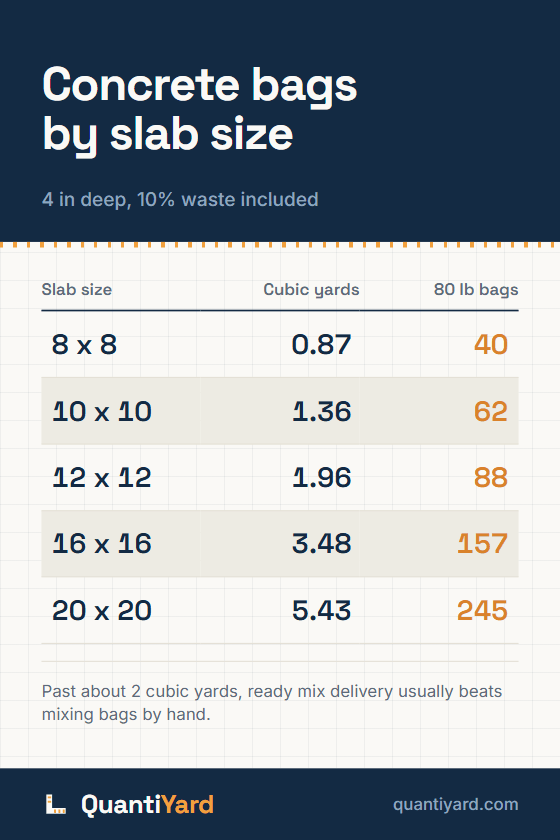
Save the concrete bag chart#
Bags and cubic yards for five slab sizes at 4 inches deep. Save it and you'll have the numbers with you at the yard.
Save to PinterestOpens Pinterest with the chart and link ready to go.
Common questions#
How many 80 lb bags of concrete are in a cubic yard?#
45 bags. An 80 lb bag of concrete mix yields 0.60 cubic feet, and a cubic yard is 27 cubic feet, so 27 divided by 0.60 comes to 45 bags.
How many bags of concrete do I need for a 10x10 slab?#
62 bags of 80 lb mix for a 10 by 10 foot slab at 4 inches thick, with a 10 percent waste allowance included. That same slab takes 82 bags of 60 lb mix or 123 bags of 40 lb mix.
What's the difference between 40, 60, and 80 lb bags of concrete?#
Only weight and yield, not mix quality. An 80 lb bag yields 0.60 cubic feet, a 60 lb bag 0.45, and a 40 lb bag 0.30, so yield scales directly with weight. Lighter bags are easier to carry and cost a bit more per cubic foot; heavier bags are cheaper per cubic foot but harder to handle alone.