Deck Calculator
Enter your deck size and board layout to get the number of decking boards, joists, joist linear feet, and deck screws, with a waste allowance built in.
Updated September 2, 2026 · Estimates for planning, not a quote
How to estimate deck materials
A deck breaks into two material layers: the decking you walk on, and the joists underneath that carry it. This calculator sizes both, plus the screws that tie them together.
Decking boards
Count the rows first: the deck dimension running across the boards, divided by one board's width plus the gap between boards. A standard deck board covers about 5.5 inches and a 1/4 inch gap is typical, though composite gaps vary by brand. Multiply the rows by the board run length for total linear feet, then divide by the length of board you're buying to get the board count. A waste allowance covers cutoffs and the occasional bad board.
Joists
Joists run perpendicular to the decking, so choosing which way the boards run sets the joist direction. They're spaced 16 inches on center for most decking, or 12 inches for many composite boards and diagonal patterns. The joist count is the span they're spaced along, divided by the spacing, plus one for the starting joist.
What this does not size
Beams, posts, and footings depend on span tables, load, wood species, and soil, which are code-governed and beyond a simple quantity estimate. Size those with a span table or a licensed contractor, and use the concrete calculator for the footing volume once you know the hole dimensions.
What it will cost
Counts are one half of the picture and prices are the other. Our deck building cost guide covers installed cost per square foot for pressure treated, cedar, and composite, totals by deck size, and a component-by-component materials breakdown you can hold a contractor quote against.
Still choosing a board? The composite vs. wood decking comparison runs pressure treated, cedar, and composite over ten and twenty years on this same 12 by 16 footprint, including what the staining actually costs.
Building the stairs off the deck? Our stair code reference covers the riser, tread and variation limits, the guard height on the open side of a flight, and the 30 inch drop that decides whether a guard is required at all.
This calculator counts joists at the spacing you give it, and stops short of sizing them. Our deck joist span chart gives the maximum span for each size across three species groups, from the AWC table the code points at, along with the wet service and incising assumptions that make a deck joist span less than a floor joist of the same size.
Method and sources
Counting decking by rows is how a deck gets laid out on site rather than a published method. Deck builders divide the span across the joists by the board width plus the gap, because that is the number of boards that will physically land, and two screws per board per joist is the standard face-screwed fastening pattern.
Boards run perpendicular to joists, so which dimension gets spanned flips with the board direction, and this page flips with it. It counts decking, joists and screws only. It does not size beams, posts or footings, and it does not check joist spans, which is what the deck joist span chart is for.
QuantiYard writes its own formulas and states them in plain language on every page. How these numbers are made covers where the constants come from, how waste factors are chosen, what these calculators deliberately do not do, and how to report an error.
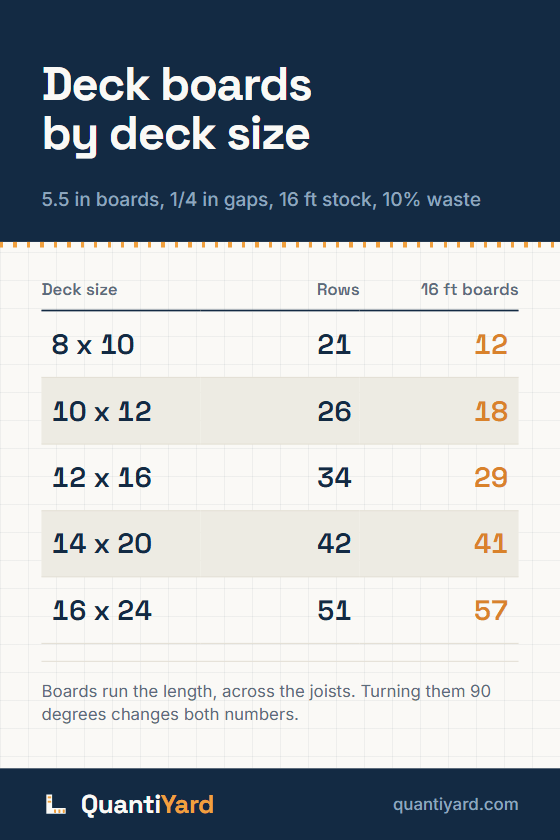
Save the deck board chart
Rows of decking and 16 foot boards for five deck sizes. Save it to your build board and price the lumber from real counts.
Save to PinterestOpens Pinterest with the chart and link ready to go.
Deck calculator FAQ
How many deck boards do I need?
Divide the deck width by the board width plus gap for the number of rows, multiply by the deck length for total linear feet, and divide by your board length. A standard board covers about 5.5 inches with a 1/4 inch gap. Add roughly 10% for waste.
How far apart should deck joists be?
16 inches on center is standard for most wood and composite decking. Many composite boards need 12 inches on center, and diagonal installs may need tighter spacing, so check the manufacturer's instructions.
Which direction should deck boards run?
Boards always run perpendicular to the joists, so the board direction sets the joist direction. Changing it in this calculator flips both the board count and the joist count.
Cite this page
Built from this page's own title, URL and last-updated date, so a citation cannot drift from what it cites.