The quick answer#
Most homeowners pay between $25 and $50 per square foot for a pressure treated deck installed in 2026, and between $40 and $80 per square foot for composite. Cedar sits in between at $30 to $47.
Pressure treated, installed
$25–$50per sq ftCedar, installed
$30–$47per sq ftComposite, installed
$40–$80per sq ftA typical backyard deck runs 200 to 400 square feet, which puts the usual project between $5,000 and $32,000 depending almost entirely on the material and how far off the ground it sits. Those ranges are for a complete deck: footings, framing, decking, railings, and a short flight of stairs. A deck quoted without railings or stairs is not the same product, and that is the most common reason two quotes on the same footprint look thousands apart.
Before you price anything
Find out how many boards and joists your deck needs
Enter your dimensions, board width, and joist spacing to get board counts, joist counts, and screws.
Cost by decking material#
The decking boards are a small share of a deck's total cost, composite boards alone running $4 to $16 per square foot against $40 to $80 installed, but they set the price of everything around them. Composite is heavier and most brands want joists at 12 inches on center instead of 16, so choosing composite quietly adds a third more framing lumber before a single board goes down.
Spacing is only half of it. How far those joists can carry before they need a beam under them is set by species and size, not by preference, and it is the number that decides how many posts and footings the deck needs. Our deck joist span chart lists the maximum spans and overhangs by species and joist size at 12, 16, and 24 inches on center, straight out of AWC DCA 6.
| Material | Materials | Full deck installed | What you are buying |
|---|---|---|---|
| Pressure treated pine | $14–$28 | $25–$50 | The default. Cheapest up front, needs staining and sealing every two to three years. |
| Cedar | — | $30–$47 | Naturally rot resistant, softer underfoot, stays cooler. Greys out without sealing. |
| Composite | $16–$32 | $40–$80 | Recycled wood and plastic. No staining, and HomeGuide says it lasts 25 to 50 years. |
Materials are HomeGuide's per square foot of deck, covering the substructure as well as the boards; no published figure gives cedar's materials alone. Installed prices are HomeGuide's for an average attached deck on a one storey home.
The maintenance math, in one line
Pressure treated wants staining every two to three years, at $1.50 to $4 per square foot each time. On a 300 square foot deck that is $450 to $1,200 a time. Composite costs $4,500 to $9,000 more up front on that same deck and needs no stain. At matching ends of those ranges the crossover lands somewhere between about year 16 and year 30, which is why the right answer depends far more on how long you are staying than on the sticker price.
Cost by deck size#
Size drives the total but not the rate. Small decks cost more per square foot, because the footings, the ledger, the stair run, and the crew's mobilization are nearly the same whether the deck is 100 square feet or 300. If you are undecided about going bigger, the extra footage is the cheapest part of the job.
| Deck size | Area | Pressure treated | Cedar | Composite |
|---|---|---|---|---|
| 10 × 10 ft | 100 sq ft | $2,500–$5,000 | $3,000–$4,700 | $4,000–$8,000 |
| 12 × 12 ft | 144 sq ft | $3,600–$7,200 | $4,320–$6,768 | $5,760–$11,520 |
| 12 × 16 ft | 192 sq ft | $4,800–$9,600 | $5,760–$9,024 | $7,680–$15,360 |
| 14 × 20 ft | 280 sq ft | $7,000–$14,000 | $8,400–$13,160 | $11,200–$22,400 |
| 16 × 20 ft | 320 sq ft | $8,000–$16,000 | $9,600–$15,040 | $12,800–$25,600 |
| 20 × 20 ft | 400 sq ft | $10,000–$20,000 | $12,000–$18,800 | $16,000–$32,000 |
Ranges apply the per-square-foot figures above to each footprint, for an average attached deck on a one storey home. HomeGuide's own 12 by 16 composite figure rounds to $15,350. Second-storey and multi-level decks land above these ranges.
What moves the price#
Height above grade#
This is the biggest swing factor after material, and the one homeowners underestimate most. A deck 18 inches off the ground needs short posts, simple footings, and no guardrail by code. Push it to a walkout off a second floor and you have added longer posts, bigger footings, bracing, a full guardrail run, and a much longer stair. HomeGuide puts a pressure treated ground-level deck at $25 to $30 per square foot, an elevated one at $30 to $50, a second-storey deck at $50 to $60, and a multi-level deck at $60 to $100. Anything over 30 inches also triggers the guardrail requirement, which is a hard cost step rather than a gradual one.
Railings#
Railing is priced per linear foot and it is where budgets quietly break. Wood rail runs $20 to $50 per linear foot installed, vinyl or composite $25 to $60, and aluminum $50 to $200. Cable runs $75 to $95 on wood posts and $150 to $285 on metal ones. On a 12 by 16 deck with rail on three sides, that is about 40 linear feet, so wood is $800 to $2,000 and cable $3,000 to $11,400.
Stairs#
Stairs built with a new deck add about $200 to $600 on HomeGuide's figures, and adding them to an existing deck later costs $1,400 to $2,600, because the stairs then need custom fitting to the frame. Every additional riser adds tread, stringer, and railing, so a full flight down from a second storey sits well above that. Stringer layout is the fussy part: get the rise and run wrong and the whole flight fails inspection, so it is worth working the numbers with the stair stringer calculator before cutting anything.
Footings#
Footings are cheap in materials and expensive in labor. Depth is set by your local frost line, not by preference, and the building department will tell you what it is where you live. Once you know the diameter and depth, the concrete calculator gives the volume per hole in its column mode, and multiplying by the hole count is the whole footing estimate.
Permits and inspections#
HomeGuide puts a deck permit at $50 to $150, and one is required almost anywhere the deck attaches to the house or rises more than 30 inches above grade. The fee is not the real cost. The real cost is the inspection schedule, which usually means an open-hole inspection before you pour footings and a final once framing and rail are up. Pouring footings before that first inspection is the classic way to end up digging them out again.
Site access and demolition#
HomeGuide puts removing a small deck, 100 to 200 square feet, at $1,000 to $2,500, and a medium one, 200 to 400 square feet, at $2,500 to $5,000. A backyard a crew cannot get a truck or a mini excavator into means every footing gets dug by hand and every board gets carried, which shows up as labor hours rather than a line item.
Materials by component#
Here is where the money goes on a 12 by 16 foot pressure treated deck (192 square feet), at HomeGuide's 2026 split between materials and labor.
| Component | Rate | Cost |
|---|---|---|
| Materials | $14–$28 per sq ft | $2,688–$5,376 |
| Labor | $11–$22 per sq ft | $2,112–$4,224 |
| Installed total | $25–$50 per sq ft | $4,800–$9,600 |
| Permit | 1 | $50–$150 |
Materials cover the framing, decking, railing and stairs together. Composite materials run $16 to $32 per square foot, $3,072 to $6,144 on this deck, and composite labor $24 to $48, because it takes more careful assembly. An older HomeGuide survey put pressure treated labor at $15 to $30 and about 60 percent of the job.
No published survey breaks those materials down by component, so this page does not either. Run your own board and joist counts through the deck calculator before pricing any of it, because a 10 percent difference in the joist count moves the framing line more than switching lumber suppliers will.
Sizing the footings
Concrete volume per post hole
Use the column mode with your hole diameter and frost depth to get cubic yards and bag counts for all your footings.
DIY versus contractor#
Labor is $11 to $22 per square foot on a pressure treated deck, about 44 percent of the installed price on HomeGuide's current figures. That is the number you are deciding whether to keep.
| Approach | Pressure treated | Composite | Time |
|---|---|---|---|
| DIY, materials only | $2,688–$5,376 | $3,072–$6,144 | 3 to 5 weekends |
| Contractor, installed | $4,800–$9,600 | $7,680–$15,360 | 4 to 7 days |
| What you keep | $2,112–$4,224 | $4,608–$9,216 | — |
DIY figures are materials only, before the permit and any tool rental; a compound miter saw and a circular saw are assumed to be on hand or borrowed.
Keeping $2,112 to $4,224 on a pressure treated build is real money for work that is mostly repetitive cutting and fastening. The savings are larger in absolute terms on composite, but composite is also less forgiving: hidden fastener systems have tight tolerances, and boards that are cut short cost far more to replace.
The two parts that are not beginner work
The ledger board, where the deck attaches to the house, has to be flashed and lag-bolted correctly. A bad ledger connection is the leading cause of deck collapses, and it fails years later under a full load of people. The other is footings below the frost line, because a footing that heaves takes the whole frame out of level. If you build the rest yourself, those are the two things worth a professional's eyes, and most inspectors will tell you what they want to see if you ask before you start.
Build the shopping list
Boards, joists, and screws for your deck
Set your board width, gap, joist spacing, and waste factor to get the counts you take to the lumberyard.
Checking a quote in two minutes#
You do not need to price every line to spot a bad quote. Work out the materials yourself, then look at what is left over.
Take the 12 by 16 pressure treated deck. HomeGuide's rates put materials at $2,688 to $5,376 and labor at $2,112 to $4,224, so a quote of $6,500 sits comfortably inside the $4,800 to $9,600 installed range. That is reasonable. If the quote is $11,000 for a ground-level pressure treated deck on an open site, where HomeGuide's ground-level rate gives $4,800 to $5,760, ask for it itemized, because something in there is either a much better railing than you asked for or priced well above market.
The same test runs the other way. A quote near or below material cost is not a bargain. It usually means footings that stop above the frost line, joists at 24 inches instead of 16, or a ledger fastened with screws rather than structural lag bolts. Ask every bidder for footing depth, joist spacing, and the fastener schedule in writing, and the cheap quotes tend to explain themselves.
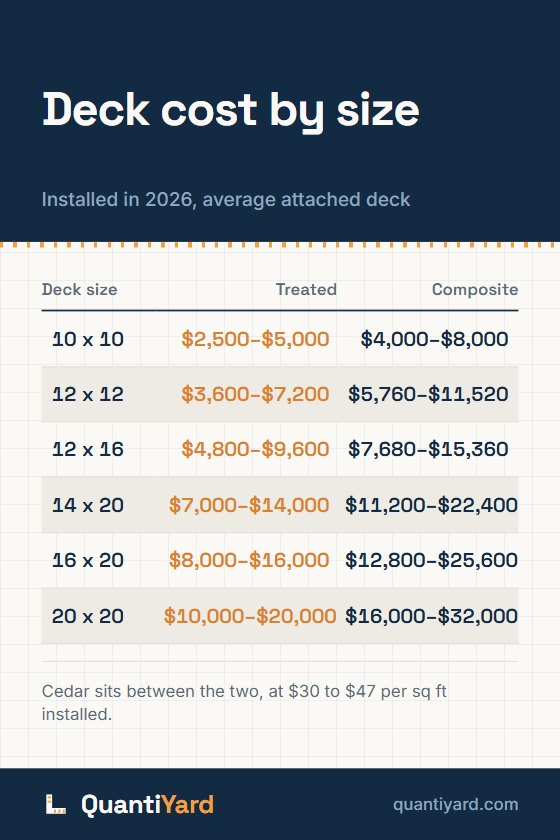
Save the deck cost chart#
Installed cost for six deck sizes, pressure treated against composite, railings and one stair run included. Save it before you call for bids.
Save to PinterestOpens Pinterest with the chart and link ready to go.
Common questions#
How much does a 12x16 deck cost?#
A 12 by 16 foot deck is 192 square feet, which runs roughly $4,800 to $9,600 installed in pressure treated lumber, $5,760 to $9,024 in cedar, and $7,680 to $15,360 in composite. Building it yourself puts the materials at $2,688 to $5,376, at HomeGuide's $14 to $28 per square foot for pressure treated pine.
Is composite decking worth the extra cost?#
It depends on how long you are staying. Composite costs about 60 percent more up front at matching ends of the two ranges but needs no staining or sealing, while pressure treated wants staining every two to three years at $1.50 to $4 per square foot each time. The running costs close the gap somewhere between about year 16 and year 30. Under 15 years, pressure treated is the cheaper answer at both ends. The composite vs. wood decking comparison runs the full ten and twenty year totals on a 12 by 16 deck and shows exactly where the crossover lands.
Can I build a deck myself?#
A ground-level deck under about 200 square feet with no roof attachment is a realistic weekend-carpenter project and keeps the labor, which HomeGuide puts at $11 to $22 of the $25 to $50 a square foot. The parts that go wrong are the ledger connection to the house and the footings. A badly flashed ledger is the single most common cause of deck collapse, so if the deck attaches to the house, that connection is worth having inspected even on a DIY build.
Do I need a permit to build a deck?#
Almost always, if the deck is attached to the house or sits more than 30 inches above grade. HomeGuide puts a deck permit at $50 to $150, depending on deck size and location, and it typically includes one or more inspections, usually at the footing stage and again at final. Freestanding decks low to the ground are sometimes exempt, but the threshold varies by municipality, so call your building department before you dig.