Paver Calculator
Enter your patio size and paver dimensions to get the paver count, plus the gravel base and sand setting bed in cubic yards and tons, with a waste allowance built in.
Updated October 3, 2026 · Estimates for planning, not a quote
How to estimate pavers for a patio
Pavers per square foot is 144 ÷ ((paver length + joint gap) × (paver width + joint gap)), with every measurement in inches. The 144 converts square inches to square feet. Multiply that rate by the patio square footage, then add a waste allowance for cuts. A 4 by 8 inch paver with a 1/8 inch joint works out to about 4.3 pavers per square foot.
The base and sand layers
A paver patio is three layers: a compacted gravel base, a thin sand setting bed, then the pavers. Patios usually get a 6 inch base. Driveways run 6 to 8 inches on well-drained soil, and 8 to 12 where freeze-thaw, poor drainage, or a weak subgrade calls for more. The sand bed is 1 inch. Both are figured the same way as any fill: patio area times depth in feet, divided by 27 for cubic yards. Gravel is sold by weight, so this calculator also converts the base to tons at 1.4 to 1.5 tons per cubic yard, as delivered. If you want to price the base on its own, run the footprint through the gravel calculator.
Why the waste allowance matters
Edges, curves, and the odd cracked unit all mean cutting. Use about 5% for a straight rectangular layout, 10% as a default, and 15% or more for a diagonal, herringbone, or curved design. Round up: pavers ship on full pallets, and a few spares are worth keeping for future repairs. For what a finished patio costs once labor is added, see the concrete patio cost guide, which compares poured concrete and pavers. Laying pavers on a driveway instead? The driveway cost guide prices pavers against gravel, asphalt, and concrete, and explains why pavers are the only one of the four you can lift and put back.
Method and sources
Where these figures come from: Two technical bulletins from the Concrete Masonry and Hardscapes Association, read together. Both were revised March 2022 and both carried ICPI numbers before ICPI merged into CMHA. Tech Note PAV-TEC-010-22, Application Guide for Interlocking Concrete Pavements, was Tech Spec 10, and it puts minimum aggregate base thickness at 4 to 6 in. for walks, 6 to 8 in. for driveways and 8 to 12 in. for streets, and screeds the bedding sand to a nominal 1 in. Tech Note PAV-TEC-002-22, Construction of Interlocking Concrete Pavements, was Tech Spec 2, and it carries the condition the first one leaves out: "Residential driveways on well-drained soils should be at least 6 in. (150 mm) thick. In colder climates, continually wet or weak soils will require that bases be thicker."
So base depth is conditional, not a single number. A patio on well-drained soil starts at 4 to 6 inches. A residential driveway on well-drained soil is 6 to 8. Add 2 to 4 inches on top of that where there are freeze-thaw cycles, drainage is poor, or the subgrade is weak, which is how the 8 to 12 inches commonly quoted for driveways arises: it is the adjusted figure, not the baseline. One caveat on that adder. The March 2022 bulletin says only that such bases should be thicker, with no figure. The 2 to 4 inches is what the ICPI Tech Spec 2 edition before it put on the word thicker, and this page keeps it because the current revision replaced a number with nothing rather than with a different number. The 1 inch sand bed is the nominal thickness the bulletin itself gives. Pavers per square foot is 144 divided by the paver length plus joint times its width plus joint, which is arithmetic, and waste applies to the paver count alone, for cuts and breakage, never to the base or the bedding sand, which are laid to a depth.
QuantiYard writes its own formulas and states them in plain language on every page. How these numbers are made covers where the constants come from, how waste factors are chosen, what these calculators deliberately do not do, and how to report an error.
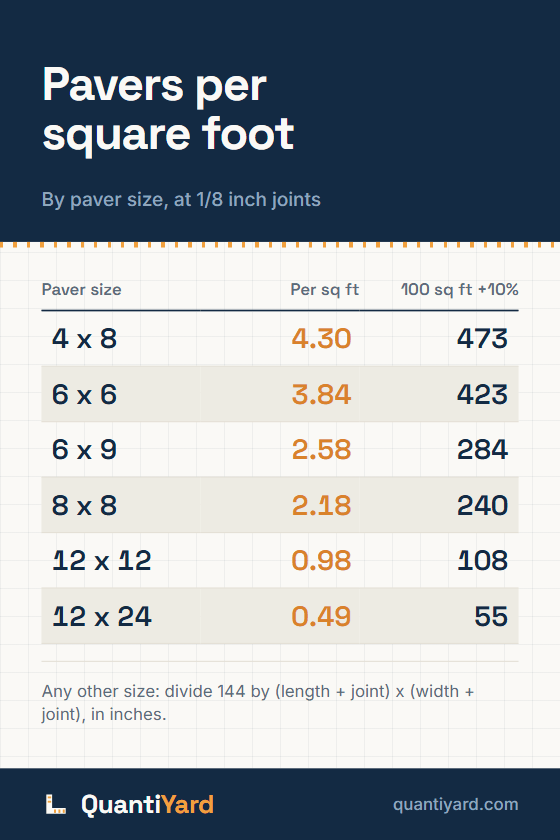
Save the paver chart
Pavers per square foot for six common sizes, sized for Pinterest. Save it to your patio board and the numbers are with you when you are standing in the stone yard.
Save to PinterestOpens Pinterest with the chart and link ready to go.
Paver calculator FAQ
How many pavers do I need per square foot?
Divide 144 by the paver length plus the joint gap, times the paver width plus the joint gap, all in inches. A 4 by 8 inch paver with a 1/8 inch joint covers about 4.3 pavers per square foot. Multiply by your patio area and add 5 to 15 percent for cuts.
How much gravel base do I need under pavers?
Most patios use a 6 inch compacted gravel base. CMHA, the association ICPI merged into, puts driveways at 6 to 8 inches on well-drained soil and says freeze-thaw, poor drainage, or a weak subgrade needs a thicker base. The 2 to 4 inches usually added for that, and the 8 to 12 you see quoted for driveways, come from the earlier ICPI edition of the companion bulletin. For a patio, multiply the area by 0.5 feet and divide by 27 for cubic yards, then multiply by about 1.4 to get tons. A 200 square foot patio needs roughly 3.7 cubic yards, or about 5 tons.
How much sand goes under pavers?
A 1 inch sand setting bed is standard over the compacted base. For a 200 square foot patio that is about 0.6 cubic yards. Do not use the sand bed to correct for an uneven base, level the gravel first.
Cite this page
Built from this page's own title, URL and last-updated date, so a citation cannot drift from what it cites.