The quick answer#
Most homeowners pay between $6 and $13 per square foot for a plain broom-finish concrete patio installed in 2026. Decorative finishes push that up sharply, with stamped concrete landing between $9 and $30 per square foot.
Plain broom finish, installed
$6–$13per sq ftStamped or decorative, installed
$9–$30per sq ftMaterials only, DIY
$3.16–$5.26per sq ftA typical backyard patio runs 200 to 400 square feet, which puts the usual project somewhere between $1,200 and $5,200 for plain concrete. The spread inside that range is wide because two of the biggest cost factors have nothing to do with concrete: your local labor market, and how much work the site needs before anyone can pour.
Before you call anyone
Find out how many yards your patio needs
Enter your dimensions and get cubic yards, bag counts, and a cost estimate at your local price per yard.
Cost by patio size#
Size is the single biggest driver of the total, but not of the per-foot rate. Small patios cost more per square foot because setup, forming, crew travel, and the concrete delivery fee are roughly the same whether you pour 100 square feet or 400. If you are on the fence about going bigger, the extra footage is the cheapest part of the project.
| Patio size | Area | Concrete to order | Plain finish | Stamped finish |
|---|---|---|---|---|
| 10 × 10 ft | 100 sq ft | 1.4 yd³ | $600–$1,300 | $900–$3,000 |
| 12 × 12 ft | 144 sq ft | 2.0 yd³ | $865–$1,870 | $1,296–$4,320 |
| 12 × 16 ft | 192 sq ft | 2.6 yd³ | $1,150–$2,500 | $1,728–$5,760 |
| 14 × 20 ft | 280 sq ft | 3.8 yd³ | $1,680–$3,640 | $2,520–$8,400 |
| 16 × 20 ft | 320 sq ft | 4.4 yd³ | $1,920–$4,160 | $2,880–$9,600 |
| 20 × 20 ft | 400 sq ft | 5.4 yd³ | $2,400–$5,200 | $3,600–$12,000 |
Concrete volume assumes a 4 inch slab with a 10 percent waste allowance. Installed prices use $6 to $13 per square foot for plain and $9 to $30 for stamped, and cover excavation, base, forms, reinforcement, pour, finish, and cleanup on an accessible site.
Cost by finish#
The finish is where a patio budget doubles or triples. The slab underneath is identical in every case. What changes is the surface treatment and, more importantly, the labor hours it takes. A crew can flat-pour and broom 800 to 1,200 square feet in a day. Stamping cuts that to 300 to 500, because the pattern has to go in while the concrete is at exactly the right stiffness.
| Finish | Per sq ft | What you get |
|---|---|---|
| Broom (plain) | $6–$13 | Light texture from a drag broom. Grippy when wet, no maintenance, gray. |
| Exposed aggregate | $7–$18 | Surface washed back to reveal the stone. Very durable, slightly rough underfoot. |
| Stained or colored | $8–$25 | Acid or water-based stain, or color mixed into the load. Needs resealing. |
| Stamped | $9–$30 | Pressed pattern imitating stone, brick, or slate. Multi-color and borders sit at the top of the range. |
| Resurfacing existing slab | $3–$9 | Single-color overlay on sound concrete; a decorative overlay runs $6 to $10. Skips demo and the pour entirely. |
Basic single-pattern stamping runs $8 to $13 per square foot, mid-range $13 to $19, and multi-color custom work $19 to $26 or more. Complex patterns, contrasting borders, and two-tone color always land at the top end.
If the slab is sound, resurface instead
Replacing a patio means demo at $2 to $6 per square foot before any new work starts. An overlay on a slab that is cracked cosmetically but structurally fine costs $3 to $9 per square foot in a single color, or $6 to $10 decorative. Get a contractor to tell you which situation you are in before you agree to a teardown.
What the price includes, and what it doesn't#
A normal quote for a patio on a flat, accessible lot covers excavation, a compacted gravel base (usually 4 inches, which you can size with the gravel calculator), forming, reinforcement, the concrete, placing and finishing, control joints, and cleanup. That is the number in the tables above.
These items are commonly quoted separately, and they are where a $2,000 patio quietly becomes a $4,000 patio:
- Demolition of an existing patio: $2 to $6 per square foot
- Steps down from a door or deck: priced per step, often several hundred dollars each
- Drainage work or regrading: variable, and non-negotiable if water currently runs toward the house
- Concrete pump: $15 a cubic yard with a $125 minimum for a trailer pump, or $140 to $190 an hour for a boom truck with a 4 to 5 hour minimum, when the truck cannot reach the pour area
- Short, weekend or after-hours load: $40 to $60 a cubic yard on top
- Sealer: often included on stamped and stained work, often not on broom finish
Ask every bidder to itemize these. Two quotes that look $1,200 apart are frequently the same price with a different set of exclusions.
DIY material cost#
Doing it yourself takes the labor out, and labor is roughly half of an installed price. Here is a full material list for a 12 by 16 foot patio (192 square feet) poured 4 inches thick, at 2026 prices.
| Item | Quantity | Cost |
|---|---|---|
| Compacted gravel base, 4 in | 4 tons | $40–$200 |
| Ready-mix concrete delivered | 2.6 yd³ | $447–$520 |
| Welded wire mesh | 192 sq ft | $30–$60 |
| Form lumber and stakes | 1 set | $50–$150 |
| Sealer, curing, tool rental | as needed | $40–$80 |
| Total materials | 192 sq ft | $607–$1,010 |
That is $3.16 to $5.26 per square foot, against $1,150 to $2,500 for the same patio installed. Concrete is $119 to $147 a cubic yard delivered plus a $53 a yard short-load charge. Gravel is crushed stone at $10 to $50 a ton before delivery, and small orders can pass $100 a ton. The mesh, form and sealer lines have no published source and are planning figures.
The part the savings don't cover
A patio slab is a single pour with a working window measured in hours, and every finishing decision is permanent once it sets. Most people who pull this off successfully stay under about 200 square feet, have the forms and base fully ready before the truck arrives, and have at least two helpers on site. Above 300 square feet, a slab that goes wrong is more expensive to fix than the labor you saved.
Sizing your base layer
Work out the gravel before the concrete
Get tons or cubic yards of crushed stone for your patio footprint and base depth.
Bags or ready-mix#
Where a plant sells short loads, a ready-mix delivery usually costs less than bags even under a cubic yard, about 45 bags of 80 lb mix, and it saves most of a day’s mixing. Bags win when the plant will not sell a short load, when a truck cannot reach the pour, or for a scatter of small holes. A patio is one slab that wants one continuous pour, so for a patio it usually comes down to whether the truck can reach.
Same 12 × 16 patio, mixed from 80 lb bags
118bags, about $763At $6.47 a bag, against $447 to $520 for the same volume delivered as a short load of ready-mix. On top of the extra money, that is five to eight hours of mixing and a real risk of inconsistent batches showing up as color variation in the finished slab.
One number worth knowing before you call a supplier: a cubic yard of concrete covers about 81 square feet at 4 inches thick, 65 square feet at 5 inches, and 54 square feet at 6 inches.
Checking a quote in two minutes#
You do not need to price out every line item to spot a bad quote. Work out the material cost yourself, then look at what is left.
Take that 12 by 16 patio. It needs 2.6 cubic yards of concrete (drop the dimensions into the concrete calculator to confirm). At $119 to $147 a yard plus the $53 short-load charge that is $447 to $520, plus $120 to $410 for base, mesh, and forms. Call it $567 to $930 in materials. If the quote is $2,000, the labor and margin are $1,070 to $1,433 for a job that takes a small crew one to two days. That is reasonable. If the quote is $4,500 for a plain broom finish on a flat, accessible lot, ask what is in it, because something is either being included that you did not ask for or priced well above market.
The same math works in reverse. A quote well below material cost plus a day of crew wages is not a bargain, it is a sign the base is getting skipped or the slab is going in thin.
Run it for your patio
Yards, bags, and cost at your local price
Put in your own dimensions and price per yard to get the material number you can hold a quote against.
What pushes the price up#
Site access#
If the mixer truck can back up to the forms, the pour is straightforward. If the patio is behind a fence, up a slope, or on the far side of the house, the concrete has to be pumped, wheelbarrowed, or both. A trailer pump adds $15 a cubic yard with a $125 minimum, and a boom truck $140 to $190 an hour with a 4 to 5 hour minimum. Wheelbarrowing adds crew hours and a hard time limit once the truck arrives.
Slab thickness#
Four inches is standard for foot traffic and furniture. Five or six inches is the call if a vehicle will ever sit on it, if you are putting a hot tub on it, or if the soil is soft or drains badly. Each extra inch adds about 25 percent to the concrete volume.
Region#
Ready-mix and labor both track local cost of living. Western and Northeastern markets sit consistently at the top of the ranges here, the Midwest and Southeast at the bottom. The gap between two plants in the same metro is often $20 to $40 per yard, which is worth three phone calls.
Season#
Peak season runs April through September and prices reflect it. Booking a pour for late fall, weather permitting, usually gets you both a better price and a crew that is not rushing to the next job. Do not pour against frozen ground or in the middle of a heat wave without a curing plan, and plan on holding above 50°F for at least the first 24 hours. Concrete reaches about 70 percent of its rated strength in the first week and close to full strength at 28 days, and that first day sets how well it gets there.
Reinforcement#
Welded wire mesh adds about $0.15 to $0.30 per square foot in material, rebar about $0.30 to $0.50 per linear foot. On a patio this is a small line item and it is not the place to save. Control joints matter just as much: they should be cut within about a day of the pour, at spacing of roughly 24 to 30 times the slab thickness, which is every 8 to 10 feet on a 4 inch slab.
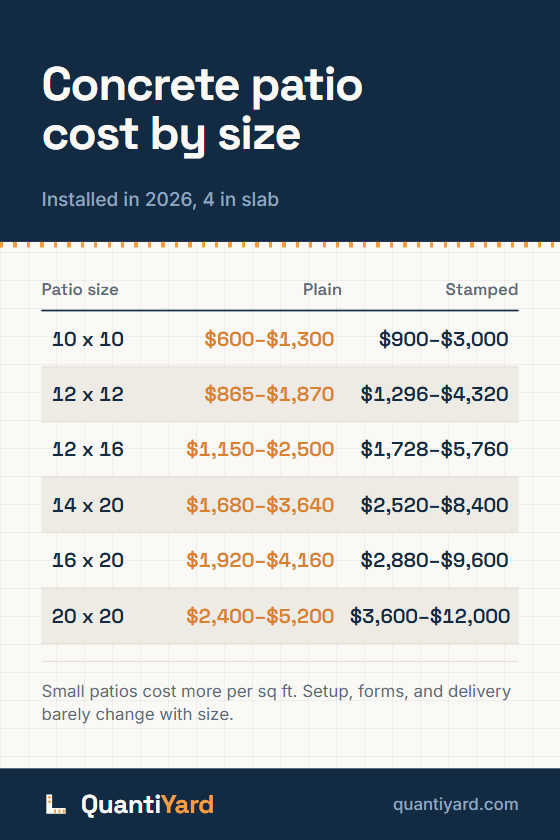
Save the patio cost chart#
Installed cost for six patio sizes, plain broom finish against stamped. Save it and you can sanity check a quote on the spot.
Save to PinterestOpens Pinterest with the chart and link ready to go.
Common questions#
How much does a 12x12 concrete patio cost?#
A 12 by 12 foot patio is 144 square feet, which comes to roughly $865 to $1,870 with a plain broom finish and $1,296 to $4,320 stamped. It takes about 2 cubic yards of concrete at 4 inches thick with waste included.
Is a concrete patio cheaper than pavers?#
A plain broom-finish slab is usually the cheapest hard surface available, because it goes in as one continuous pour rather than piece by piece. Once you add stamping or staining, concrete and pavers land close enough that the decision comes down to looks and repairability. Pavers can be lifted and reset. Concrete cannot.
How long does a concrete patio last?#
Thirty years or more with a proper base and correctly cut control joints. Almost every patio that fails early failed underneath: an uncompacted base, no base at all, or drainage running the wrong way. That is why skimping on site prep to hit a lower quote is the worst trade available.
Can I pour a patio over an existing slab?#
Yes, if the existing slab is structurally sound. A bonded overlay of 1 to 2 inches costs $3 to $9 per square foot in a single color, or $6 to $10 for a decorative finish, and skips demolition entirely. If the old slab is heaved, settled, or cracked through, an overlay will telegraph the same cracks within a year or two.