Insulation Calculator
Find the R-value your climate zone calls for, how much of it you still need, and how many bags or batt packages that works out to.
Updated October 3, 2026 · Estimates for planning, not a quote
How insulation math works
R-value measures resistance to heat flow: higher R means less heat escaping in winter and less creeping in during summer. It stacks, so R-19 of old insulation plus R-30 of new gives you R-49. That's why the useful number isn't the target on its own, it's the gap between what you have and what you want.
Where the recommended numbers come from
The targets here follow ENERGY STAR's recommended home insulation levels, which are drawn from the 2021 International Energy Conservation Code. Attics run R-30 in zone 1, R-49 in zones 2 and 3, and R-60 from zone 4 north. Floors over unheated space go R-13 in zones 1 and 2, R-19 in zones 3 and 4, R-30 in zones 5 and 6, and R-38 in zone 7. Wood-frame walls run R-13 in the hot zones up to R-30 in the cold ones, and crawlspace walls go from not required in zones 1 and 2 up to R-19 of cavity insulation in zones 5 through 7.
Turning R-value into inches
Every material has an R-value per inch, so the depth you need is the gap divided by that figure. Blown fiberglass runs from about R-2.6 per inch at R-13 to R-2.9 at R-60, because it is blown denser for the higher values, so this calculator reads its depth straight off the Owens Corning AttiCat label rather than dividing by one figure. Blown cellulose reads its depth off the Greenfiber SANCTUARY attic card the same way, R-49 at 14.3 inches blown and 13.3 settled. Standard fiberglass batts run about R-3.2 and rigid foam board about R-5.0. Foam gets you the most R in the least space, which is why it's the usual answer when a cavity is too shallow to hit the target.
Where cavity depth matters
In an attic, depth is rarely a constraint: you can pile loose fill as deep as you like above the joists. In a wall, floor, or crawlspace, the framing sets a hard ceiling. A 2x4 wall gives you 3.5 inches, which tops out near R-13 to R-15 with batts no matter what the code table says. Zones 4 and up ask for R-30 walls, and the difference is meant to come from continuous rigid foam sheathing outside the framing, not from cramming more into the cavity. This calculator flags it when the cavity can't reach the target on its own.
Counting bags and packages
Loose fill is sold by the bag, and a bag covers less area the deeper you go, since the same material gets spread thinner across the floor. Blown fiberglass bag counts come from the coverage chart on the 27.5 lb AttiCat bag, which at R-49 is 39.9 square feet per bag at 17 inches. Cellulose bag counts come from the coverage chart on the same 25 lb SANCTUARY bag, which at R-49 is 14.1 square feet per bag, and the depth shown for cellulose is the initial depth to blow, with the settled depth from the same card. Batts are sold in packages sized by R-value, and rigid foam comes in 4x8 sheets covering 32 square feet each, layered up when you need more than 2 inches. Those two loose-fill charts belong to those two products: if you buy another brand of blown fiberglass or cellulose, install it to the depth and bag count on its own bag's chart, not to these.
Insulation is only half the job
Air sealing comes first. Insulation slows heat moving through a surface, but it does nothing about air pouring through gaps around recessed lights, plumbing chases, and the top plates of interior walls. Seal those with caulk and foam before you add depth, or you'll pay for R-value that leaks straight past. If you're sizing heating and cooling for the same house, the BTU and HVAC sizing calculator covers the other side of that equation.
A basement wall is a below-grade concrete wall and does not behave like a framed wall above ground. Our basement finishing cost guide covers why rigid foam goes against the concrete before any framing does, and what the whole assembly costs.
Having the roof done? A tear-off is the cheapest moment in the life of a house to deal with attic insulation, because the attic is open and the crew is already there. Our roof replacement cost guide covers why the two jobs belong together.
Deciding between loose fill and batts? Our blown-in vs. batt comparison prices both to R-49, explains why batts win on R per inch and still lose in an attic, and gives separate answers for attics and walls.
Sizing a system after insulating? Our mini-split vs. central AC comparison covers why a well-sealed house often needs half a ton to a ton less than a rule of thumb suggests, and why the insulation belongs before the equipment order rather than after.
Insulating before replacing a system is the right order, because a tighter envelope needs less equipment. Our AC size chart shows the tonnage a house needs by size and climate, and why reducing the load beats buying capacity to meet it.
Method and sources
Where these figures come from: ENERGY STAR recommended R-values, from 2021 IECC Table R402.1.3. Blown fiberglass depth and bag coverage come from the Owens Corning AttiCat PINK Product Data Sheet, May 2026. Cellulose depth and bag coverage come from the Greenfiber SANCTUARY attic card, Rev K, for the 25 lb bag, read row by row the same way.
The recommended R-value is a lookup on your climate zone and where the insulation is going. Depth is the shortfall against that target, read off the AttiCat label minimum thickness for blown fiberglass and the Greenfiber card for cellulose, and divided by R per inch for batts and foam. Cellulose is shown at the initial depth to blow, with the settled depth from the same card. Cellulose bags use the same card's maximum net coverage per 25 lb bag. Per-bag coverage varies by manufacturer, so the chart on the bag wins over the figure here.
QuantiYard writes its own formulas and states them in plain language on every page. How these numbers are made covers where the constants come from, how waste factors are chosen, what these calculators deliberately do not do, and how to report an error.
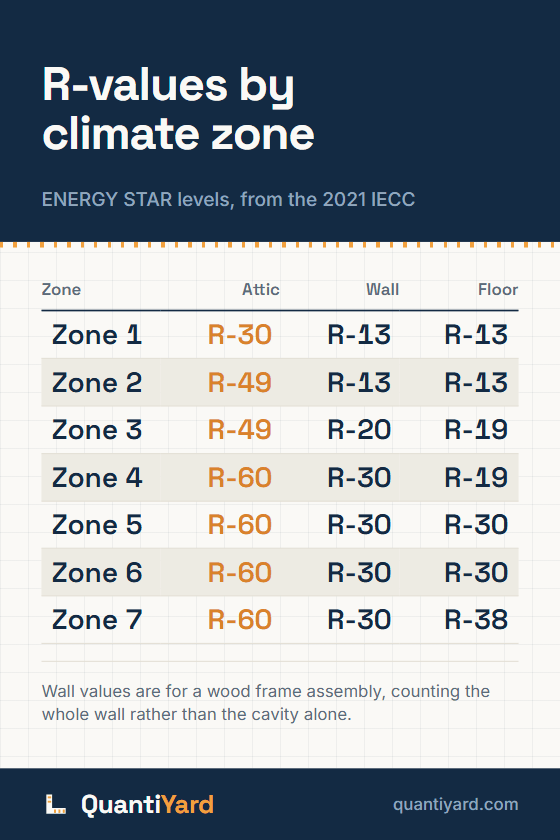
Save the R-value chart
Attic, wall and floor R-value targets for all seven US climate zones. Save it before you buy a single bag.
Save to PinterestOpens Pinterest with the chart and link ready to go.
Insulation calculator FAQ
What R-value do I need in my attic?
It depends on your climate zone. ENERGY STAR and the 2021 IECC put attics at R-30 in zone 1, R-49 in zones 2 and 3, and R-60 in zones 4 through 8. If you already have some insulation, you only need to add the difference between what you have and the target.
How many bags of blown-in insulation do I need?
Divide your attic area by the coverage per bag at your target depth. A bag of AttiCat blown fiberglass covers 68.5 square feet at R-30 and 39.9 square feet at R-49, while cellulose covers far less per bag because it goes in denser. Always check the coverage chart printed on the bag, since it varies by manufacturer.
Can I add new insulation over old insulation?
Yes, in an attic you can blow new loose fill or lay unfaced batts right over existing insulation, and the R-values add together. Do not add a second faced batt on top, because the second vapor retarder can trap moisture. Use unfaced material for any layer going over insulation that is already there.
Cite this page
Built from this page's own title, URL and last-updated date, so a citation cannot drift from what it cites.