The quick answer#
Finishing a basement costs $30 to $50 per square foot on HomeGuide's figures and $7 to $23 on HomeAdvisor's, and both surveys put most projects between $15,000 and $75,000. A 1,000 square foot basement is $30,000 to $50,000 at HomeGuide's rate and $7,000 to $23,000 at HomeAdvisor's.
HomeGuide
$30–$50per sq ftHomeAdvisor
$7–$23per sq ftMost projects
$15,000–$75,000both surveys1,000 sq ft, HomeGuide
$30,000–$50,000at $30 to $50That is an enormous spread for the same square footage, and the reason is that "finished basement" covers everything from drywall and carpet over a dry slab to a full second living floor with a bathroom, a wet bar, and a home theatre. The structural shell is free. Everything you add inside it is not.
Fix the water before you price anything else
Every figure on this page assumes a dry basement. If yours takes water, the finishing budget is the second conversation. An interior drain cut into the floor runs $40 to $85 per linear foot, so $4,000 to $8,500 for 100 feet, plus $500 to $1,800 for a sump pump; a deep drain dug down to the footings outside runs $30 to $90 per foot. Both are cheaper than doing them after the drywall is up. A basement that leaks once a year will destroy a $60,000 finish, and no amount of good framing changes that.
Cost per square foot#
Two national surveys price basement finishing, and they disagree by a wide margin on the rate while agreeing on what most projects cost in total.
| Survey | Per sq ft | Most projects |
|---|---|---|
| HomeGuide | $30–$50 | $15,000–$75,000 |
| HomeAdvisor | $7–$23 | $15,000–$75,000 |
Neither survey splits its range into finish levels, so this page does not either. Because they agree on the total and not on the rate, the useful way to budget is the line by line breakdown below, priced against your own scope.
The biggest single line inside either range is the bathroom. Adding one to a basement means breaking the slab for drain lines or installing an ejector pump. HomeGuide puts a medium to large full bathroom at $8,000 to $25,000, plus $2,000 to $5,500 for an ejector pump where the drain sits below the sewer line.
Cost by basement size#
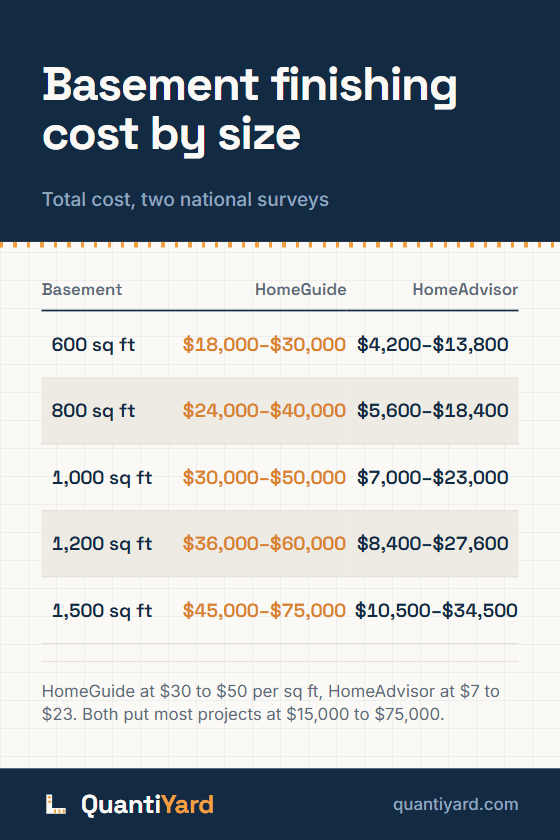
Cost scales close to linearly with area at either rate, because the expensive parts, framing and drywall and flooring, are all area-driven. The bathroom is the one fixed cost that does not scale, which is why a small basement with a bath carries a higher effective rate per square foot.
| Basement size | HomeGuide, $30–$50 | HomeAdvisor, $7–$23 |
|---|---|---|
| 600 sq ft | $18,000–$30,000 | $4,200–$13,800 |
| 800 sq ft | $24,000–$40,000 | $5,600–$18,400 |
| 1,000 sq ft | $30,000–$50,000 | $7,000–$23,000 |
| 1,200 sq ft | $36,000–$60,000 | $8,400–$27,600 |
| 1,500 sq ft | $45,000–$75,000 | $10,500–$34,500 |
Totals are the per-square-foot ranges applied to each area, so they carry the same spread. They cover the finish only, not water remediation, not structural work, and not a new HVAC system if the existing one cannot carry the extra load.
Where the money goes#
Here is a 1,000 square foot basement with a full bathroom and an egress window, broken out by trade. The numbers are what a contractor pays plus margin, so a DIY column tells you which lines are worth taking on.
| Line item | Contractor | DIY materials |
|---|---|---|
| Framing, walls and soffits | $1,100–$4,500 | — |
| Insulation, walls and rim | $1,040–$4,680 | $520–$3,328 |
| Electrical rough and finish | $2,000–$13,500 | Licensed work |
| Full bathroom, medium to large | $8,000–$25,000 | Licensed work |
| Drywall, hung and finished | $1,500–$7,000 | $525–$1,750 |
| Flooring, LVP | $4,000–$16,000 | $2,000–$10,000 |
| Painting | $800–$2,500 | — |
| Doors | $225–$1,900 | — |
| Egress window and well | $6,000–$8,000 | — |
| Ceiling, drywall | $1,000–$6,000 | — |
| Permits | $280–$1,850 | $280–$1,850 |
| Total of the lines above | $25,945–$90,930 | — |
The contractor column includes labor, materials, and margin. The DIY column is materials only, and is left blank where the work is licensed or where no published figure splits the line into labor and materials. Insulation is 1,040 square feet of wall (130 linear feet at 8 feet) at the $1.00 to $4.50 installed and $0.50 to $1.30 labor in our insulation cost guide; drywall is HomeGuide's $1,500 to $7,000 for a 1,000 square foot basement with labor at 65 to 75 percent, as in our drywall cost guide; flooring is LVP at the $4 to $16 installed and $2 to $10 material in our flooring cost guide. Electrical, painting, doors and the drywall ceiling are HomeGuide's basement figures; the bathroom is its medium to large full bath, $8,000 to $12,500 and $10,000 to $25,000; egress is its egress guide; permits are the three in the permit table below. Framing is HomeGuide's $1,100 to $4,500. The lines add to $25,945 to $90,930, against $30,000 to $50,000 at HomeGuide's per square foot rate and $7,000 to $23,000 at HomeAdvisor's: those totals are a rate applied to the area rather than a sum of these lines, so read this table as where the money goes rather than as a second estimate. Electrical and plumbing in a finished basement are inspected work in essentially every jurisdiction, and an unpermitted basement is a problem at resale, not just at inspection.
Three lines dominate at the top of their ranges: the bathroom at $8,000 to $25,000, the flooring at $4,000 to $16,000, and the electrical at $2,000 to $13,500. Framing is smaller than people expect, $1,100 to $4,500 on HomeGuide's figures for roughly 130 linear feet of new wall, and the wall framing calculator will give you the stud, plate, and header counts for each run so the lumber order is not a guess. Drywall is the next one: HomeGuide puts a 1,000 square foot basement at $1,500 to $7,000 hung and finished, and with labor at 65 to 75 percent of that, doing it yourself keeps $975 to $5,250.
Size the drywall order
Sheets, mud, and screws for the whole basement
Enter the room dimensions and tick the ceiling to get sheet counts, joint compound, and screws for each space.
Insulation is where basements are different#
A basement wall is a below-grade concrete wall, and it does not behave like a framed wall above ground. Code in most climate zones asks for R-13 to R-19 on a basement wall, and the way you get there matters more than the number: rigid foam against the concrete, then a framed wall inboard of it, keeps the framing off the cold surface and stops condensation forming inside the cavity. Fiberglass batts alone against bare concrete is the single most common basement mistake and it is a mold problem waiting to happen.
The insulation calculator gives the recommended R-value for your climate zone and works out how many inches of each material gets you there. For a basement wall it is the wall figure you want, not the attic one, and rigid foam at R-5 per inch is what makes the assembly work in a shallow cavity.
Get the R-value right
Recommended R-value and material depth by zone
Pick your climate zone and the application to get the target R-value, the inches needed, and the bag or board count.
Flooring over a slab#
Basement flooring has one rule the rest of the house does not: it has to survive getting wet. Luxury vinyl plank is the default for this reason, at $4 to $16 per square foot installed, and engineered wood and carpet both work over a dry slab with the right underlayment. Solid hardwood does not belong on a slab at all. The flooring calculator works out boxes from the area and the waste factor, which for a basement is usually the straight-layout 10 percent rather than the 15 a diagonal layout needs.
Egress and permits#
If any room in the finished basement will be used as a bedroom, it needs an egress window, and this is not negotiable. The 2024 International Residential Code sets a net clear opening of at least 5.7 square feet, at least 24 inches high and 20 inches wide (R319.2.1 and R319.2.2), with the bottom of the opening no more than 44 inches above the floor (R319.2.3). Below grade it also needs an area well, with a permanently fixed ladder or steps if the well is deeper than 44 inches (R319.4.2).
HomeGuide puts an egress window at $6,000 to $8,000 installed, covering the window, the well and the excavation, and over $10,000 on a complex job. Its basement finishing guide quotes $2,000 to $5,000 for an egress window without saying what that includes. It is the most commonly skipped item in an unpermitted basement finish and the one most likely to fail an appraisal, because a bedroom without egress cannot be counted as a bedroom when the house sells.
| Item | Typical cost |
|---|---|
| Basement finishing permit | $200–$1,000 |
| Electrical permit | $50–$350 |
| Plumbing permit | $30–$500 |
| Total of the three | $280–$1,850 |
These are HomeGuide's permit ranges. HomeAdvisor puts basement building permits at $1,200 to $2,000, usually covering the inspections. Many jurisdictions set the permit as a percentage of project value rather than a flat fee, which is why the ranges are so wide.
Unpermitted work is a resale problem, not a code problem
The inspector is not going to find your basement. The appraiser and the buyer's agent will. Unpermitted finished square footage cannot be included in the home's official square footage, which means the $75,000 you spent adds nothing to the appraised value, and a buyer's lender may require it to be brought up to code or torn out before closing. The $280 to $2,000 in permits is the cheapest insurance in the whole project.
What you can do yourself#
A basement is one of the better DIY projects because almost nothing in it is structural and almost nothing is visible from the street. Framing, insulation, drywall, flooring, trim, and paint are all within reach of a determined homeowner, and together they are most of the money.
Adding up the lines in the DIY column, insulation, drywall and flooring come to $3,045 to $15,078 in materials against $6,540 to $27,680 of contractor pricing for the same scope. That is a saving of $3,495 to $12,602 on a 1,000 square foot basement. Framing, trim, paint and the ceiling are within reach of a homeowner too, but no published figure splits their cost into labor and materials, so they are left out of that number rather than guessed at.
Two of those lines are worth sizing before you commit to doing them. Run each room through the drywall calculator with the ceiling ticked, because a basement ceiling is usually in scope and it is a third of the board on its own. Then run the floor area through the flooring calculator at the straight-layout 10 percent, since a basement is normally a simple rectangle and does not need the 15 a diagonal takes. Those two counts turn the biggest DIY line items into a supplier order rather than an estimate.
What to leave alone: the electrical, the plumbing, and the egress cut. Electrical and plumbing are licensed and inspected in essentially every jurisdiction. Cutting an egress opening means removing a section of load-bearing foundation wall, which needs a proper header and, in many cases, an engineer's sign-off. Those three lines are $16,000 to $46,500 of the project and they are where the risk lives.
Save the basement cost chart#
Five basement sizes priced at HomeGuide's and HomeAdvisor's per square foot rates side by side, so you can see the spread before you call anyone.
Save to PinterestOpens Pinterest with the chart and link ready to go.
Common questions#
How much does it cost to finish a 1,000 square foot basement?#
It is $30,000 to $50,000 at HomeGuide's $30 to $50 per square foot and $7,000 to $23,000 at HomeAdvisor's $7 to $23, and both surveys put most projects between $15,000 and $75,000. The biggest single line is a bathroom, which means breaking the slab or fitting an ejector pump and typically adds $8,000 to $25,000 on its own.
Is finishing a basement worth it?#
It is the cheapest square footage you can add to a house, because the shell already exists, and HomeGuide puts the typical return at 70 to 75 percent of its cost at resale. The two things that decide it are whether the basement is dry and whether the work was permitted. Unpermitted finished space cannot be counted in the home's official square footage, so it adds living space but not appraised value.
What is the biggest hidden cost in finishing a basement?#
Water, then the bathroom, then egress. An interior drain runs $40 to $85 per linear foot, plus $500 to $1,800 for a sump pump, and it must happen before any framing goes up. A bathroom adds $8,000 to $25,000 because a basement drain sits below the sewer line. An egress window for a bedroom is $6,000 to $8,000 and cannot be skipped if the room is going to be called a bedroom.
Do I need a permit to finish my basement?#
In essentially every jurisdiction, yes, and separate electrical and plumbing permits on top of the building permit. Permits total $280 to $1,850 on HomeGuide's figures and $1,200 to $2,000 on HomeAdvisor's, with inspections usually included. The reason to pull them is not the inspector, it is the appraiser: unpermitted finished square footage does not count toward the home's official size, and a buyer's lender can require it to be brought up to code before closing.