Drywall Calculator
Enter your room dimensions to get the number of 4×8 sheets, joint compound, and screws needed.
Updated September 12, 2026 · Estimates for planning, not a quote
How to estimate drywall
Add up your wall area (perimeter times height) plus the ceiling if you're finishing it, then divide by 32 square feet (the coverage of a standard 4×8 sheet) and round up. Add roughly 10% for cuts around outlets, doors, windows, and corners.
Mud and screws
Figure one gallon of joint compound per 100 square feet for a standard three-coat finish, which is what USG's own published coverage works out to, and about 32 screws per sheet at 16-inch stud spacing. Trade estimating often quotes 150 square feet to the gallon, and that is the lean end: coverage moves with finish level and with how heavy a hand the taper has. This calculator buys to 100, because a leftover bucket is a small cost and a mid-job store run is an afternoon.
Board and mud are the start of it, and paint is the finish. Our cost to paint a room guide covers what the painting runs once the walls are up, including why new drywall always needs a primer coat before any color goes on.
Doing a whole basement rather than one room? Our basement finishing cost guide puts drywall next to framing, insulation, and flooring line by line, and shows which of them are worth taking on yourself.
Method and sources
This page figures one gallon of joint compound per 100 square feet of surface, and that is the manufacturer figure rather than a trade allowance: the USG submittal sheet for Sheetrock Brand All Purpose Joint Compound puts coverage at approximately 10 gallons per 1,000 square feet of gypsum panels. Estimating houses commonly quote 150 square feet to the gallon, which is the lean end. Both are defensible, because coverage genuinely moves with finish level and with how heavy a hand the taper has, and the page buys to the heavier of the two on purpose: a leftover bucket is a small cost and running out mid-wall stops the job. About 32 screws per sheet at 16 inch spacing is trade practice and nothing publishes it.
A 4 by 8 sheet covers 32 square feet, which is arithmetic rather than an allowance. Wall area is twice length plus width times height, plus the ceiling when it is checked. Fastener spacing is set by GA-216-2024, Application and Finishing of Gypsum Panel Products, the Gypsum Association standard the International Building Code references, and by your inspector, and this page does not compute it: the screw count is a shopping figure, not a layout. GA-216 is a paid publication, so that link goes to where you buy it rather than to the text.
QuantiYard writes its own formulas and states them in plain language on every page. How these numbers are made covers where the constants come from, how waste factors are chosen, what these calculators deliberately do not do, and how to report an error.
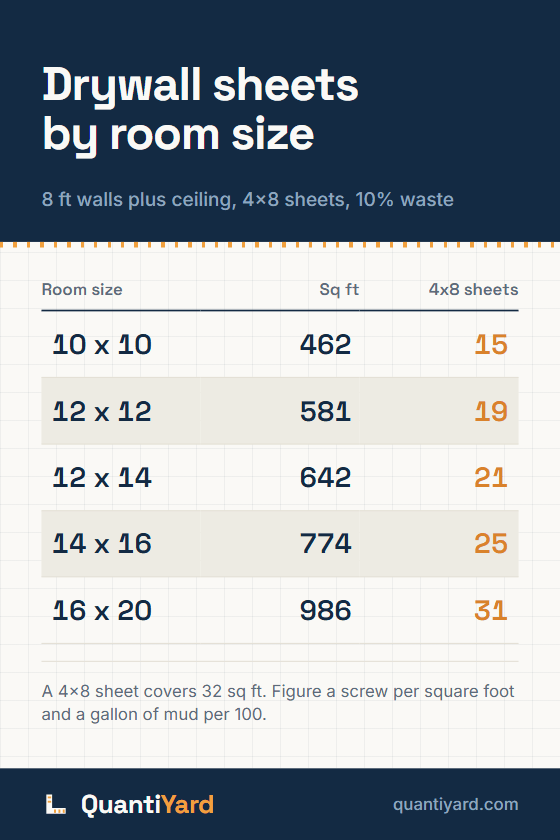
Save the drywall chart
Square footage and 4x8 sheet counts for five room sizes, ceiling included. Save it and you will not be one sheet short.
Save to PinterestOpens Pinterest with the chart and link ready to go.
Drywall calculator FAQ
How many sheets of drywall do I need per room?
Divide total wall (and ceiling, if finishing it) area by 32 square feet, round up, and add about 10% for waste.
How much joint compound do I need?
About one gallon per 100 square feet for a three-coat finish, so a 5-gallon bucket covers about 500 square feet. That is USG's own published coverage. Trade estimating often quotes 150 square feet to the gallon, which is the lean end of the range.
How many screws per sheet of drywall?
About 32 screws per 4×8 sheet at 16-inch stud spacing. Ceilings sometimes use tighter spacing and need more.
Cite this page
Built from this page's own title, URL and last-updated date, so a citation cannot drift from what it cites.