The quick answer#
In an attic at R-49, blown-in costs $0.87 to $1.26 per square foot in materials and batts cost $1.71 to $2.32. Blown-in is roughly half the price, goes down in an afternoon, and fills around joists and wiring that batts have to be cut around. In a wall, the answer depends entirely on whether the wall is open.
Blown-in attic, R-49
$0.87–$1.26per sq ft, materialsBatt attic, R-49
$1.71–$2.32per sq ft, materialsBlown fiberglass
R-2.8–2.9per inch, R-30 to R-60Fiberglass batt
R-3.2per inchThe interesting part is that batts have the better R-value per inch and are still the more expensive way to insulate an attic. That is because an attic has no depth constraint, so R per inch stops mattering, and everything else about the two products starts to.
R-value per inch#
This is the number that decides which product can reach a target in the space available, and it is the only place batts win outright.
| Material | R per inch | To R-30 | To R-49 | To R-60 |
|---|---|---|---|---|
| Fiberglass batt | 3.2 | 9.5 in | 15.5 in | Two layers |
| Blown fiberglass | 2.8 to 2.9 | 10.75 in | 17 in | 20.5 in |
| Blown cellulose | 3.6 to 3.7 settled | 8.9 in, settles to 8.3 | 14.3 in, settles to 13.3 | 17.3 in, settles to 16.1 |
| Rigid foam board | 5.0 | 6 in | 9.8 in | 12 in |
Batts are sold in standard sizes rather than by the inch: R-13 and R-15 at 3.5 in, R-19 at 6.25 in, R-21 at 5.5 in, R-30 at 9.5 in, and R-38 at 12 in. Blown fiberglass depths are the minimum thicknesses on the Owens Corning AttiCat label, May 2026, and its R per inch rises with depth because the higher values are blown denser. Cellulose depths are the initial and settled thicknesses on Greenfiber’s SANCTUARY attic card for the 25 lb bag, and its R per inch is the R-value over the settled thickness. Anything above R-38 in an attic means a second layer laid crosswise over the first.
Cellulose is the surprise on that table. It has the best R per inch of the three loose fills, which means it hits a target in less depth and matters in a shallow attic or a cathedral ceiling. It is also denser and heavier, which is worth knowing before loading a ceiling that was framed decades ago.
Start with the target
R-value, depth, and bag count by zone
Pick your climate zone and the application to get the recommended R-value, the inches you need, and the bags or batts it takes.
In an attic#
An attic is a floor with joists running across it and no depth limit above them, and that is the situation blown-in was designed for.
| Material | Depth | Coverage per bag | Cost per sq ft |
|---|---|---|---|
| Blown fiberglass | 17 in | 39.9 sq ft | $0.87–$1.26 |
| Blown cellulose | 14.3 in, settles to 13.3 | 14.1 sq ft | $0.92–$1.28 |
| Batts, R-38 plus R-13 | 15.5 in | 42.7 sq ft | $1.71–$2.32 |
Coverage per bag comes from the insulation calculator: blown fiberglass from the coverage chart on the 27.5 lb Owens Corning AttiCat bag, and cellulose from the coverage chart on Greenfiber's 25 lb SANCTUARY bag. Batt coverage is per bag of R-38 at 42.7 square feet. Installed by a contractor, blown-in attic insulation runs $0.90 to $2.40 per square foot and batts $0.80 to $2.60 (HomeGuide).
The cost gap is only half the story. The other half is that an attic floor is full of obstructions: joists at 16 or 24 inches, wiring runs, junction boxes, plumbing vents, bracing, and duct runs. Blown-in flows around every one of them and self-levels. Batts have to be cut to fit around each, and every cut that is even slightly off leaves a gap, and gaps in insulation cost far more performance than their area suggests. A batt job with 5 percent gaps loses far more than 5 percent of its R-value.
Blown-in also handles the awkward geometry near the eaves, where the roof deck comes down to meet the top plate and there is no room to stand, let alone to place a batt. That strip is where a lot of attics quietly have no insulation at all, and it sits directly over the exterior walls, which is the worst possible place for a gap.
Baffles first, always
Whatever goes in, the path from the soffit vents up to the ridge has to stay clear. Loose fill blown into the eaves will block soffit vents outright, and a blocked soffit vent turns a well-insulated attic into a moisture trap: warm damp air gets up there, has nowhere to go, and condenses on the underside of the deck. Install baffles at every rafter bay before the insulation goes in. They are a few dollars each and they are the difference between insulation working and insulation causing a problem.
In a wall#
The wall answer is different because a wall cavity has a fixed depth, is enclosed on both faces, and cannot be walked on.
An open wall#
If the studs are exposed, on new construction or a gut renovation, batts are the obvious choice. A 2x4 cavity takes an R-13 or R-15 batt at 3.5 inches, a 2x6 cavity takes an R-19 at 6.25 inches or an R-21 at 5.5, and the batt is sized to the cavity so there is nothing to calculate. Materials run about $0.88 to $1.18 per square foot at R-15. Blown-in in an open wall needs netting stapled over the studs and a blower, which is a professional setup for a marginal gain.
A closed wall#
If the drywall is staying up, batts are simply not an option, and dense-pack cellulose is the standard answer. Holes are drilled at the top of each stud bay, cellulose is blown in under pressure to at least 3.5 pounds per cubic foot, Greenfiber’s stated minimum, and the holes are plugged. Installed, this runs $2.00 to $2.30 per square foot on HomeAdvisor's and Fixr's figures, and $1.60 to $4.20 on HomeGuide's. It is genuinely good work: dense pack fills the cavity completely, including around wiring, and the density is what stops it settling later.
This is not a DIY job. Getting the density right requires a machine that most rentals are not, and under-packing produces a wall that settles in a few years and leaves an uninsulated strip along the top of every bay, which is exactly the strip that matters most.
| Situation | Use | Cost per sq ft |
|---|---|---|
| Open 2x4 wall | R-13 or R-15 batt | $0.88–$1.18 materials |
| Open 2x6 wall | R-19 or R-21 batt | $1.10–$1.55 materials |
| Open wall, netted | Blown fiberglass | $1.10–$3.70 installed (HomeGuide) |
| Closed wall | Dense-pack cellulose | $2.00–$2.30 installed, $1.60–$4.20 on HomeGuide’s figures |
| Basement wall | Rigid foam, then framing | $1.80–$3.20 materials |
A basement wall is the exception to all of this. It is a below-grade concrete wall, and rigid foam goes against the concrete first so the framing never touches the cold surface. Fiberglass batts straight against bare concrete is the most common basement insulation mistake and it is a mold problem waiting to happen.
Neither one air seals#
This is the most important paragraph on the page. Insulation slows heat conduction. It does not stop air moving, and air moving is where a large share of a house's heat actually goes.
Loose fill is often assumed to seal because it flows into gaps, and it does not: air passes through blown fiberglass almost freely, and through cellulose with more resistance but not none. Batts seal nothing at all. Piling R-60 over an unsealed attic floor is insulating a colander.
The order of operations is air seal first, then insulate. Caulk and foam the top plates, seal around every penetration, gasket or foam the attic hatch, and box and seal any recessed lights that are not rated for contact. That work costs a few hundred dollars in materials and routinely does more for comfort and bills than the insulation going over it. Once it is done, use the insulation calculator to work out what depth gets you to your zone's target from whatever is already up there.
Settling and coverage charts#
Loose fill settles, and the amount depends on the product. Modern blown fiberglass is stabilized and settles very little in an attic. Cellulose settles noticeably when loose-blown, which is why manufacturer charts specify a settled thickness and an installed thickness, and the installed one is higher.
The practical consequence is that a coverage chart on the bag beats any calculator, including ours. Bag volumes differ between manufacturers, and the chart on the bag is the one the manufacturer will stand behind for the R-value claim. The insulation calculator reads blown fiberglass straight off the Owens Corning AttiCat chart and cellulose straight off Greenfiber’s SANCTUARY chart for the 25 lb bag, but the bag in your hand is the authority. Blown fiberglass depths on this page come from the Owens Corning AttiCat label and cellulose from the Greenfiber SANCTUARY Attic Card; any other brand should be installed to its own bag's chart.
The other consequence is depth markers. Staple a few in the attic before you start blowing and check them as you go. Loose fill looks deeper than it is when it is freshly blown and fluffy, and the difference between the depth you think you laid and the depth you actually laid is often several R-values.
DIY and equipment#
Blowing an attic is one of the better DIY jobs in a house, which surprises people who assume it needs a contractor.
Most big box stores lend the blower free with a minimum purchase, usually 10 to 20 bags, and otherwise it rents for $100 to $200 a day (HomeGuide, HomeAdvisor). It is a two-person job: one feeding bags into the hopper at ground level, one in the attic with the hose. A 1,200 square foot attic to R-49 takes 31 bags of fiberglass and a long afternoon. Wear a respirator, long sleeves, and eye protection, work off boards laid across the joists, and do the air sealing on a different day, because you cannot do it once the insulation is down.
Batts in an attic are also doable and are worse work: more time on your knees, more cutting, and a much higher chance of leaving gaps. The case for batts in an attic is a small area, an attic you cannot get a hose into, or a floor you intend to walk on and store things over, where loose fill would just be displaced.
What it does to your HVAC sizing#
Insulation changes the load a heating and cooling system has to meet, which means it changes the size of system the house needs. This is the connection people miss, and it runs in an expensive direction if you get it backwards.
The rule-of-thumb sizing that most quick calculators use, including our BTU and HVAC sizing calculator, works off square footage, climate, ceiling height, and sun exposure. It does not have an input for insulation, and that is a real limitation rather than an oversight: rules of thumb assume an average house. A 1,500 square foot house in a moderate climate comes out at 37,500 BTU, or a 3.0 ton unit, whether it is insulated to R-13 or R-49 in the attic.
That is exactly why a Manual J load calculation exists, and why insulating before replacing a system rather than after is the right order. A properly insulated and air sealed house can often drop a half or full ton against the rule of thumb, and a smaller unit costs less to buy, less to run, and dehumidifies better because it runs longer cycles instead of short-cycling. Do the insulation first, then have the load calculated, then buy the equipment.
After the insulation
A first pass at the BTU and tonnage
Enter the area, climate, ceiling height, and sun exposure for a rule-of-thumb cooling and heating load, then have a Manual J done before buying.
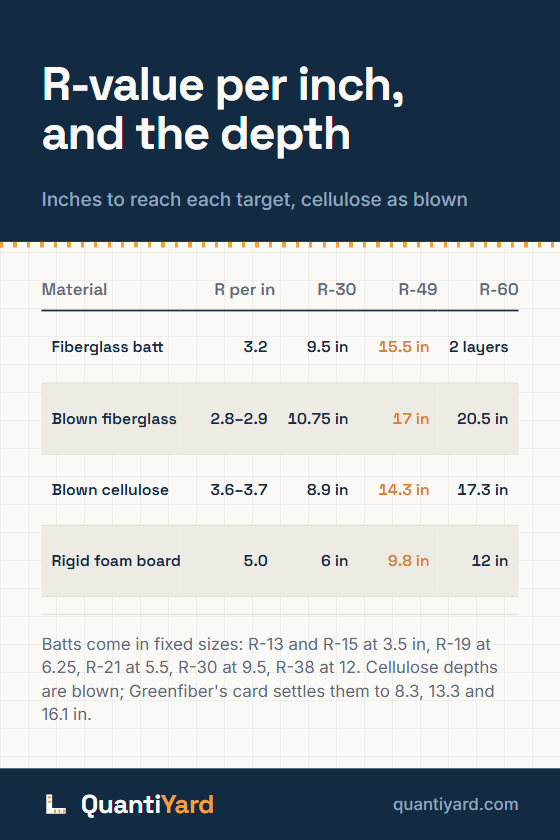
Save the R-value depth chart#
R-value per inch for four materials and the depth each needs to hit R-30, R-49, and R-60. Save it before you stand in the aisle guessing.
Save to PinterestOpens Pinterest with the chart and link ready to go.
Common questions#
Is blown-in insulation better than batts?#
In an attic, yes, on almost every measure. It is roughly half the price at R-49, $0.87 to $1.26 per square foot in materials against $1.71 to $2.32, it goes down in an afternoon, and it flows around joists, wiring, and boxes that batts have to be cut around. In an open wall cavity, batts are the better answer, because the cavity is a fixed size and a batt is made to fit it.
How many inches of insulation do I need for R-49?#
It depends on the material. Blown fiberglass needs 17 inches, the minimum thickness on the Owens Corning AttiCat label, blown cellulose is blown to about 14.3 inches and settles to 13.3 on Greenfiber's SANCTUARY attic card, and batts get there with an R-38 at 12 inches plus an R-13 laid crosswise over it, about 15.5 inches total. Above R-38, batts always mean two layers, because no single batt goes higher.
Does blown-in insulation settle?#
Cellulose does, noticeably, when it is loose-blown, which is why manufacturer charts give both an installed thickness and a settled one. Modern blown fiberglass is stabilized and settles very little in an attic. Dense-pack cellulose in a wall does not settle if it is packed to at least 3.5 pounds per cubic foot, Greenfiber’s stated minimum, and under-packing is exactly what causes a wall to settle and leave a gap along the top of every stud bay.
Do I need to air seal before insulating?#
Yes, and it matters more than the insulation does. Neither blown-in nor batts stop air moving: air passes through blown fiberglass almost freely and through batts entirely. Caulk and foam the top plates, seal every penetration, and gasket the attic hatch first. That work costs a few hundred dollars and routinely does more for comfort and bills than the insulation laid over it.