BTU / HVAC Sizing Calculator
Estimate the cooling and heating BTU your space needs from its size, ceiling height, climate, sun, and how many people use it.
Updated October 2, 2026 · Estimates for planning, not a quote
How to estimate the BTU you need
A BTU (British Thermal Unit) measures heating and cooling capacity: more BTU means more power to move heat in or out of a space. HVAC equipment is rated in BTU per hour, and air conditioners are also rated in tons, where one ton equals 12,000 BTU per hour.
The starting point
Cooling load starts from the floor area times a rate that depends on climate: roughly 20 BTU per square foot in a cool northern region, up to about 35 in a hot desert one. That figure is then adjusted for the factors that change how hard the system works: a taller ceiling means more air to condition, a sun-drenched room gains more heat, extra occupants each add warmth, and a kitchen adds a large fixed load from appliances.
Why right-sizing beats oversizing
It's tempting to buy the biggest unit you can, but an oversized air conditioner is a common and costly mistake. It cools the air quickly and shuts off before pulling out enough humidity, so the room feels cold and damp, and the constant short cycling wastes energy and shortens the equipment's life. An undersized unit simply can't keep up on the hottest days. The goal is the right size, not the biggest.
Treat this as a ballpark
This calculator gives a quick estimate, useful for choosing a window unit or a mini-split, or for sanity-checking a contractor's quote. It is not a substitute for a Manual J load calculation, the industry-standard method that accounts for insulation R-values, window type and orientation, air leakage, and ductwork. For a permanent central system, have a professional run one.
This rule of thumb cannot see your insulation, which is one reason a Manual J load calculation exists. Our blown-in vs. batt insulation comparison covers what it costs to bring an attic up to target, and why doing that before sizing equipment can drop half a ton off the system you buy.
Deciding between ductless and ducted? Our mini-split vs. central AC comparison prices both by number of zones, covers the 20 to 30 percent that attic ductwork loses, and is clear that whether the house already has ducts decides this more often than any spec does.
Want the answer as a lookup rather than a form? Our AC size chart runs this same formula across eight house sizes and all four climate zones, and is explicit about what a square footage chart cannot see. Once you know the size, our AC replacement cost guide prices central air by tonnage, tier and efficiency.
Method and sources
Where these figures come from: ACCA Manual J is the method real equipment is sized with. This page is the rule of thumb that comes before it.
Cooling load is floor area times a BTU per square foot figure for the climate, adjusted for ceiling height and sun, plus 600 BTU for each occupant over two and 4,000 for a kitchen. Those per square foot figures are trade rules of thumb and take no account of insulation, windows or air sealing, which is exactly what Manual J adds.
QuantiYard writes its own formulas and states them in plain language on every page. How these numbers are made covers where the constants come from, how waste factors are chosen, what these calculators deliberately do not do, and how to report an error.
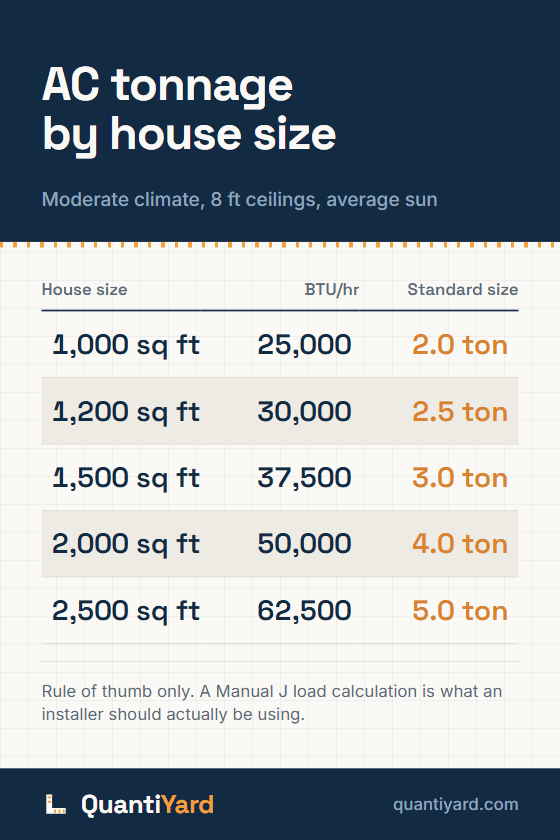
Save the AC sizing chart
BTU and standard tonnage for five house sizes in a moderate climate. Save it and check a contractor quote against it.
Save to PinterestOpens Pinterest with the chart and link ready to go.
BTU calculator FAQ
How many BTU do I need per square foot?
For cooling, about 20 BTU per square foot in a mild climate, up to 30 to 35 in a hot one, adjusted for ceiling height, sun, and occupancy. These are estimates, not an equipment spec.
What size air conditioner do I need?
Divide the cooling BTU by 12,000 to get tons, then round to the nearest standard size. A 1,500 square foot home in a moderate climate often lands near 3 tons, but insulation and windows shift that.
Is a bigger air conditioner always better?
No. An oversized unit cools fast but shuts off before removing humidity, leaving the space cold and clammy, and the short cycling wastes energy and wears the equipment. Right-sizing matters more than going big.
Cite this page
Built from this page's own title, URL and last-updated date, so a citation cannot drift from what it cites.