The quick answer#
A single-zone mini-split costs $2,500 to $6,000 installed. Central air on existing ductwork costs $5,000 to $12,500. Central air that needs new ductwork costs $9,000 to $16,000, which is the number that decides most of these decisions.
Mini-split, one zone
$2,500–$6,000installedMini-split, 3 zones
$6,500–$11,000installedCentral, existing ducts
$5,000–$12,500installedCentral, new ductwork
$9,000–$16,000installedSo the first question is not which system is better. It is whether the house has usable ducts. If it does, central air is usually the cheaper way to cool the whole house and the comparison gets genuinely close. If it does not, running ductwork through a finished house is invasive, expensive, and often means soffits and dropped ceilings that were not part of the plan.
Side by side#
| Factor | Mini-split | Central AC |
|---|---|---|
| Installed, one zone or one house | $2,500 to $6,000 | $5,000 to $12,500 |
| Installed, no existing ducts | $10,000 to $15,000 for five zones | $9,000 to $16,000 |
| Each additional zone | $2,500 to $5,000 per wall-mounted zone | $1,700 to $4,500 for damper zoning |
| Efficiency | Inverter driven, typically above the minimum | 13.4 SEER2 minimum, 14.3 in the Southeast and Southwest |
| Duct losses | None | 20 to 30 percent in an unconditioned attic |
| Retrofit difficulty | A small hole per head for the line set | Invasive without existing ducts |
| Heating | Built in, as a heat pump | None, needs a furnace |
| Appearance | A visible head in every room | Registers only |
| Filtration | A small washable filter per head | Whole-house media filter |
SEER2 is the current efficiency metric, required on central air conditioners made since January 1, 2023. The federal minimum for a new split-system central AC under 45,000 Btu/hr is 13.4 SEER2, and 14.3 in the Southeast and Southwest.
Ductwork decides it#
Ducts are the whole comparison, and they cut both ways.
If the house has them and they are in reasonable condition, central air is the straightforward answer. One outdoor unit, one air handler, existing registers, and the cooling is invisible. Nothing hangs on a wall. The cost is $5,000 to $12,500 and the installation takes a day or two. Our AC replacement cost guide breaks that down by tonnage and efficiency.
If the house does not have them, adding them is a construction project rather than a mechanical one. Ducts have to travel from a central air handler to every room, and in a house with no chases that means soffits along ceilings, a dropped ceiling in a hallway, or losing a closet on each floor. HomeGuide puts a duct retrofit alone at $2,400 to $6,600 and central air with new ductwork at $9,000 to $16,000 installed, and the drywall and paint around it can run past that. A mini-split needs a small hole per head and a line set run down an exterior wall.
The duct losses nobody quotes
Ductwork in an unconditioned attic loses 20 to 30 percent of the air it carries, through leakage at the joints and heat gain through the duct walls. A 3 ton system with attic ducts is delivering something closer to 2.2 tons where you want it, and you are paying to cool an attic. Sealing and insulating existing ducts costs far less than replacing a system and is usually the highest-return thing you can do to central air. A mini-split has no ducts and therefore none of this loss, which is a real part of why its rated efficiency translates better into an actual bill.
Zoning and cost per zone#
A standard central system is one zone: one thermostat, one temperature, the whole house. That is fine in a house that behaves uniformly and a genuine problem in one that does not, which is most houses with a second floor, a west-facing room, or an addition.
Mini-splits are zoned by construction. Every head is its own zone with its own thermostat, so an unused guest room costs nothing to not cool and a hot office over the garage can run harder than the rest of the house. A wall-mounted zone runs $2,500 to $5,000 installed, and a multi-zone system needs a larger and more expensive outdoor unit than a single-zone one.
Central air can be zoned with motorized dampers and multiple thermostats for $1,700 to $4,500, which works well and is under-specified in most retrofits. It is worth asking about if the complaint about the current system is that the upstairs is always warm.
| Zones | Mini-split | Central AC |
|---|---|---|
| 1 zone or whole house | $2,500–$6,000 | $5,000–$12,500 |
| 2 zones | $4,500–$8,000 | $6,700–$15,300 |
| 3 zones | $6,500–$11,000 | $7,200–$16,000 |
| Whole house, no ducts | $10,000–$15,000 | $9,000–$16,000 |
Central AC zone figures are the base system plus damper zoning added to it, and the whole-house mini-split figure is a five-zone system. The last row is the case that matters most: with no existing ductwork, a whole-house mini-split system and a fully ducted central system land in overlapping ranges, and the choice becomes about how you want to live with it rather than what it costs.
Efficiency and running cost#
Mini-splits are more efficient, and the gap is larger in practice than the ratings suggest.
On the rating alone, mini-splits typically sit well above the 13.4 SEER2 federal minimum that a basic central system is built to. That is because they use inverter-driven variable-speed compressors that modulate output continuously, rather than a single-speed compressor that is either on at full output or off. Modulating means longer, gentler cycles, which is both more efficient and much better at removing humidity.
Then add the ducts back in. A central system's rated efficiency is measured at the air handler, not at the register, so the 20 to 30 percent lost in attic ductwork comes off the real number. A 16 SEER2 central system with leaky attic ducts can deliver less useful cooling per dollar than a 20 SEER2 mini-split with none.
The counterweight is filtration and air distribution. A central system moves and filters the air in the whole house through one media filter, which matters for allergies and for keeping rooms with closed doors from stagnating. Mini-split heads each have a small washable filter and only move the air in their own room. A house with mini-splits and no ventilation strategy can have noticeably worse air distribution than a ducted one.
Worth saying plainly before any of this decides anything: the cheapest efficiency upgrade in most houses is not the equipment. An attic short of its target R-value wastes more every month than the difference between a 16 and a 20 SEER2 unit will ever recover, and it costs a fraction as much to fix. Run the attic through the insulation calculator before you spend anything on a bigger efficiency number.
Heating capability#
This is the largest functional difference on the list and the one most often missed. Central air conditioning cools. It does not heat, and it needs a furnace or a separate heat pump to do so.
Almost every mini-split sold today is a heat pump, which means it heats as well as it cools, at the same efficiency advantage. Standard models produce useful heat down to about 5 degrees Fahrenheit, and cold-climate models are rated to keep working well below zero. In a mild or moderate climate, a mini-split can replace both the cooling and the heating in a space, which changes the comparison completely: you are not comparing an air conditioner to an air conditioner, you are comparing a whole HVAC system to half of one.
That is why mini-splits so often win in an addition, a garage conversion, a finished attic, or a sunroom. Extending both a duct run and a heating system into a new space is a large job. One mini-split head does both, and it does not care that the rest of the house has a furnace.
Noise and appearance#
Mini-split indoor heads run 19 to 32 decibels, which at the low end is quieter than a whisper and genuinely hard to hear. Central registers run 40 to 55 decibels, most of which is air noise rather than the equipment. For a bedroom, that difference is the one people comment on after living with it.
The tradeoff is that the head is on the wall. A mini-split head is roughly the size of a long wall cabinet, mounted high, and it is visible in a way a register is not. Ceiling cassettes and low-wall units exist and cost more. Some people stop seeing them in a week and some never do, and it is worth looking at one in person before committing four of them to a house.
There is also a line set running from each head to the outdoor unit, usually in a covering on the exterior wall. On a rear elevation nobody sees, this is nothing. On a street-facing wall of a house where appearance matters, it is worth planning the routing before the installer picks the shortest path.
Sizing comes before shopping#
Whichever way this goes, an oversized system is the most common and most expensive mistake in residential HVAC, and it is more damaging with central air than with a mini-split.
An oversized single-speed system cools the air to the thermostat setpoint fast and shuts off, which sounds good and is not. Short cycles do not run long enough to pull humidity out, so the house ends up cold and clammy, and the equipment wears faster from the starting and stopping. A modulating mini-split is more forgiving because it can throttle down, but an oversized one still costs more than it needed to.
Start with a rough figure from our BTU and HVAC sizing calculator: a 1,500 square foot house in a moderate climate comes out at 37,500 BTU, which is a 3.0 ton unit. Use that to sanity check what a contractor proposes, then insist on a Manual J load calculation before anything is ordered. If a contractor sizes off square footage alone and will not do one, that is a reason to call somebody else.
The other half of sizing is the envelope, and it is the part you can change. A rule of thumb cannot see your insulation, which is exactly why a properly insulated and air sealed house often needs a half or full ton less than the rule suggests. Our blown-in vs. batt insulation comparison covers what it costs to get an attic to its target, and the insulation calculator gives the depth and bag count for your climate zone. Doing that first and then sizing the system is the order that saves money twice, once on the equipment and again every month.
Before you get quotes
A first pass at BTU and tonnage
Enter the area, climate, ceiling height, and sun exposure for a rule-of-thumb cooling and heating load to check a contractor's proposal against.
When each one wins#
Mini-split when#
There is no existing ductwork, which is the single biggest one. You are conditioning an addition, a garage conversion, a finished attic, or a sunroom, where extending ducts and heat is a project in itself. There is one problem room, hot, cold, or over a garage, and the rest of the house is fine. You want zoning without a ducted zoning system. You need heating and cooling from one piece of equipment. Or the house is a older one with plaster walls and no chases, where the drywall damage from ducting is the real cost.
Central AC when#
The house already has ducts in reasonable condition, which makes it the cheaper whole-house answer. You have an existing furnace that shares the air handler, so the cooling is genuinely an add-on. Filtration matters, for allergies or air quality. You do not want equipment visible in living spaces. Or the house is being built or gutted anyway, so ductwork can go in during framing at a fraction of the retrofit price.
The middle answer#
Keeping a working central system and adding one mini-split to the room it never handled is extremely common and usually the cheapest fix available. A single head at $2,500 to $6,000 solves a hot upstairs bedroom or a west-facing office without touching the rest of the system, and it does not commit you to anything. If the central system is near end of life anyway, that head is also a working test of whether you would want the whole house on mini-splits.
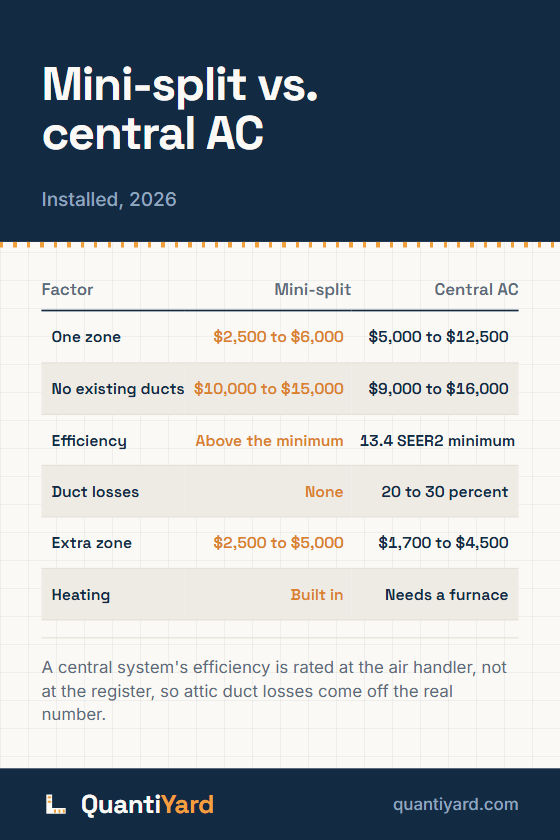
Save the HVAC comparison#
Cost, efficiency, duct losses, noise, and heating for both systems side by side. Save it before you take a single HVAC quote.
Save to PinterestOpens Pinterest with the chart and link ready to go.
Common questions#
Is a mini-split cheaper than central AC?#
For one room or one zone, yes: $2,500 to $6,000 installed against $5,000 to $12,500 for a whole central system. For a whole house that already has ductwork, central is usually cheaper. For a whole house with no ductwork, they land in overlapping ranges, $10,000 to $15,000 for a five-zone mini-split against $9,000 to $16,000 for central air with new ducts, and the decision stops being about price.
Do mini-splits heat as well as cool?#
Almost all of them do, because almost every mini-split sold today is a heat pump. Standard models produce useful heat down to about 5 degrees Fahrenheit and cold-climate models work well below zero. Central air conditioning does not heat at all and needs a furnace or a separate heat pump alongside it, which is why a mini-split so often wins in an addition or a converted space.
Are mini-splits more efficient than central air?#
Yes, on two counts. Inverter-driven compressors modulate output rather than cycling on and off, which is why mini-splits typically rate well above the 13.4 SEER2 federal minimum for central air. And they have no ducts, so they avoid the 20 to 30 percent that ductwork in an unconditioned attic loses to leakage and heat gain. A central system's rating is measured at the air handler, not at the register.
What size air conditioner do I need?#
A rule of thumb puts a 1,500 square foot house in a moderate climate at 37,500 BTU, or a 3.0 ton unit. Use that to check a proposal, not to buy from. Insist on a Manual J load calculation, because rules of thumb cannot see your insulation, your windows, or your air sealing, and a well-sealed house often needs half a ton to a ton less. Oversizing is the most common mistake in residential HVAC.