The quick answer#
Most homeowners pay $1.00 to $4.50 per square foot for insulation installed in 2026. Fiberglass or cellulose batts and rolls run $0.80 to $2.60, blown-in runs $1.00 to $2.80, and spray foam runs $1.00 to $4.50.
Batt and roll, installed
$0.80–$2.60per sq ftBlown-in, installed
$1.00–$2.80per sq ftSpray foam, installed
$1.00–$4.50per sq ftRigid foam board, installed
$1.20–$3.70per board ftHomeGuide puts the average whole-house job at $1,600 to $8,000. The spread inside each type comes mostly from R-value, because a higher R-value means more material in the same square foot: an attic in a cold zone wants R-60, which is about twice the depth of an attic in Florida. Work out the R-value your zone calls for before you compare prices, because two quotes for "insulating the attic" at R-38 and R-60 are not the same job. The insulation calculator looks it up by climate zone and turns it into a depth and a bag or batt count.
Before you price anything
Find the R-value your zone wants, and how much material reaches it
Pick your climate zone and where the insulation goes to get the target R-value, the depth, and the bags or batts it takes.
Cost by insulation type#
The type sets both the rate and where it can go. Batts need an open cavity, blown-in suits attic floors and closed walls, and spray foam and rigid board are the answer where moisture or air leakage matters as much as R-value.
| Type | Installed | Material only | Where it fits |
|---|---|---|---|
| Batt and roll | $0.80–$2.60 | $0.30–$1.30 | Open wall, floor and rafter cavities. Fiberglass is the cheapest and the most DIY-friendly. |
| Blown-in | $1.00–$2.80 | $0.30–$1.80 | Attic floors and closed walls. Fills around joists, wiring and odd shapes. |
| Spray foam | $1.00–$4.50 | $0.30–$1.00 per board ft | Rim joists, roof decks, crawl spaces. Closed cell also blocks moisture. |
| Rigid foam board | $1.20–$3.70 per board ft | $0.25–$0.75 per board ft | Basement walls and under new siding. The highest R-value per inch. |
| Radiant barrier | $0.30–$2.00 | — | Hot-climate attics. Blocks radiant heat only, so it adds to insulation rather than replacing it. |
Installed figures are HomeGuide's national ranges. Material figures are HomeGuide's prices for fiberglass (batts), fiberglass and cellulose (blown-in), open and closed cell polyurethane (spray foam) and polystyrene to polyiso (rigid board). A board foot is one square foot one inch thick, so spray foam and rigid board are priced by depth as well as area. HomeGuide's own spray foam section quotes $1.50 to $5.00 installed; the $1.00 to $4.50 above is its comparison table.
The R-value targets, in one table
ENERGY STAR's retrofit levels for an uninsulated attic, from the 2021 IECC, are R30 in zone 1, R49 in zones 2 and 3, and R60 in zones 4 through 8. With 3 to 4 inches already down, the amount to add drops to R25, R38 and R49. A zone 5 attic quoted at R-38 is under the target by a third, and that is a common way a cheap quote gets cheap.
Cost by attic size#
The attic floor is where most insulation money goes, and it scales straight with area. The figures below apply each type's installed range to five common attic sizes. A small job does not get a lower total than a contractor's minimum, and HomeGuide notes that some insulation companies carry a $1,500 to $2,000 minimum project fee.
| Attic floor | Batt and roll | Blown-in | Spray foam |
|---|---|---|---|
| 500 sq ft | $400–$1,300 | $500–$1,400 | $500–$2,250 |
| 1,000 sq ft | $800–$2,600 | $1,000–$2,800 | $1,000–$4,500 |
| 1,200 sq ft | $960–$3,120 | $1,200–$3,360 | $1,200–$5,400 |
| 1,500 sq ft | $1,200–$3,900 | $1,500–$4,200 | $1,500–$6,750 |
| 2,000 sq ft | $1,600–$5,200 | $2,000–$5,600 | $2,000–$9,000 |
Ranges multiply the per square foot figures above by the floor area, so they carry the same spread. They cover the insulation only: removing old material, air sealing and baffles are separate lines, priced below.
Walls are priced the same way but measured differently. HomeGuide puts all the exterior walls of a typical house at $1,400 to $8,500, at $0.80 to $4.60 per square foot, with blown-in or dense-pack the method when the drywall is staying up and batts the method when it is coming down. If the wall is open anyway, price the board with the drywall calculator in the same sitting, because the insulation and the drywall go in back to back.
What moves the price#
R-value and depth#
Every step up in R-value is more material over the same floor. On the Owens Corning AttiCat label the insulation calculator uses, blown fiberglass reaches R-49 at 17 inches and R-60 at 20.5, and takes 31.5 bags per 1,000 square feet at R-60 against 25 at R-49, so a zone 6 attic takes roughly a quarter more material than a zone 3 attic of the same size. That is the main reason two attic quotes can differ by a lot without either being wrong.
Old insulation coming out#
Removing old insulation adds $1.00 to $2.00 per square foot on HomeGuide's figures and $1 to $3 on Fixr's, and all in, HomeGuide prices a full replacement at $2 to $8 per square foot. It is only needed when the old material is wet, moldy, contaminated by pests or compressed to nothing. Dry, intact insulation can stay, and new material goes on top of it.
Air sealing#
Air sealing an attic costs $350 to $3,000 on HomeGuide's figures. It is the work done before the insulation: foam around plumbing and wiring holes, caulk along top plates, a sealed hatch. Insulation slows heat moving through it, but warm air leaking through gaps goes straight past, which is why a good quote does the sealing first and lists it as its own line.
Access#
Crawl spaces, low-pitched attics and finished walls all cost more labor per square foot. HomeGuide puts crawl space and under-floor work at $1.00 to $4.50 per square foot, against $1 to $4 for an attic, because the crew is working on its back. A finished wall needs holes drilled, filled and patched, which is labor batts in an open stud bay never need.
New versus existing construction#
Insulating an open frame is the cheapest it will ever be: the cavities are exposed, batts drop in, and nothing has to be patched. Retrofitting the same wall later means drilling and dense-packing, or pulling the drywall. If a renovation is opening the walls anyway, that is the time to insulate them.
Materials by component#
Material prices per square foot from HomeGuide, before installation. The spread inside each line is R-value and product grade, so match the material to the depth your zone needs before comparing.
| Material | Price | R per inch |
|---|---|---|
| Fiberglass, batt or blown | $0.30–$1.30 per sq ft | 2.2–2.9 |
| Cellulose, batt or blown | $0.30–$1.80 per sq ft | 3.1–3.8 |
| Mineral wool | $1.00–$2.50 per sq ft | 3.2–4.1 |
| Open-cell spray foam | $0.30–$0.50 per board ft | 3.5–3.7 |
| Closed-cell spray foam | $0.90–$1.00 per board ft | 5.0–7.0 |
| Polystyrene board, XPS or EPS | $0.25–$0.70 per board ft | 3.6–5.0 |
| Polyiso board | $0.40–$0.75 per board ft | 6.0–8.0 |
A roll of fiberglass costs $20 to $90 and covers 40 to 75 square feet, per HomeGuide. Blown-in is sold by the bag, and the bag count comes from the depth rather than the area alone.
The bag count is where a DIY attic goes wrong, because coverage per bag falls as the depth rises. A 1,000 square foot attic blown to R-49 with fiberglass takes 26 bags at the AttiCat label's 39.9 square feet per bag, and the same attic to R-60 takes 32 at 31.8. The bag's own coverage chart is the final word, since coverage varies by manufacturer.
Counting bags or batts
How much material your area takes at your R-value
Enter the area, what is already there and the material, and get the depth, the bag or batt count, and the coverage you are buying.
DIY versus contractor#
HomeGuide puts insulation labor at $0.50 to $1.30 per square foot for attics, crawl spaces and batts, and Fixr says labor is 30 to 50 percent of a typical job. That share is what you are deciding whether to keep.
| Approach | Cost | Time |
|---|---|---|
| Contractor, installed | $1,000–$2,800 | A few hours |
| Labor inside that price | $500–$1,300 | — |
| DIY saving, national surveys | $560–$950 | A long day, two people |
Labor is HomeGuide's $0.50 to $1.30 per square foot applied to 1,000 square feet. The saving is Fixr's figure for a standard project; HomeAdvisor's is $575 to $750. HomeGuide and HomeAdvisor both put a blower rental at $100 to $200 a day.
Batts in an open wall and blown-in on an attic floor are both reasonable DIY work. Spray foam is not: it needs a two-part rig, protective gear and a trained hand, and badly mixed foam can off-gas and pull away from the framing. Most people who DIY an attic do the air sealing themselves first, because it is the part a rushed crew most often skips.
The two things to check before any insulation goes down
Recessed lights that are not rated for insulation contact need a cover or a clearance, and any bathroom or kitchen fan venting into the attic has to be ducted outside first, or the moisture ends up in the new insulation. HomeGuide puts a new roof vent at $200 to $700. Both are cheaper before the insulation is in than after.
Walls open for the insulation?
Count the drywall to close them back up
Enter the room and ceiling height to get sheets, screws and joint compound for the walls you just insulated.
Checking a quote in two minutes#
Work out what the job should cost from the area and the type, then look at what is left over.
Take a 1,000 square foot attic blown in to R-49. HomeGuide's blown-in range puts that at $1,000 to $2,800. A quote of $2,200 is inside it. A quote of $5,000 is $5 per square foot, above HomeGuide's top for any attic, so ask for it itemized: it may carry removal of the old insulation at $1 to $2 a foot and air sealing at up to $3,000, both of which are real work, or it may not.
The same test runs the other way. A quote far under the range usually means a lower R-value than your zone wants, no air sealing, or no baffles at the eaves to keep the soffit vents clear. Ask every bidder for the R-value, the installed depth, and whether air sealing is included, and the cheap quotes tend to explain themselves.
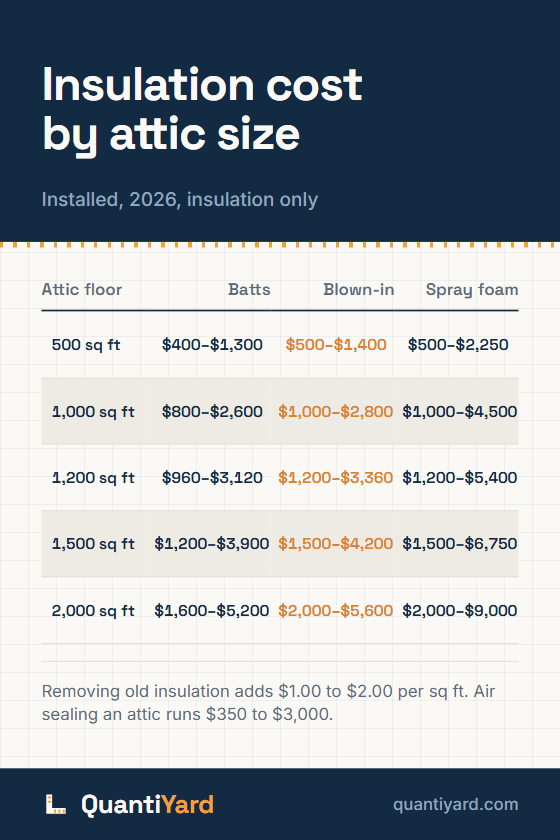
Save the insulation cost chart#
Installed cost for five attic sizes in batts, blown-in and spray foam. Save it and you can hold an insulation quote against it before anyone climbs into the attic.
Save to PinterestOpens Pinterest with the chart and link ready to go.
Common questions#
How much does it cost to insulate a 1,000 square foot attic?#
Blown-in insulation runs $1,000 to $2,800 for a 1,000 square foot attic, and batts run $800 to $2,600, at HomeGuide's national rates. Removing old insulation adds $1 to $2 per square foot, and air sealing first adds $350 to $3,000 depending on how many gaps there are.
Is blown-in or batt insulation cheaper?#
In an attic, blown-in usually is, and it fills around joists and wiring that batts have to be cut around. Installed national ranges overlap, $1.00 to $2.80 per square foot for blown-in against $0.80 to $2.60 for batts, because both span every R-value from a wall to a cold-zone attic. In an open wall cavity, batts are the simpler and cheaper choice.
Do I need to remove old insulation before adding new?#
Only if it is wet, moldy, contaminated by pests or badly compressed. Dry, intact insulation can stay, and new material goes straight on top of it. Removal adds $1.00 to $2.00 per square foot on HomeGuide's figures and $1 to $3 on Fixr's.
How much insulation does my attic need?#
ENERGY STAR's retrofit levels, based on the 2021 IECC, are R30 in climate zone 1, R49 in zones 2 and 3, and R60 in zones 4 through 8 for an uninsulated attic. With 3 to 4 inches already there, add R25, R38 or R49 respectively.