The quick answer#
A new asphalt roof costs $400 to $600 per square installed in 2026 for architectural shingles, which is the shingle on most houses. Three-tab runs $300 to $500 and standing seam metal runs $900 to $1,600. A typical 2,000 square foot house lands between $8,960 and $13,440.
Architectural asphalt
$400–$600per squareThree-tab asphalt
$300–$500per squareStanding seam metal
$900–$1,600per square2,000 sq ft house
$8,960–$13,440architecturalA square is 100 square feet of roof surface. It is the unit every roofer works in and the unit almost no homeowner thinks in, which is the first place a quote stops making sense. The second is that the roof surface is larger than the house footprint, sometimes by a quarter, and that gap is pure pitch.
Why roofers price in squares#
One square covers 100 square feet, and a bundle of architectural shingles covers a third of a square, so it takes 3 bundles to a square. That is the whole vocabulary. The part that catches people is converting a house footprint into roof squares, because a pitched roof has more surface than the ground it covers.
The conversion is a pitch multiplier: the square root of the rise squared plus 144, divided by 12. A 6/12 roof has a multiplier of 1.118, so a 1,200 square foot footprint is 1,342 square feet of roof, or 13.4 squares. A 12/12 roof multiplies by 1.414, so the same footprint becomes 1,697 square feet. Same house, 26 percent more roof.
| Pitch | Multiplier | Roof area | Squares |
|---|---|---|---|
| 4/12 | 1.054 | 1,265 sq ft | 12.7 |
| 6/12 | 1.118 | 1,342 sq ft | 13.4 |
| 8/12 | 1.202 | 1,442 sq ft | 14.4 |
| 10/12 | 1.302 | 1,562 sq ft | 15.6 |
| 12/12 | 1.414 | 1,697 sq ft | 17.0 |
Multipliers are the square root of rise squared plus 144, divided by 12, which is how the roofing calculator does it. Squares are the roof area divided by 100, before any waste allowance.
Before you read a single quote
Turn your footprint into squares
Enter the footprint and the pitch to get roof area, squares, shingle bundles, and underlayment rolls with a waste factor.
Cost by roofing material#
Material sets the rate per square, and it is the biggest lever on the whole project. Everything below is installed cost on a walkable roof with a standard tear-off.
| Material | Per square | Per sq ft | Expected life |
|---|---|---|---|
| Three-tab asphalt | $300–$500 | $3.00–$5.00 | 15 to 20 years |
| Architectural asphalt | $400–$600 | $4.00–$6.00 | 20 to 30 years |
| Metal, corrugated or exposed fastener | $500–$1,200 | $5.00–$12.00 | 30 to 80 years or more |
| Metal, standing seam | $900–$1,600 | $9.00–$16.00 | 30 to 80 years or more |
| Wood shake | $2,500–$3,000 | $25.00–$30.00 | — |
Installed prices are HomeGuide's, with lifespans from the same survey; it publishes no lifespan for wood shake. Underlayment is usually included in a replacement estimate, and the tear-off may or may not be, so ask.
Three-tab is not the bargain it looks like
Three-tab saves about $100 per square up front at matching ends of the two ranges and gives up 5 to 10 years of life: HomeGuide puts three-tab at 15 to 20 years and architectural at 20 to 30, with typical warranties of 25 to 30 years against 30 to 50. On a 13.4 square roof that is about $1,340 saved against a shingle that will need doing again 5 to 10 years sooner, on a job where the tear-off costs the same either way. Architectural shingles are thicker, more durable, resist high winds better, and are what almost every roofer will quote unless you ask for three-tab by name. There are good reasons to pick three-tab, but saving money over the life of the roof is not one of them.
Cost by roof size#
These are architectural asphalt at $400 to $600 per square, on a 6/12 roof. Find your house footprint, not your roof area, and the table does the pitch conversion for you.
| Footprint | Roof area | Squares | Installed cost |
|---|---|---|---|
| 1,200 sq ft | 1,342 sq ft | 13.4 | $5,360–$8,040 |
| 1,500 sq ft | 1,677 sq ft | 16.8 | $6,720–$10,080 |
| 2,000 sq ft | 2,236 sq ft | 22.4 | $8,960–$13,440 |
| 2,500 sq ft | 2,795 sq ft | 28.0 | $11,200–$16,800 |
| 3,000 sq ft | 3,354 sq ft | 33.5 | $13,400–$20,100 |
Footprint is the ground area under the roof, so a two-storey house uses the footprint of one floor. Roof area is the footprint times the 6/12 multiplier of 1.118. A cut-up roof with dormers, valleys, and multiple planes runs 10 to 20 percent above these figures on waste alone.
Tear-off against overlay#
An overlay is a new shingle layer laid straight over the old one. It saves the tear-off, which HomeGuide puts at $1 to $3 per square foot, $100 to $300 per square, so on a 13.4 square roof it saves $1,340 to $4,020. It is legal in most jurisdictions when there is only one existing layer and the deck is sound.
It is also usually the wrong call. An overlay hides the deck, so nobody finds the soft sheathing or the failed flashing until the new roof leaks over it. It adds weight the framing was not sized for. It runs hotter, which shortens shingle life. And it makes the next roof a two-layer tear-off, which costs more than the overlay saved. Almost every roofer will recommend a full tear-off, and on this one the trade consensus is right.
| Item | Cost |
|---|---|
| Tear-off, shingles or metal | $100–$300 per square |
| Tear-off, slate or tile | $200–$500 or more per square |
| Dumpster, 20 yard | $280–$699 per week |
Disposal is often folded into the per-square tear-off figure rather than billed separately, and the dumpster is HomeGuide's weekly rate for a 20 yard container. Ask which way a quote handles it, because it is a common place for two bids to look further apart than they are.
Decking replacement#
Nobody knows what the deck looks like until the shingles come off, which is why a well-built roofing quote carries a decking allowance and a per-sheet price for anything beyond it. This is the single most common change order on a roofing job.
Replacement runs $2 to $5 per square foot installed, which is $64 to $160 per 4 by 8 sheet. A full re-deck of that 1,342 square foot roof is 42 sheets, so $2,688 to $6,720 on top of the roof itself. Most roofs need somewhere between zero and eight sheets, and a quote that includes an allowance for four or five is being realistic rather than padding.
If you want to sanity check a re-deck figure, the plywood and sheathing calculator gives the sheet count from the area directly. Enter the pitch-adjusted roof area rather than the footprint, and use the 15 percent roof waste setting, since a cut-up roof leaves offcuts a wall does not.
Underlayment, flashing, and vents#
These are the lines that separate a $6,000 quote from an $8,000 one on the same roof, and they are where a cheap bid does its cutting.
| Component | Cost | Where it goes |
|---|---|---|
| Underlayment, felt or synthetic | $10–$80 per square | The whole deck, under the shingles. |
| Drip edge | $1.50–$3.00 per linear ft | Every eave and rake edge. |
| Flashing, full replacement | $400–$1,000 per roof | Walls, chimneys, and every valley. |
| Roof vents | $200–$700 | Exhaust at the ridge, paired with soffit intake. |
Ice and water shield at the eaves, pipe boots and ridge vent are other lines a quote should name; no published survey prices them separately, so this table does not. Reusing old flashing is the most common corner cut, and it is the reason a new roof leaks at a chimney.
Drip edge is priced off the eave and rake run, and that is the same measurement a gutter is priced off. A tear-off is when the gutter comes down anyway, so it is the cheapest moment to replace it: the drip edge and the first shingle course both tie into it, and doing the two jobs separately means paying twice to get at the same edge. Our gutter calculator turns that eave run into gutter linear feet, downspout count and a 5 inch or 6 inch recommendation.
Ventilation is not an upsell
A roof needs intake at the soffits and exhaust at the ridge, and it needs them in rough balance. Without it the deck cooks in summer and condenses in winter, which takes years off the shingles and can void the manufacturer's warranty outright. HomeGuide puts roof vent installation at $200 to $700, which is a small line on a $12,000 roof. If a quote does not mention ventilation at all, that is worth a question.
Pitch, stories, and permits#
Two roofs of the same size can be thousands apart on access alone. Steep roofs need staging and roof jacks, and everything from the shingles to the tear-off debris moves slower.
| Condition | Added cost |
|---|---|
| 7/12 to 9/12 pitch | 10 to 20 percent |
| 10/12 pitch and steeper | 25 to 50 percent |
| Second storey | 5 to 15 percent |
| Third storey or poor access | 20 to 35 percent |
| Cut-up roof, dormers and valleys | 10 to 20 percent |
| Building permit | $100–$500 |
Surcharges compound. A third-storey roof at 10/12 or steeper is not one surcharge over the base figure, it is both: 1.25 × 1.20 is 1.50 and 1.50 × 1.35 is 2.03, so 50 percent to roughly double. Permit fees are often set as a percentage of project value rather than a flat rate.
The one upgrade to do now#
A tear-off is the cheapest moment in the life of a house to deal with attic insulation, and almost nobody takes it. The attic is open, the crew is already there, and any air sealing at the top plates is reachable in a way it never is again once the deck is back on.
The recommended attic R-value is R-49 in most of the country and R-60 in the coldest zones, and the median existing house is nowhere near either. The insulation calculator gives the target for your climate zone and works out the depth and the bag count from what is already up there. Blown fiberglass needs 20.5 inches to reach R-60 on the Owens Corning AttiCat label, which is deeper than most people expect and deeper than most attics have.
The reason to pair it with the roof is ventilation. Adding insulation without keeping a clear path from the soffit vents to the ridge turns a well-insulated attic into a moisture trap, and the ridge vent going on with the new roof is half of that path. Doing both at once is how the assembly ends up working; doing insulation two years later, from inside, is how baffles get skipped.
While the attic is open
Target R-value, depth, and bag count
Pick your climate zone and the attic application to get the recommended R-value, the inches you need, and how many bags it takes.
One more reason to run the roofing calculator before the crew arrives: it gives the underlayment roll count as well as the bundles, and underlayment is quietly one of the more variable lines between quotes. A roof needing 14 rolls priced at 10 is a quote that will grow.
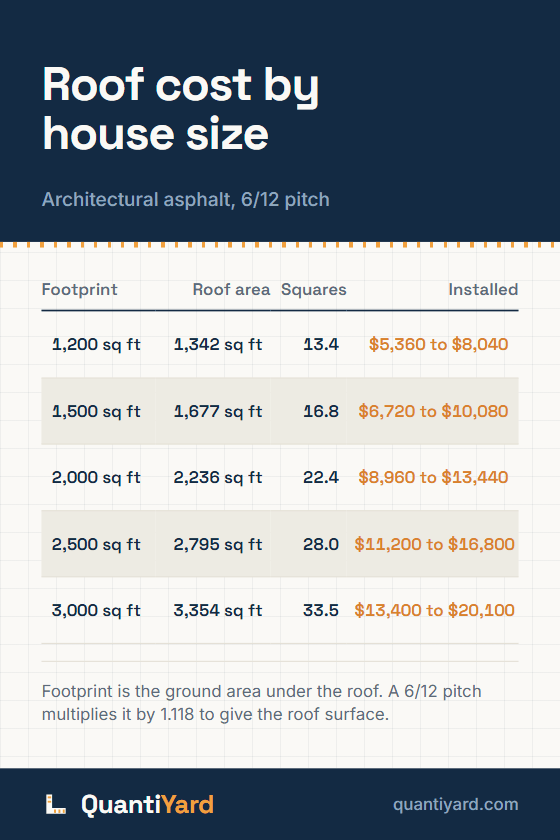
Save the roof cost chart#
Five house footprints converted to roof squares and priced. Save it and you can check a roofing quote against your own square count instead of taking the roofer's.
Save to PinterestOpens Pinterest with the chart and link ready to go.
Common questions#
How much does it cost to replace a 2,000 square foot roof?#
If 2,000 square feet is the house footprint, a 6/12 roof over it is 2,236 square feet of surface, or 22.4 squares, which is $8,960 to $13,440 in architectural asphalt at $400 to $600 per square. If 2,000 square feet is the roof area itself, it is 20 squares, so $8,000 to $12,000. Check which one a quote is using, because the gap is real money.
What is a roofing square?#
A square is 100 square feet of roof surface, and it is the unit every roofer prices in. A bundle of architectural shingles covers a third of a square, so 3 bundles make one. Roof surface is always larger than the house footprint: a 6/12 pitch multiplies the footprint by 1.118, and a 12/12 pitch by 1.414.
Is an overlay cheaper than a tear-off?#
Yes, by the $100 to $300 per square that tear-off costs, so $1,340 to $4,020 on a 13.4 square roof. It is usually still the wrong call. An overlay hides the deck so nobody finds soft sheathing or failed flashing, it adds weight, it runs hotter and shortens shingle life, and it makes the next roof a two-layer tear-off.
Should I replace the roof decking?#
Only what is soft or rotten, which nobody can see until the shingles are off. Replacement is $2 to $5 per square foot installed, $64 to $160 per 4 by 8 sheet, and most roofs need between zero and eight sheets. A quote carrying an allowance for four or five sheets with a stated per-sheet price beyond that is being realistic. A full re-deck of a 1,342 square foot roof is 42 sheets, or $2,688 to $6,720.