Plywood & Sheathing Calculator
Enter the area you are covering and the sheet size you are buying. You get sheets needed, the coverage those sheets actually buy you, and estimated cost.
Updated September 5, 2026 · Estimates for planning, not a quote
How the sheet count works
Sheathing math is one division with a waste allowance on top: sheets = area × (1 + waste) ÷ sheet coverage, rounded up. A 4 by 8 sheet covers 32 square feet, a 4 by 9 covers 36, and a 4 by 10 covers 40. So 1,000 square feet of wall at 10 percent waste is 1,100 square feet to cover, and 1,100 ÷ 32 = 34.4, which rounds up to 35 sheets.
The coverage bought line is there because the rounding is never free. Those 35 sheets cover 1,120 square feet, so you finish with about 20 square feet of full sheet left over on top of your offcuts. That is normal, and worth knowing before you decide whether to buy one more.
Why waste is higher on a roof
A rectangular wall or a plain gable roof cuts cleanly: most offcuts are straight strips you can use somewhere else on the same wall. Hips and valleys do not work that way. Every rafter run against a hip needs an angled cut, and the triangle you cut off is usually too small and too oddly shaped to place anywhere. That is the difference between the 10 percent default and the 15 percent this calculator switches to for roofs.
Use roof area, not footprint
A pitched roof always has more surface than the rectangle of ground it covers, and the steeper the pitch the bigger the gap. A 30 by 40 footprint under a 6/12 roof is 1,200 square feet on the ground but about 1,342 square feet of actual roof. Sheathing the footprint number leaves you roughly four sheets short.
Run your footprint and pitch through the roofing calculator first, take the roof area it gives you, and enter that here.
Plywood or OSB
Both are sold in the same sheet sizes and both cover the same square footage, so the count is identical either way. OSB is usually cheaper per sheet. Plywood handles repeated wetting better and holds a fastener slightly better at an edge. For pricing, put whichever one you are actually buying into the price field.
Sizing a roof re-deck? Enter the pitch-adjusted roof area rather than the footprint, and see our roof replacement cost guide for what replacement decking costs per sheet and how big an allowance a quote should carry.
Method and sources
The waste factors are framing practice: 10 percent on walls and subfloor and 15 on a roof, because a roof plane has more edges to cut to and more offcuts nothing else uses. Framers and lumber yards estimate sheet goods from that band.
Sheet coverage is arithmetic on the stock size, 32 square feet for a 4 by 8. Coverage bought is shown alongside coverage needed, because a sheet you do not use is still a sheet you paid for. This page does not pick a sheathing thickness: span rating against framing spacing is a code question.
QuantiYard writes its own formulas and states them in plain language on every page. How these numbers are made covers where the constants come from, how waste factors are chosen, what these calculators deliberately do not do, and how to report an error.
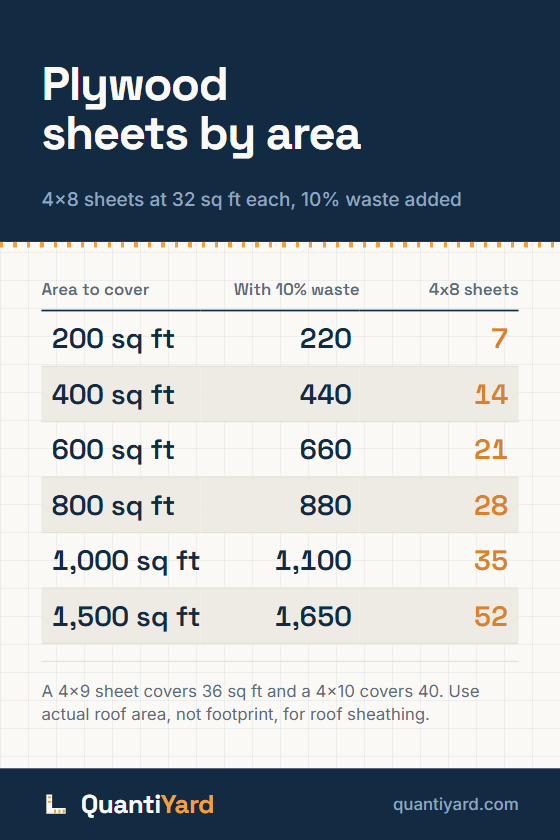
Save the sheathing chart
Sheet counts for six common areas at 10 percent waste, in standard 4x8 sheets. Save it and you can size a sheathing order from the truck.
Save to PinterestOpens Pinterest with the chart and link ready to go.
Plywood calculator FAQ
How many square feet does a sheet of plywood cover?
A standard 4 by 8 foot sheet covers 32 square feet. A 4 by 9 covers 36 and a 4 by 10 covers 40. Divide your area by that number, after adding waste, to get the sheet count.
How much waste should I add for plywood sheathing?
10 percent covers a straightforward wall or subfloor. Use 15 percent on a roof with hips and valleys, because every angled cut leaves an offcut too small to use somewhere else.
Do I use the roof footprint or the actual roof area for sheathing?
Actual roof area, not footprint. A pitched roof has more surface than the rectangle it sits on, so multiply the footprint by the pitch multiplier first. The QuantiYard roofing calculator does that step for you.
Cite this page
Built from this page's own title, URL and last-updated date, so a citation cannot drift from what it cites.