Stair Stringer Calculator
Enter your total rise to get the step count, riser height, tread depth, total run, stringer length, and stair angle, checked against common code limits.
Updated September 2, 2026 · Estimates for planning, not a quote
How to lay out a stair stringer
Every stair calculation starts from one measurement: the total rise, the vertical distance from the surface of the lower floor to the surface of the upper floor or landing. Everything else follows from it.
Risers and treads
Divide the total rise by a comfortable target riser height, around 7 to 7.5 inches, and round to the nearest whole number to get the number of risers. The actual riser height is the total rise divided by that count, so every step comes out equal. The number of treads is always one less than the number of risers, because the top landing acts as the final step.
Run, stringer length, and angle
Total run is the number of treads times the tread depth. The stringer board itself follows the diagonal of the staircase, so its minimum length is the square root of the total rise squared plus the total run squared. The stair angle is the arctangent of rise over run, and a comfortable flight usually lands between 30 and 37 degrees.
Code limits worth knowing
The International Residential Code caps riser height at 7 and 3/4 inches and sets a minimum tread depth of 10 inches, and it requires that the tallest and shortest riser in a flight differ by no more than 3/8 inch. This calculator flags whether your riser and tread fall within those limits, but local codes can be stricter, so confirm the final numbers before you cut.
The limits this calculator checks against are the 2021 IRC minimums, and there are more of them than riser and tread. Our stair code reference lists headroom, width, landings, handrail graspability and guard openings with the section number for each, and covers the 3/8 inch variation limit that fails more stairs than the riser cap does.
Method and sources
Where these figures come from: 2021 International Residential Code section R311.7: 7 3/4 inch maximum riser, 10 inch minimum tread depth.
The number of risers is the total rise divided by a target riser height and rounded to the nearest whole, and every riser is then equal, which is what the code cares about most. Stringer length is the hypotenuse of the total rise and total run. Your jurisdiction adopts a code edition and may amend it, so check locally before you cut.
QuantiYard writes its own formulas and states them in plain language on every page. How these numbers are made covers where the constants come from, how waste factors are chosen, what these calculators deliberately do not do, and how to report an error.
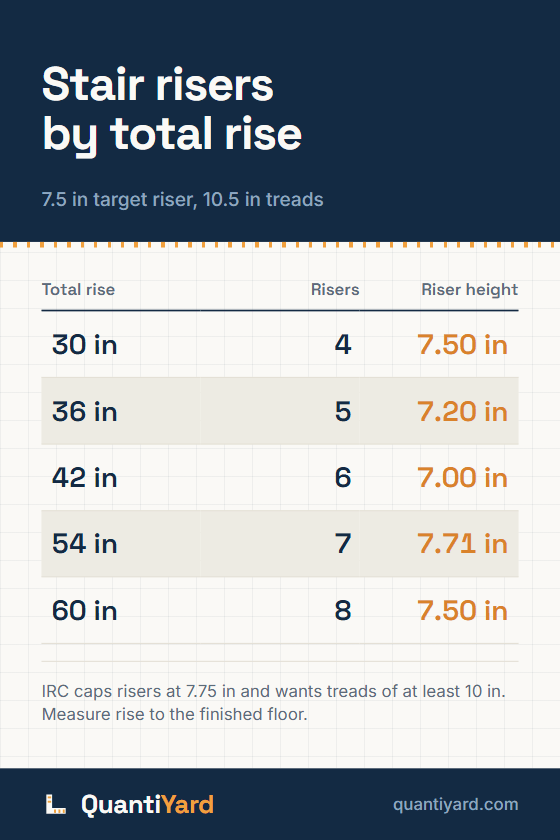
Save the stair riser chart
Risers and riser height for five common deck and porch heights, all inside the IRC cap. Save it before you cut a stringer.
Save to PinterestOpens Pinterest with the chart and link ready to go.
Stair stringer FAQ
How do I calculate the number of stairs from the total rise?
Divide the total rise (floor to floor) by a comfortable target riser of about 7 to 7.5 inches and round to the nearest whole number for the riser count. Actual riser height is the total rise divided by that number, and treads are always one fewer than risers.
What is the maximum riser height and minimum tread depth?
Under the IRC, maximum riser height is 7 and 3/4 inches and minimum tread depth is 10 inches, with no more than 3/8 inch variation between risers in a flight. Local codes can differ, so confirm with your building department.
How long does a stair stringer need to be?
The minimum board length is the diagonal of the staircase: the square root of the total rise squared plus the total run squared. Buy longer than that to leave material for the top and bottom cuts.
Cite this page
Built from this page's own title, URL and last-updated date, so a citation cannot drift from what it cites.