The quick answer#
Over ten years, pressure treated is the cheapest deck at both ends of the price ranges, even after its staining. Composite catches up somewhere between about year 16 and year 30, depending on what you pay and how often the wood gets stained. So the real question is not which material is better. It is how long you plan to own the deck.
Treated, 10 year total
$5,664–$13,44012 by 16 deckComposite, 10 year total
$7,680–$15,36012 by 16 deckComposite catches up
Year 16 to 30at matching endsWood staining
$288–$768each time, every 2 to 3 yearsEvery total on this page is a range, low end against low end and high end against high end, because each input is published as a range and no one figure inside it is more right than another. That is also why there is no single crossover year: the cheap ends cross late and the dear ends cross early.
Before you price anything
Find out how many boards your deck actually takes
Enter your deck size, board width, and joist spacing to get rows of decking, board count, joists, and screws. The board count is what turns a per square foot price into a real number.
The three side by side#
Material price is the least interesting row in this table. What separates the three is what happens in the years after the build.
| Factor | Pressure treated | Cedar | Composite |
|---|---|---|---|
| Installed, per sq ft | $25–$50 | $30–$47 | $40–$80 |
| Materials, per sq ft | $14–$28 | — | $16–$32 |
| Lifespan | 10 to 25 years | — | 25 to 50 years |
| Upkeep routine | Stain and seal every 2 to 3 years | Seal every 2 to 3 years, or let it grey | Soap and water, no stain |
| Staining, each time | $288–$768 | $288–$768 if sealed | None |
| Upkeep hours, per year | 6 to 8 | 6 to 8 | 1 to 2 |
| Heat in full sun | Moderate | Coolest of the three | Hottest, 10 to 30 °F above air |
| Fade behavior | Greys and checks; sands back and re-stains | Weathers to silver; sands back if you want the color | Fades slightly in year one, then holds |
| Scratches | Sand and re-stain the spot | Sand and re-seal the spot | Permanent. Cannot be sanded out |
Per square foot prices match the QuantiYard deck building cost guide and are HomeGuide's for an average attached deck on a one storey home. Staining is HomeGuide's $1.50 to $4 per square foot on 192 square feet. No published figure gives cedar's materials alone or its lifespan, so those cells are blank.
Ten years on a 12 by 16 deck#
A 12 by 16 deck is 192 square feet, which is the most common size people actually build. Run each material through it at both ends of the installed range, with staining every 3 years at the low end and every 2 years at the high end.
| Cost | Pressure treated | Cedar | Composite |
|---|---|---|---|
| Installed, year 0 | $4,800–$9,600 | $5,760–$9,024 | $7,680–$15,360 |
| Staining, years 1 to 10 | $864–$3,840 | $864–$3,840 | $0 |
| Ten year total | $5,664–$13,440 | $6,624–$12,864 | $7,680–$15,360 |
Installed figures are the 12 by 16 ranges in the deck cost guide. Wood staining is 3 treatments at $288 at the low end and 5 at $768 at the high end. Cleaning, which no published survey prices, is left out for all three.
At ten years treated is still the cheaper deck at both ends: $5,664 to $13,440 against $7,680 to $15,360 for composite. Anyone planning to sell inside a decade is choosing between materials, not between cost curves.
Where the staining figure comes from
HomeGuide puts power washing, staining and sealing a deck at $1.50 to $4 per square foot, every 2 to 3 years. On 192 square feet that is $288 to $768 a time. Doing it yourself swaps most of that for your own Saturday: stain for a deck this size is about 4 gallons once you count the railing, $80 to $200 at HomeGuide's $20 to $50 a gallon, and the deck stain calculator works out the gallons from your own railing runs and stairs.
The railing is what makes that number bigger than people expect. On a 12 by 16 deck the boards are 192 square feet and the railing, counting both faces, is more than that again. Skip it in your estimate and you buy half the stain you need, which is why the deck stain calculator asks for railing length and stair count rather than just deck size.
Twenty years, and the crossover#
Stretch the window to twenty years and the staining starts to add up. Composite costs $2,880 to $5,760 more up front on this deck, and each treatment on the wood closes $288 to $768 of that.
| Cost | Pressure treated | Cedar | Composite |
|---|---|---|---|
| Installed, year 0 | $4,800–$9,600 | $5,760–$9,024 | $7,680–$15,360 |
| Staining, years 1 to 20 | $1,728–$7,680 | $1,728–$7,680 | $0 |
| Twenty year total | $6,528–$17,280 | $7,488–$16,704 | $7,680–$15,360 |
Totals are before any replacement. Wood staining is 6 treatments at the low end and 10 at the high end. HomeGuide gives a pressure treated deck 10 to 25 years and composite 25 to 50, and Trex's warranties run 20 to 25 years.
At the low end the composite premium is $2,880 and a treatment is $288, so it takes 10 treatments to close, which is year 30 staining every third year. At the high end it is $5,760 against $768, so 8 treatments, year 16 staining every second year. At twenty years the cheap ends still favor treated, $6,528 against $7,680, and the dear ends favor composite, $17,280 against $15,360.
What the totals leave out
A wood deck that wears out early changes the answer. HomeGuide puts a pressure treated deck's life at 10 to 25 years and a replacement at $30 to $55 per square foot, $5,760 to $10,560 on this deck, so a treated deck at the short end of its life costs that again inside twenty years, while composite is still on its original boards. How long the wood lasts depends far more on climate, sun exposure, and whether anybody actually stains it than on the species printed on the tag.
What upkeep actually involves#
The dollar figure hides the part people care about, which is the weekend.
Wood, every two to three years. Clear the deck, wash it with a cleaner or brightener, let it dry for a day or two, then brush or roll on stain and cut in around railings and stair treads. On 192 square feet with a railing run, that is most of a Saturday for the wash and most of a Sunday for the stain, plus the drying day in between. Call it 6 to 8 hours a year averaged over the cycle. Paying someone is the $288 to $768.
Composite, once a year. Soap, water, a soft brush, and a rinse, mostly to get pollen and mildew out of the grain. An hour or two. Composite is not maintenance free, whatever the brochure says. It is maintenance light.
Cedar, either way. Cedar is the only one of the three that gives you a genuine choice. Sealed on the same two to three year cycle it keeps its warm color and costs the same as treated. Left alone it weathers to a silver grey and costs nothing, because cedar's rot resistance is in the wood itself rather than in the finish. Plenty of cedar decks are deliberately never sealed.
Heat, fade, and scratches#
Three things that do not show up in a cost table and change how a deck feels to live on.
Heat. Composite runs hot. In direct sun a composite surface typically sits 10 to 30 degrees Fahrenheit above air temperature, and a dark board runs hotter than a light one. Cedar is the coolest of the three, treated pine sits in between. On a north-facing or shaded deck this is a non-issue. On a west-facing deck with kids and bare feet it can be the deciding factor, ahead of any twenty year total.
Fade. Composite fades noticeably in its first year, then largely stops, which is why manufacturers quote fade warranties from a stabilized color rather than from new. Wood does the opposite: it keeps changing. Treated pine greys and checks, cedar weathers to silver, and both can be sanded and re-finished back to something close to new whenever you feel like it.
Scratches. This is composite's real weakness. A dragged planter or a dog's claws leave a mark in the cap that does not sand out, because sanding removes the cap. On wood, the same scratch is a five minute fix with a sanding block and a brush of stain. If your deck takes furniture, planters, or dogs, weigh that against the staining you are avoiding.
Who each option suits#
Pressure treated pine#
- You are on a budget and want the most deck per dollar today
- You expect to move within fifteen years
- You do not mind a staining weekend every second or third summer, or you like doing it
- The deck will take furniture, planters, or a dog, and you want repairable
- You are building it yourself, since treated is forgiving to cut and fasten
Cedar#
- You want real wood that looks better than treated pine from day one
- The deck gets full afternoon sun and will be walked on barefoot
- You are happy either sealing it or letting it grey, and want that choice
- You will pay $5,760 to $9,024 on a 12 by 16 deck, a range that overlaps treated's
Composite#
- This is the last deck you plan to build at this house
- You would rather spend more now than spend weekends later
- The deck is shaded, or heat underfoot is not a concern
- You can absorb $2,880 to $5,760 more up front on a 12 by 16 deck
- Nobody is dragging heavy furniture across it
Turn a per square foot price into a real quote
Board counts for whichever material you pick
The material changes the price per board, not the number of boards. Get the count first from your deck size and board width, then multiply.
A decision framework#
Work through these in order. Most people have their answer before question four.
1. How long are you staying?#
Under fifteen years, pressure treated is cheaper at both ends of the price ranges and nothing in the twenty year table applies to you. Past about year 16, composite's numbers can start working, and by year 30 they do at both ends. Between the two, the rest of these questions decide it.
2. Will the deck get direct sun and bare feet?#
If yes, cedar is worth a look, since its price overlaps treated's, and composite is worth thinking twice about. Heat underfoot is not something you get used to, and it is not something you can fix later.
3. Are you going to stain it?#
Answer this one truthfully. A wood deck that never gets sealed sits at the short end of its 10 to 25 years, and the whole cost case for wood assumes it gets sealed. If staining is not going to happen, composite is the better deck and cedar left to grey is the better wood.
4. What is going on the deck?#
Heavy furniture, planters on casters, a grill, a dog. All of those scratch composite permanently and sand out of wood in five minutes. A deck that is mostly chairs and a table does not have this problem.
5. What does the total actually come to?#
Get the board count from the deck calculator, price it against the ranges in the deck cost guide, and add the upkeep line for as many years as you plan to be there. A per square foot number is a starting point, not a quote.
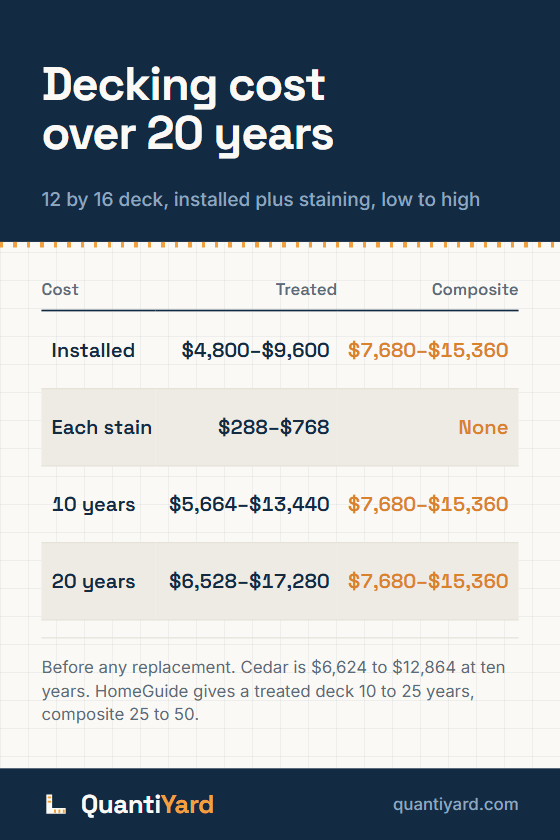
Save the 20-year decking cost chart#
Installed cost, staining, and ten and twenty year totals for treated, cedar, and composite on a 12 by 16 deck, low end and high end. Save it before you price a single board.
Save to PinterestOpens Pinterest with the chart and link ready to go.
Common questions#
Is composite decking cheaper than wood in the long run?#
Eventually, but not soon. On a 12 by 16 deck, pressure treated runs $5,664 to $13,440 over ten years against $7,680 to $15,360 for composite, so wood is ahead at both ends. Composite catches up somewhere between about year 16 and year 30 on staining alone, and sooner if the wood deck wears out early.
How long does a pressure treated deck last?#
HomeGuide puts a pressure treated deck at 10 to 25 years, with sealing every 2 to 3 years, and less than that if it is never sealed. The pressure treated framing underneath often outlives the deck surface, which is why a re-deck can replace the boards and railing but keep the joists, beams, and footings.
Does composite decking get hot?#
Yes. In direct sun a composite surface typically runs 10 to 30 degrees Fahrenheit above air temperature, and darker boards run hotter than light ones. Cedar stays coolest of the three, pressure treated sits in between. If the deck faces full afternoon sun and gets bare feet, this matters more than any cost table.
Do you have to stain cedar decking?#
No, and that is the one real choice cedar gives you. Sealed every two to three years it holds its warm color, at $288 to $768 a treatment on a 192 square foot deck. Left alone it weathers to a silver grey without rotting, because cedar's rot resistance is in the wood rather than in the finish.