Deck Stain & Sealer Calculator
Deck boards are the easy part. Add the railing and the stairs and the surface area often doubles, which is why people run out of stain halfway through the second coat.
Updated September 5, 2026 · Estimates for planning, not a quote
How the stain estimate works
gallons = total surface area × coats ÷ coverage per gallon. The arithmetic is the same as any paint job. What makes decks different is the surface area, which is almost never the number people start with.
The railing is not a rounding error
A 12 by 16 deck is 192 square feet of boards. Put a railing on three sides at 3 feet high and you add 44 linear feet of railing, and because you coat both faces that is 44 × 3 × 2, or 264 square feet. The railing is more surface than the deck. Total 456 square feet, which at 250 square feet per gallon and two coats is 3.65 gallons, so 4 cans.
Doubling the linear run for both faces is the working figure and it is deliberately a little generous, because it covers the balusters, the top cap, and the posts, none of which are flat. A railing with wide flat balusters uses more than this; a cable railing uses much less.
Stairs
Each step is a tread plus a riser, roughly 18 inches of surface across the width of the stair, so a 3 foot wide step is about 4.5 square feet. Four steps is 18 square feet, which is small next to the railing but not nothing. Stringer sides are extra, and if yours are exposed, add a few square feet a step.
Coverage, and why the can is optimistic
250 square feet per gallon is the figure to use on smooth, previously sealed wood. Rough-sawn boards, or any deck that has never had a finish on it, drink far more: closer to 150 square feet per gallon on the first coat. The second coat then goes much further, because the first one filled the wood.
If the deck has never been sealed, buy for 150 and expect to have some left over rather than the other way round. There is no worse place to run out than three quarters of the way across a deck in the sun, because a lap mark where wet stain met dry stain does not sand out.
New pressure treated wood has to wait
This is the single most common deck finishing mistake. New pressure treated lumber is still saturated with the treatment solution, and stain will not penetrate wood that is already full of something else. It sits on the surface, stays tacky, and peels within a season.
Give it a few months of weather, then test it: sprinkle water on a board. If it beads up, the wood is not ready. If it soaks in within a minute or two, it will take stain. This is a wood-moisture question, not a calendar one, so the test beats any rule about waiting six months.
Cans, and buying the right size
Stain is sold in gallons and 5 gallon pails, and this calculator rounds up to whole gallons. Once you are past about 4 gallons, price the pail: it is usually cheaper per gallon and, more usefully, it is one batch, so there is no color variation between cans. If you are buying separate gallons, box them together first by pouring them into one bucket and mixing.
Sizing the deck itself
If the deck is not built yet, the deck calculator gives board and joist counts, and the composite vs. wood decking comparison puts the cost of this staining cycle against what composite saves you, which is the real argument between the two materials.
Method and sources
Where these figures come from: Spread rate as stated on the can, typically 250 square feet per gallon on smooth previously sealed wood and 150 on rough or bare boards.
Total area is the deck, plus the railing counted at both faces, plus about 1.5 feet of surface per step across the stair width. The railing is often more surface than the boards. New pressure treated lumber has to dry before it will take stain.
QuantiYard writes its own formulas and states them in plain language on every page. How these numbers are made covers where the constants come from, how waste factors are chosen, what these calculators deliberately do not do, and how to report an error.
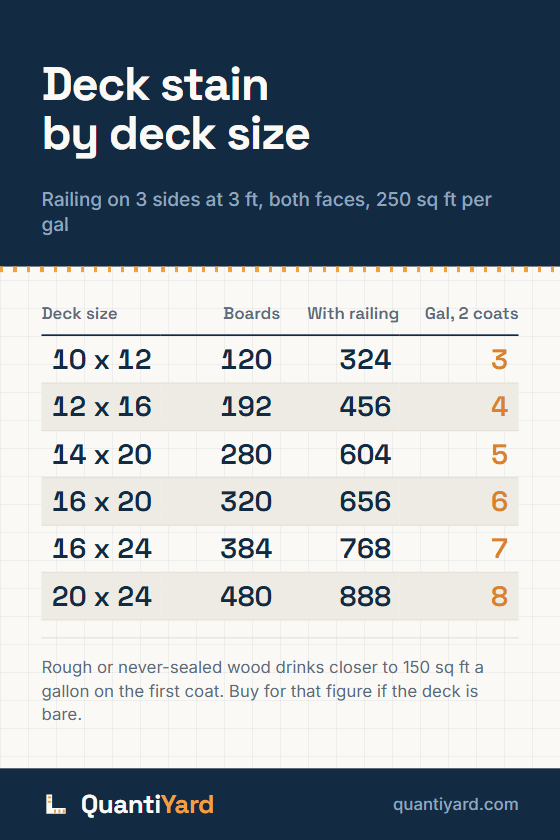
Save the deck stain chart
Board area, real surface with the railing counted, and gallons for two coats at six deck sizes. Save it and you will not be a can short.
Save to PinterestOpens Pinterest with the chart and link ready to go.
Deck stain calculator FAQ
How much stain do I need for a 12x16 deck?
About 4 gallons for two coats, once you count the railing. The boards alone are 192 square feet, but a railing on three sides at 3 feet high adds another 264 square feet because you coat both faces. That is 456 square feet, which at 250 square feet per gallon is 3.65 gallons for two coats.
Can you stain new pressure treated wood?
Not straight away. New pressure treated lumber is still wet with treatment chemicals and will not absorb stain properly. Let it weather for a few months and test it by sprinkling water on a board: if the water beads, the wood is not ready, and if it soaks in within a minute or two, it is.
How much does a gallon of deck stain cover?
About 250 square feet on smooth, previously sealed wood. Rough-sawn or never-sealed wood drinks far more, closer to 150 square feet per gallon on the first coat, and the second coat then goes much further. If the deck has never been sealed, buy for the lower figure.
Cite this page
Built from this page's own title, URL and last-updated date, so a citation cannot drift from what it cites.