Siding Calculator
Enter up to four wall elevations plus any gables, take the openings off, and get squares of siding, a piece count at your exposure, boxes, and the trim that goes with it.
Updated September 5, 2026 · Estimates for planning, not a quote
How the siding count works
Siding is one of the easier take-offs once you have the right area, and most of the mistakes happen before the arithmetic starts.
Wall area
Each elevation is length times height, measured to the top of the wall rather than to the roof. Four fields cover a rectangular house; for an L-shaped house, run the extra legs through as separate walls or use the fields twice.
Gables are triangles
gable area = 0.5 × width × rise to the peak. A 30 foot wide gable rising 6 feet to the ridge is 0.5 × 30 × 6, which is 90 square feet. Measure the rise from the top of the wall to the peak, not from the ground. Two gables on that house add 180 square feet, which is most of two squares of siding and the single most commonly forgotten number on the whole job.
Exposure, and why it is not the board width
Exposure is the part of a course you can see after the next course laps over it. An 8 inch lap board might only show 6 3/4 inches. It is exposure, not the board width, that decides how much wall a piece covers:
coverage per piece = piece length in inches × exposure ÷ 144
A 12 foot piece is 144 inches, so at a 6 inch exposure it covers exactly 6 square feet. That gives a tidy shortcut for 12 foot stock: the coverage in square feet is the same number as the exposure in inches. Divide your adjusted area by that figure and round up.
Squares and boxes
A square is 100 square feet of finished wall, and siding is priced by the square everywhere. Vinyl usually ships in boxes covering 2 squares, so the box count is your area divided by 200, rounded up. Ordering by the square and ordering by the box are not the same thing: a house needing 12.8 squares takes 7 boxes, which is 14 squares of material, so there will be some left over.
Waste
10 percent covers a plain rectangular house with a handful of windows. Use 15 percent on anything cut up: lots of openings, dormers, several gables, or an elevation broken by a bump-out. Every one of those turns a full-length piece into two pieces with an offcut in between, and the offcuts get shorter as the wall gets busier.
Starter strip and J-channel
Starter strip runs along the bottom of every wall, once, so it is the total of your wall lengths. J-channel goes around every opening, and the figure here is the perimeter of the openings you entered. Add the rake on each side of every gable and the run under the eave, because those are real linear feet this calculator does not know about.
What goes under it
Siding goes over sheathing and house wrap, and both are figured from the same wall area. If the sheathing is going on at the same time, run the numbers through the plywood and sheathing calculator, and use the wall framing calculator if the walls are being built rather than re-clad.
Method and sources
A square is 100 square feet, by definition. Coverage per piece is its length times its exposure divided by 144. A gable is a triangle, so half its width times its rise.
On 12 foot stock the coverage in square feet equals the exposure in inches, which is a useful check. Gross area is the elevations plus the gables, less the openings, times a waste factor. A vinyl box covers two squares. Corner posts, soffit, fascia and fasteners are not counted.
QuantiYard writes its own formulas and states them in plain language on every page. How these numbers are made covers where the constants come from, how waste factors are chosen, what these calculators deliberately do not do, and how to report an error.
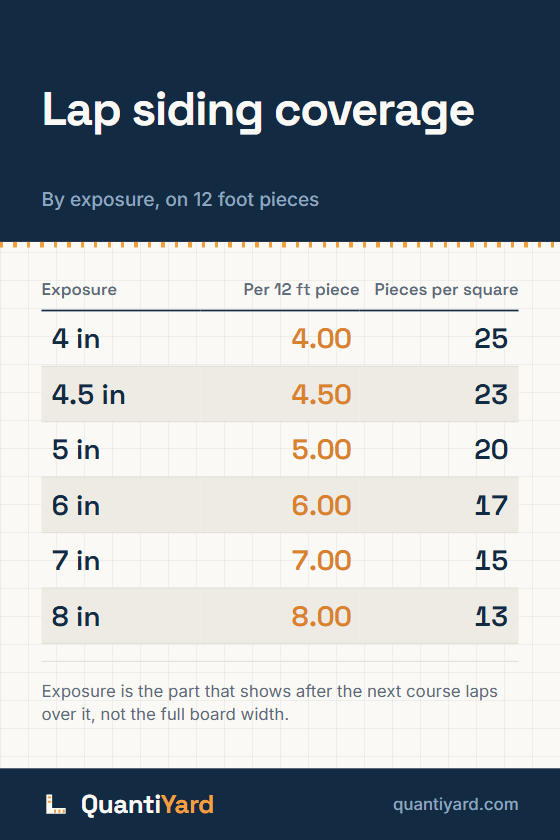
Save the siding coverage chart
Coverage per 12 foot piece and pieces per square at six common exposures. Save it and you can check a supplier's piece count against your own.
Save to PinterestOpens Pinterest with the chart and link ready to go.
Siding calculator FAQ
How do you calculate the area of a gable?
Half the width times the height. A gable is a triangle, so a 30 foot wide gable rising 6 feet to the peak is 0.5 times 30 times 6, which is 90 square feet. Do that for each gable and add it to the wall area.
How much does one piece of lap siding cover?
Length in inches times exposure in inches, divided by 144. A 12 foot piece is 144 inches, so at a 6 inch exposure it covers exactly 6 square feet. Exposure is the part that shows once the next course laps over it, which is always less than the board's full width.
What is a square of siding?
100 square feet of finished wall. Siding is priced and ordered by the square, and vinyl usually ships in boxes that cover 2 squares, or 200 square feet. So a house needing 12.8 squares takes 7 boxes.
Cite this page
Built from this page's own title, URL and last-updated date, so a citation cannot drift from what it cites.