The quick answer#
Most homeowners pay between $25 and $50 per linear foot for a 6 foot wood privacy fence installed in 2026. Chain link runs $10 to $20, vinyl privacy runs $40 to $60, and ornamental aluminum runs $40 to $75.
Wood privacy, installed
$25–$50per linear ftChain link, installed
$10–$20per linear ftVinyl privacy, installed
$40–$60per linear ftAluminum, installed
$40–$75per linear ftA typical backyard fence runs 150 to 250 linear feet, which puts the usual project between $1,500 and $18,750 depending almost entirely on the material and how many gates the layout needs. Those ranges are for a complete installed fence: posts, concrete, rails or panels, and standard hardware. A quote that skips the walk gate or prices line posts without their concrete is not the same job, and that gap is the most common reason two bids on the same yard land far apart.
Before you price anything
Find out how many posts and bags of concrete your fence needs
Enter your fence length, post spacing, and gate openings to get post counts, panel counts, and concrete bags for the holes.
Cost by fence material#
The fencing material sets the rate per foot, but posts, concrete, and gates are shared costs that land on every style. Privacy fencing, wood or vinyl, costs more than chain link mostly because it uses far more material per foot of run: solid boards or panels instead of open fabric.
| Material | Materials only | Full fence installed | What you are buying |
|---|---|---|---|
| Wood privacy, 6 ft | $10–$30 | $25–$50 | Posts, rails, and pickets. Cheapest privacy option, needs staining every few years. |
| Chain link, 4 ft | $5–$10 | $10–$20 | Galvanized fabric, line posts, top rail. No privacy, lowest cost, decades of service. |
| Vinyl privacy, 6 ft | $25–$45 | $40–$60 | Molded PVC panels and posts. No staining, resists rot, higher upfront cost. |
| Aluminum, ornamental | — | $40–$75 | Powder-coated panels, 4 to 5 ft. Sees through, low maintenance, pool-code friendly. |
Materials-only prices are per linear foot of fence line at retail, before waste, and the vinyl figure covers every vinyl style rather than privacy panels alone. No published figure for aluminum materials alone was found, so that cell is left blank. Installed prices cover posts, concrete, and standard hardware, with panels or pickets in the height noted, on an accessible site with no gates.
The maintenance math, in one line
Wood privacy wants a wash and a coat of stain every few years, and hiring it out runs $0.50 to $2.50 per square foot of fence face each time. On a 150 foot run of 6 foot fence, that is 900 square feet, or $450 to $2,250 a coat. Installed, vinyl costs $1,500 to $2,250 more than wood on that same run, $6,000 to $9,000 against $3,750 to $7,500, and asks for nothing but a hose. Chain link needs no maintenance at all but offers no privacy and eventually shows rust at the fabric ties, which is the tradeoff that keeps it the cheapest option decade after decade.
Cost by yard size#
Total cost scales almost straight-line with fence length, unlike a deck or a patio, because there is no fixed footprint the length is spread across. What does not scale linearly is a gate: a walk gate adds the same fixed cost to the job whether the run is 100 feet or 300, so a short fence with a gate pays a noticeably higher effective rate per foot than a long one.
| Fence run | Wood privacy | Chain link | Vinyl privacy | Aluminum |
|---|---|---|---|---|
| 100 ft | $2,500–$5,000 | $1,000–$2,000 | $4,000–$6,000 | $4,000–$7,500 |
| 150 ft | $3,750–$7,500 | $1,500–$3,000 | $6,000–$9,000 | $6,000–$11,250 |
| 200 ft | $5,000–$10,000 | $2,000–$4,000 | $8,000–$12,000 | $8,000–$15,000 |
| 250 ft | $6,250–$12,500 | $2,500–$5,000 | $10,000–$15,000 | $10,000–$18,750 |
| 300 ft | $7,500–$15,000 | $3,000–$6,000 | $12,000–$18,000 | $12,000–$22,500 |
Ranges apply the per-linear-foot figures above to each run length and assume flat, accessible ground with no gates. Gates are priced on top of these totals.
What moves the price#
Height#
Height is the biggest swing factor after material. A 4 foot fence uses noticeably less picket, panel, or fabric per foot of run than a 6 foot privacy fence, and going to 8 feet adds not just more material but often bigger posts and deeper holes to resist the wind load of a solid, tall surface. Many municipalities also cap residential fence height without a variance, usually lower in a front yard than a back yard, so an 8 foot privacy fence can mean a permit application before it means a bigger lumber order.
Terrain and soil#
A sloped yard needs either a racked fence, where the rails follow the slope and each panel stays a parallelogram, or a stepped fence, where each section stays level and steps down with small gaps underneath. Racking adds labor but keeps the top line clean, which is why it costs more. Rocky or heavy clay soil raises the cost on every fence style, since hand-digging post holes in rock can take twice as long as loamy soil and sometimes forces a rented hydraulic auger.
Gates#
A single walk gate, 3 to 4 feet wide, is a fixed cost on top of the per foot rate, frame, hinges, and latch included. A double drive gate for vehicle access, 10 to 12 feet wide, costs considerably more, since the posts on either side need to be set deeper and in more concrete to carry the cantilever load of a gate that size without sagging.
Post setting#
Corner, end, and gate posts always go in concrete, since they carry the sideways pull of the fence line. Line posts in between sometimes go into compacted gravel or tamped soil instead, which is cheaper but only appropriate for lighter fence styles in stable ground. Run your fence length and spacing through the fence calculator to get an exact post count first, since concrete is quoted per hole and every extra post is another hole. Each hole is a small cylinder, the same cylinder math the concrete calculator uses in its column mode, so plugging in your hole diameter and depth there gives the bag count directly.
Removing an old fence#
Tear-out and haul-away runs $10 to $20 per linear foot depending on what is coming down. Chain link is fast and cheap to remove, at $3 to $5 per linear foot, since the fabric rolls up and the posts often pull with a truck and chain. A heavy wood privacy fence with buried concrete footings sits at the top of that range, since every post has to be dug out rather than just pulled.
Materials by component#
Here is where the money goes on a 150 foot wood privacy fence, 6 feet tall, at standard 8 foot post spacing with one 4 foot walk gate. That layout works out to 21 posts and 42 bags of 80 lb concrete mix at the fence calculator's default 10 inch, 24 inch deep hole. The quantities come from the calculators. The materials total is HomeGuide’s wood fence range of $10 to $30 per linear foot, since no published source found prices the components one by one.
| Component | Quantity | Cost |
|---|---|---|
| Posts, 4x4 pressure treated | 21 posts | — |
| Concrete footings | 42 bags | — |
| Rails, 2x4 pressure treated | 38 rails | — |
| Pickets, dog-ear boards | ~300 boards | — |
| Gate hardware, 1 walk gate | 1 set | — |
| Fasteners and brackets | 1 set | — |
| Total materials | 150 linear ft | $1,500–$4,500 |
That is $10 to $30 per linear foot in materials, against $3,750 to $7,500 for the same fence installed. Picket width changes the board count directly: wider boards with a small overlap use fewer, narrower pickets use more, so treat the ~300 figure as a starting point for a standard 5½ inch board.
Sizing the footings
Concrete volume per post hole
Use the column mode with your hole diameter and depth to get cubic yards and bag counts for every post on the line.
Posts and concrete are easy to underestimate when picturing a fence as mostly pickets: 21 posts and 42 bags is a pickup load before a single board arrives. Cutting post count by widening spacing saves money but trades away rigidity, especially on taller privacy panels that catch wind like a sail. Run your own length, spacing, and gate count through the fence calculator before pricing lumber, since a change of just one foot of spacing shifts the post count more than switching lumber suppliers will.
DIY versus contractor#
Labor runs $5 to $20 per linear foot for a wood fence and $5 to $15 for vinyl on its own. That is the number you are deciding whether to keep.
| Approach | Wood privacy | Chain link | Time |
|---|---|---|---|
| DIY, materials only | $1,500–$4,500 | $750–$1,500 | 2 to 4 weekends |
| Contractor, installed | $3,750–$7,500 | $1,500–$3,000 | 2 to 4 days |
| What you keep | $2,250–$3,000 | $750–$1,500 | — |
DIY figures include hardware but not tool rental. What you keep pairs the low end of each range with the low end and the high with the high. A rented power auger pays for itself past about eight or ten holes; a post level and a string line are assumed to be on hand or borrowed.
Keeping $2,250 to $3,000 on a wood privacy build is real money for work that is mostly repetitive digging, setting, and fastening. Chain link keeps a smaller dollar amount but a similar share of the total, since it is the fastest style to install either way.
The two parts that are not beginner work
Corner and gate posts have to be plumb, set below any frost heave zone, and squared to the property line before the concrete goes in, because every other post in the run takes its alignment from those first few. The other is the property line itself: a fence set even a few inches over can turn into a dispute or a forced rebuild years later. If you are anywhere close to an uncertain line, a survey costing a few hundred dollars is cheap insurance next to tearing out and resetting an entire run.
Build the shopping list
Posts, panels, and concrete for your fence line
Set your fence length, post spacing, and gate count to get the post, panel, and bag counts you take to the supplier.
Checking a quote in two minutes#
You do not need to price every line to spot a bad quote. Work out the materials yourself, then look at what is left over.
Take the 150 foot wood privacy fence. Materials land around $1,500 to $4,500, and labor at $5 to $20 a foot is $750 to $3,000 more, so a fair quote sits inside the $3,750 to $7,500 installed range once margin is added. If the quote is well over $7,500 for a flat, accessible yard with no gates, ask for it itemized, because something in there is either a much heavier post schedule than typical or priced well above market.
The same test runs the other way. A quote near or below material cost is not a bargain. It usually means posts spaced past 8 feet, line posts set in dirt with no gravel or concrete at all, or a hole depth that stops short of the local frost line. Ask every bidder for post spacing, hole depth, and whether corner and gate posts are set in concrete, and the cheap quotes tend to explain themselves.
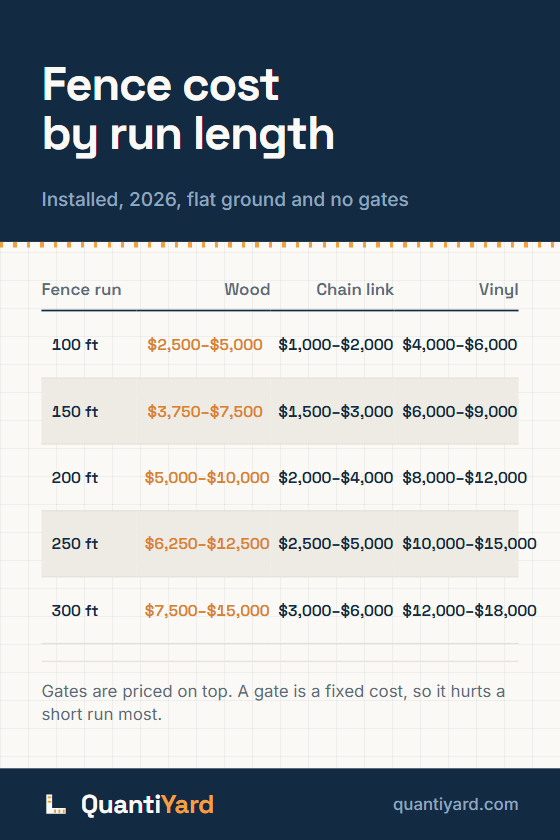
Save the fence cost chart#
Installed cost for five run lengths in wood, chain link, and vinyl. Save it and you can hold a fence bid against it in the driveway.
Save to PinterestOpens Pinterest with the chart and link ready to go.
Common questions#
How much does it cost to install a 150 foot fence?#
A 150 foot run costs $3,750 to $7,500 installed in wood privacy, $1,500 to $3,000 in chain link, $6,000 to $9,000 in vinyl, and $6,000 to $11,250 in aluminum. Building it yourself puts the materials somewhere between $750 in chain link and $6,750 in vinyl, most of that in posts, concrete, and the pickets or panels.
Is chain link or wood cheaper?#
Chain link is the cheapest fence to install, running $10 to $20 per linear foot against $25 to $50 for wood privacy. It buys no privacy and the fabric coating fades and rusts over time, so a lower price per foot does not always mean a lower cost over the life of the fence.
Should fence posts be set in concrete or gravel?#
Corner, end, and gate posts carry the sideways pull of the fence line and the swinging weight of any gate, so they should always be set in concrete. Line posts in between can sometimes go into compacted gravel or tamped soil instead, depending on the fence style and how stable the soil is.
Do I need a permit to install a fence?#
Often, once the fence passes a certain height or sits on or near the property line. Many municipalities exempt low fences, usually with a lower limit in a front yard than a back yard, but the threshold varies by town, and corner lots often carry separate sightline rules near intersections. Permits typically run $40 to $150 and sometimes require a survey to confirm the property line before you dig.