Shed Foundation Calculator
Enter your shed size and pick a foundation. A gravel pad has to run past the shed on every side, and that overhang is the part most estimates leave out.
Updated October 3, 2026 · Estimates for planning, not a quote
Gravel pad or slab
For most sheds a gravel pad is the better foundation and the cheaper one. It drains, it can be levelled by hand, it does not crack, and it does not need a frost footing because it moves with the ground rather than fighting it. A slab is worth it when the shed is a workshop with heavy equipment, when you want a finished floor, or when the local code requires one.
A 10 by 12 shed on a 6 inch pad with a 12 inch overhang takes 3.11 cubic yards, which is 4.36 to 4.67 tons of crushed stone at 1.4 to 1.5 tons a yard. The same footprint as a 4 inch slab is 1.48 cubic yards. The slab is less material and considerably more work, and at 67 bags of 80 lb mix it is well past the point where bags stop making sense.
The overhang is not optional
A gravel pad has to extend past the shed on every side, and 12 inches is the usual figure. The reason is water: rain coming off the roof lands beyond the wall, and if the pad stops at the wall that water hits soil right at the edge, undermines the stone and wicks back underneath. A pad that runs a foot proud gives the drip line somewhere to land and drain.
That overhang is also why a pad takes more material than people expect. On a 10 by 12 shed it turns a 120 square foot footprint into a 168 square foot pad, which is 40 percent more stone.
Building the pad
Strip the sod and topsoil first, because organic material under a pad decomposes and the pad settles into the hollow. Lay landscape fabric, then the stone in lifts of about 3 inches, compacting each one. Use angular crushed stone rather than rounded pea gravel: angular stone locks together and stays put, and round stone rolls and stays loose forever.
Contain the edge with timber or a paver border if the ground slopes at all, or the pad migrates downhill over a few seasons.
If you are pouring a slab
Four inches is standard for a shed, over 4 inches of compacted base, with the same stripping and fabric underneath. At 1.48 cubic yards, a ready-mix short load will usually cost less than the 67 bags, as long as a truck can reach the pad. Our concrete calculator gives the volume and all three bag sizes, and the bagged vs. ready-mix comparison works through short loads and the cases where bags still win.
For the stone either way, our gravel calculator converts yards to tons, which is the unit most stone yards quote and deliver in.
Method and sources
The 12 inch overhang past the shed walls is what shed builders and pad installers work to, so that runoff off the roof lands on stone rather than on soil at the edge of the pad. Six inches of gravel and four inches of slab are the matching rules of thumb for a garden building on stable ground.
The overhang is not trim. On a small shed it is about 40 percent of the stone, which is why the pad dimensions are the shed plus twice the overhang rather than the footprint. Bag yields and the crushed stone density are taken from the concrete and gravel calculators. A shed heavy enough to need footings, or one on made ground, is a different job.
QuantiYard writes its own formulas and states them in plain language on every page. How these numbers are made covers where the constants come from, how waste factors are chosen, what these calculators deliberately do not do, and how to report an error.
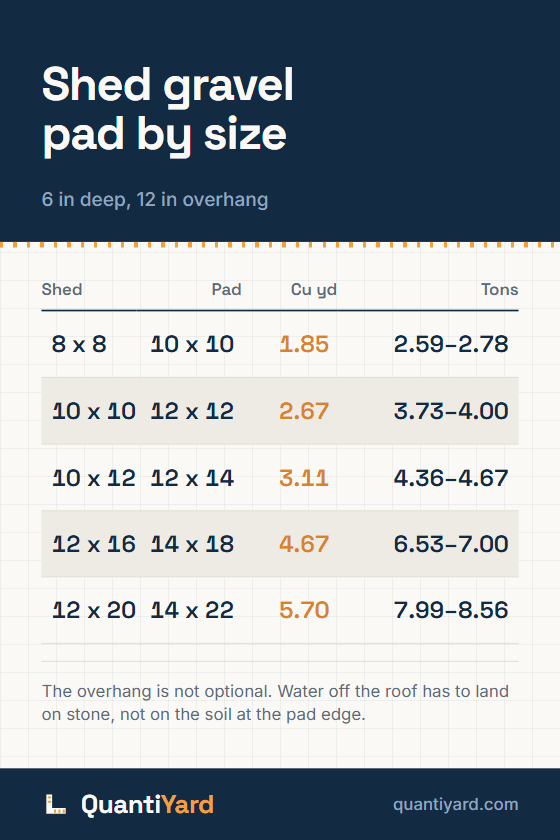
Save the shed pad chart
Pad size, cubic yards and tons for five shed sizes at 6 in deep. Save it before you order, because the pad runs a foot past the shed on every side.
Save to PinterestOpens Pinterest with the chart and link ready to go.
Shed Foundation Calculator FAQ
How much gravel do I need for a 10x12 shed?
About 3.11 cubic yards, or 4.36 to 4.67 tons of crushed stone, for a 6 inch pad with a 12 inch overhang on every side. The overhang turns the 120 square foot shed footprint into a 168 square foot pad, which is where 40 percent of that material goes. At 4 inches deep instead it drops to 2.07 cubic yards.
Does a gravel pad need to be bigger than the shed?
Yes, normally 12 inches past the shed on every side. Rain coming off the roof lands beyond the wall, and a pad that stops at the wall sends that water into the soil right at the edge, which undermines the stone and wicks back underneath. The overhang gives the drip line somewhere to land and drain away.
Gravel pad or concrete slab for a shed?
A gravel pad for most sheds. It drains, levels by hand, does not crack, and needs no frost footing because it moves with the ground. A slab is worth the extra work for a workshop with heavy equipment, for a finished floor, or where code requires it. A 10 by 12 slab at 4 inches is 1.48 cubic yards, which is past the point where bagged mix makes sense.
Cite this page
Built from this page's own title, URL and last-updated date, so a citation cannot drift from what it cites.