The quick answer#
Bulk mulch costs $20 to $80 per cubic yard, plus a delivery fee, and needs topping up every year. Crushed stone costs $15 to $75 per cubic yard and lasts a decade. On a 500 square foot bed, comparing the same end of each price range, rock is the cheaper option from year 2 or 3 onward and costs under half as much over ten years.
Mulch, bulk
$20–$80per cubic yardCrushed stone
$15–$75per cubic yardRiver rock
$45–$140per cubic yardCrossover
Year 2 or 3500 sq ft, like pricesThe prices per yard are close enough to be a rounding error. The whole difference is that one of them decomposes and the other does not. Mulch turns into soil, which is a feature, and needing to be bought again every spring, which is the price of that feature.
Side by side#
| Factor | Mulch | Rock |
|---|---|---|
| Cost per cubic yard | $20 to $80, plus delivery | $15 to $75 crushed, $45 to $140 river |
| Coverage depth | 3 inches | 2 to 3 inches |
| Lifespan before refresh | 1 year for a top-up | 10 years or more |
| Weed suppression | Good at 3 inches | Good, but weeds seed on top |
| Soil effect | Breaks down and feeds it | None, and it raises pH over time |
| Heat | Insulates, keeps roots cool | Absorbs and radiates it back |
| Slope behavior | Washes off, floats in heavy rain | Stays where you put it |
| Drainage | Holds moisture at the surface | Water passes straight through |
| Weight to move | About 500 lb per cubic yard | About 2,800 to 3,000 lb per cubic yard |
| Reversibility | Rototill it in and forget it | Has to be dug out by hand |
Rock weight is crushed stone at 1.4 to 1.5 tons per cubic yard as delivered, the same range the gravel calculator uses. That weight is why a rock bed is a one-time job and also why changing your mind about one is not.
The crossover year#
Here is a 500 square foot bed at 3 inches deep, which is 5.09 cubic yards and the depth that actually suppresses weeds. Mulch is priced at a full application in year one and a top-up of roughly half that volume each year after. Rock is priced with landscape fabric under it, because rock without fabric is a mistake you only make once.
| Line | Mulch | Rock |
|---|---|---|
| First application | $102–$407 | $76–$382 |
| Landscape fabric | — | $60–$225 |
| Yearly top-up | $51–$204 | — |
| Top-ups over 10 years | 9 of them | 2 of them |
| Ten-year total | $561–$2,243 | $236–$847 |
Mulch volumes and prices come from the mulch calculator at 3 inches with its 10 percent allowance. Mulch is bulk at $20 to $80 per cubic yard before the delivery fee, which a yearly top-up pays again each time. Rock is crushed stone at $15 to $75 per cubic yard, and its two top-ups are $50 to $120 each. Fabric is Lawn Love's $0.12 to $0.45 per square foot (How Much Does Mulch Cost, December 27, 2025). Neither figure includes labor, which favors rock in year one and mulch every year after.
Run the cumulative totals at the same end of each price range and the lines cross in year 2, though only by $4 at the dear end, and a fabric from the middle of Lawn Love's range under the cheapest stone pushes it to year 3. Call it year 2 or 3. Mulch starts $34 to $200 cheaper because there is no fabric to buy, and it gives that back with the first top-up or the second. By year 5, before any rock top-up, rock is ahead by $170 to $616, and by year 10 it has cost under half. Pair the cheapest mulch with the dearest stone and the crossover slides out past year 10, so price both locally. At matching prices it is not close.
The crossover is not the point
At like prices, rock wins on money in two or three years, and it is still the wrong choice around most plants. What you are buying with mulch is not ground cover, it is soil: organic matter breaking down into the bed year after year, feeding the plants, holding moisture, and keeping the root zone cool. Rock does none of that and slowly makes the bed a harder place to grow in. Pick rock where nothing needs to grow, and pay the subscription where something does.
Either way, start with volume
Cubic yards and bags for your beds
Enter the bed dimensions and the depth to get cubic yards and, if you are going bagged, the bag count.
What mulch does that rock cannot#
A bark mulch bed loses about an inch and a half a year, and that inch and a half does not vanish. It becomes organic matter in the top few inches of soil, which is where fine feeder roots live. Over five years, a mulched bed measurably improves: better structure, better water holding, more biological activity. This is the reason landscape professionals mulch ornamental beds and it has nothing to do with how it looks.
Rock does the opposite over a long enough period. It adds nothing, it compacts the soil beneath it under its own weight, and most decorative stone is limestone-based, which leaches calcium carbonate and pushes soil pH up. For acid-loving plants, azaleas, rhododendrons, blueberries, hydrangeas you want blue, that is a slow problem you will not notice until the leaves start yellowing.
There is also the practical matter of ever changing anything. Mulch can be turned into the bed with a rototiller and forgotten. A cubic yard of rock weighs about 2,800 to 3,000 pounds, and 5.09 of them is over 7 tons that has to come out by hand, one shovel at a time, if you ever want to plant there properly. Use the gravel calculator to see the tonnage before you order, because the volume figure understates the commitment badly.
Heat, slope, and drainage#
Heat#
Rock absorbs solar heat all day and radiates it back into the bed and the plants through the evening. In a cool climate that is neutral or even useful against a north wall. In a hot one it is a real stress on anything growing there, and a rock bed on a south or west exposure will run noticeably hotter than a mulched one a few feet away. Mulch does the opposite: it insulates, so the root zone stays cooler in summer and warmer through a cold snap.
Slope#
This is where rock wins outright. Mulch floats. A hard rain on a sloped bed moves bark chips downhill and into the lawn, the path, or the storm drain, and shredded hardwood knits together better than nuggets but still goes. Rock stays where you put it, which is why you see stone on every bed that borders a downspout, a swale, or a driveway edge.
If you are pricing a sloped bed in stone, run it through the gravel calculator rather than a mulch volume, because stone yards quote and deliver by the ton and the conversion is not something to do in your head at the counter. A 500 square foot bed at 3 inches is 5.09 cubic yards, which is 7.13 tons of crushed stone.
Drainage#
Water runs straight through rock, so a stone bed drains fast and dries fast. Mulch holds moisture at the surface, which is what you want around plants and exactly what you do not want against a foundation. A mulched bed pushed up against siding holds damp wood chips against it and invites both rot and termites. Whatever you use elsewhere, the strip within a foot of the house should be stone, and the mulch should stop short of the siding.
Weed suppression, in practice#
Both suppress weeds and neither prevents them, and the way each one fails is different enough to matter. This is the section where the marketing on both products oversells.
Mulch at 3 inches blocks light well enough that most seeds in the soil never germinate. What does get through is easy to pull, because the mulch stays loose. As the layer thins toward the end of the season the suppression fades, which is part of why the yearly top-up is not optional if weeds are the point. Two inches of mulch is a decorative layer, not a weed barrier, and the difference between 2 and 3 inches on a 500 square foot bed is only $34 to $136 of material.
Rock blocks light indefinitely, so nothing comes up from below. What happens instead is that dust, leaf litter, and seed blow in and build a thin layer of soil on top of the stone, and after three or four years weeds root in that. Pulling them is worse than in mulch, because the roots wrap around stone and the whole plant tears rather than lifting. Landscape fabric under the rock helps for the first few years and then becomes its own problem: it degrades, it surfaces in ugly strips, and the weeds root through it anyway.
Which to use where#
| Location | Use | Why |
|---|---|---|
| Shrub and perennial beds | Mulch | The soil benefit is the whole reason those beds do well. |
| Around trees | Mulch | Keeps roots cool and moist. Keep it off the trunk. |
| Vegetable beds | Mulch | Straw or leaf mulch, tilled in at the end of the season. |
| Foundation strip | Rock | Keeps damp organic matter off the siding. |
| Downspouts and swales | Rock | Moving water takes mulch with it. |
| Slopes | Rock | Mulch floats downhill in heavy rain. |
| Side yards and paths | Rock | Nothing is growing there, so nothing needs feeding. |
| Fire-prone areas | Rock | Bark mulch is fuel within 5 feet of a structure. |
The pattern is simple enough to state in one line: mulch where something is growing, rock where nothing is.
One last practical note. If you are switching a bed from mulch to rock, do the arithmetic on removal first: whatever mulch is in there has to come out, or the rock sinks into it over two seasons and you end up with both. And if you are switching rock to mulch, price the removal in hours rather than dollars. Run the volume through the mulch calculator either way, because a bed almost always measures smaller than it looks.
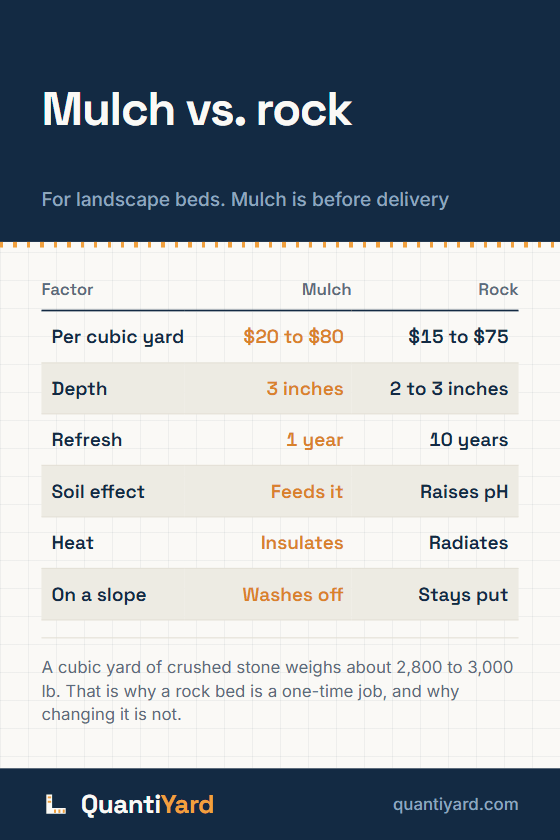
Save the mulch vs. rock chart#
Cost per yard, refresh interval, soil effect, heat, and slope behavior for both. Save it before you order a bed's worth of either.
Save to PinterestOpens Pinterest with the chart and link ready to go.
Common questions#
Is rock cheaper than mulch?#
Not up front, and from year 2 or 3 onward when you compare the same end of each price range. On a 500 square foot bed at 3 inches, mulch is $102 to $407 for the first application and rock is $76 to $382 plus $60 to $225 of fabric. Mulch then needs $51 to $204 of top-up every year, and rock needs two top-ups in a decade. Over ten years mulch runs $561 to $2,243 before delivery fees and rock runs $236 to $847.
How deep should mulch and rock be?#
Three inches of mulch, which is the depth that actually suppresses weeds. Two inches is decorative and lets seeds through, and the difference on a 500 square foot bed is only $34 to $136 of material. Rock works at 2 to 3 inches, and going deeper adds weight and cost without adding suppression, since rock blocks light at any depth.
Does rock damage soil?#
Slowly, yes. It adds no organic matter, it compacts the soil beneath it under its own weight, and most decorative stone is limestone-based, so it leaches calcium carbonate and raises soil pH over time. That is a problem for acid-loving plants like azaleas, rhododendrons, blueberries, and hydrangeas. Use rock where nothing needs to grow.
Can I put rock over existing mulch?#
Not without taking the mulch out first. The mulch underneath keeps decomposing and the rock sinks into it over about two seasons, and you end up with a bed that is neither one thing nor the other and is much harder to fix. Strip the mulch, lay fabric, then rock. A cubic yard of rock weighs about 2,800 to 3,000 pounds, so plan the removal before you order the stone rather than after.