The quick answer#
Gravel costs $4 to $10 per square foot installed and concrete costs $6 to $15. On a typical 480 square foot two-car driveway that is $1,920 to $4,800 against $2,880 to $7,200. Gravel is about two thirds of the price up front, and on published figures it stays cheaper for the whole life of a concrete drive.
Gravel, installed
$4–$10per sq ftConcrete, installed
$6–$15per sq ftGravel, 10 years
$1,920–$4,800480 sq ft, before regradingConcrete, 10 years
$4,420–$14,800480 sq ftSo this is not a money decision, however much it looks like one. If cost were the only input, gravel would win at every horizon a homeowner actually plans over. The reasons to pour concrete are snow, wheels, slope, and the neighborhood, and all four of them are real. What follows is the case for each, with the numbers behind it, rather than a verdict.
Side by side#
| Factor | Gravel | Concrete |
|---|---|---|
| Installed cost | $4 to $10 per sq ft, $1 to $3 for the stone alone | $6 to $15 per sq ft |
| 480 sq ft driveway | $1,920 to $4,800 | $2,880 to $7,200 |
| Lifespan | Up to 100 years with a stable base | 30 to 40 years |
| Maintenance | Regrade and top up as needed | Reseal every 2 to 3 years |
| Maintenance cost | No published rate | $1 to $3 per sq ft hired |
| Drainage | Permeable, water goes through | Impermeable, needs slope |
| Freeze-thaw | Heaves and ruts, does not crack | Cracks and spalls, salt-sensitive |
| Snow removal | Plow lifts the stone | Plow, shovel, or blow freely |
| Resale | Neutral to negative in a paved street | Positive, expected in most suburbs |
| DIY feasibility | Genuinely doable in a weekend | Not a homeowner job past a small pad |
Installed and maintenance figures match the ones in our driveway cost guide, which prices gravel, asphalt, concrete, and pavers side by side across five driveway sizes.
The ten-year number#
Upfront price is the wrong comparison for a surface one of which is maintained yearly and the other of which is not. Here is the same 480 square foot driveway over a decade.
| Line | Gravel | Concrete |
|---|---|---|
| Installation | $1,920–$4,800 | $2,880–$7,200 |
| Regrade and top up | Not priced | — |
| Sealing, hired, 3 to 5 times | — | $1,440–$7,200 |
| Crack repair over 10 years | — | $100–$400 |
| Ten-year total | $1,920–$4,800 plus regrading | $4,420–$14,800 |
Concrete resealing is $1 to $3 per square foot hired, every 2 to 3 years, so three to five times in a decade, and minor crack repair is $100 to $400. No published survey prices regrading and topping up a gravel drive, so the gravel column carries installation only. Each total pairs the cheap end of every line with the cheap end and the dear with the dear. Neither figure includes snow removal, which favors concrete, or drainage work, which favors gravel.
The gap widens rather than closes. Professional sealing alone adds $160 to $720 a year to the concrete, $1 to $3 a square foot every 2 to 3 years on 480 square feet. Starting from the installed prices, and pairing cheap with cheap and dear with dear, gravel stays cheaper through the whole 30 to 40 year life of a concrete drive unless its own upkeep tops about $190 to $800 a year. No published figure says whether it does, so on published numbers the two do not cross within concrete’s life, and your local cost for a load of stone is what would change that.
What this does and does not prove
It shows that "concrete pays for itself over time" is not supported on a driveway by published materials and maintenance figures. It does not prove gravel is the better surface. Everything gravel gives up, it gives up in use rather than in dollars: stone in the lawn, ruts after a wet spring, a surface a bike or a wheelchair or a shovel fights, and dust in a dry August. Those are real costs. They just are not on an invoice.
Freeze, thaw, and drainage#
The two surfaces fail in completely different ways, and which failure you would rather have is most of the decision in a cold climate.
Gravel heaves, concrete cracks#
Gravel has no continuous surface to crack, so a freeze cycle moves it and it settles back. What it does instead is heave and rut: water in the base freezes, lifts, and leaves depressions where the tires run. The fix is a regrade, which is a rake and a few hours, or a drag behind a tractor. It is not a repair so much as maintenance that was always going to happen.
Concrete cracks. Air-entrained concrete, proper control joints, and a base that drains will keep the cracking to the joints where it belongs, but the surface is rigid and the ground is not. Add deicing salt in the first winter, before the concrete has fully cured, and you get spalling: the surface flakes away and cannot be repaired, only resurfaced or replaced. Almost every ruined-looking driveway you pass was salted too early.
Drainage is the underrated one#
Gravel is permeable. Water goes through it into the base and the soil, which is why gravel is the default on a lot that already struggles to shed water, and why some municipalities count it differently in impervious surface calculations. Concrete sheds everything it receives, so a 480 square foot driveway adds 480 square feet of runoff going somewhere, which on a sloping lot is usually toward the house.
Both surfaces sit on the same base, and that base is not optional in either case. A driveway wants 8 to 12 inches of compacted crushed stone against the 4 to 6 inches a patio takes, and skimping there is what kills a driveway of either kind. The gravel calculator will convert your area and depth to cubic yards and tons, which matters because stone yards quote by weight.
Either way, the base first
Cubic yards and tons of crushed stone
Enter the driveway area and the base depth to get cubic yards and tons, so you can order in the unit the stone yard actually quotes in.
DIY feasibility#
This is the least ambiguous section on the page. Gravel is a genuine homeowner project. Concrete is not.
A gravel driveway is excavation, geotextile fabric, and stone in lifts, compacted. The hardest part is the excavation, and the practical answer is to rent a machine for a day. Material for a 480 square foot driveway at 10 inches of base is about 14.8 cubic yards, or 20.7 to 22.2 tons of crushed stone at 1.4 to 1.5 tons a yard, which is two or three truckloads, and the gravel calculator gives both figures from the area and depth.
Concrete at driveway scale is not the same category of job. A 480 square foot slab at 4 inches is 5.9 cubic yards, which is a ready-mix truck rather than bags, and once that truck arrives the clock is running. Placing, screeding, floating, edging, jointing, and finishing that much concrete before it goes off takes a crew who have done it before. The concrete calculator will size the pour precisely, and it is worth running even if a contractor is doing the work, because ordering short on a driveway means a cold joint straight across the middle of it.
If you are pouring
Cubic yards for the slab
Enter the driveway dimensions and the slab thickness to get cubic yards and bag counts, and see whether the pour is a truck or a mixer.
Resale and the street#
Appraisers rarely add a line for a driveway. What they do is note it, and what buyers do is react to it. A gravel drive on a rural property or a long approach reads as normal and costs nothing at sale. The same gravel drive in a suburb where every other house is poured concrete reads as deferred maintenance, and it becomes a negotiating point whether or not it deserves to be.
That is the fair version of the resale argument. It is not that concrete adds its cost back in value, because it usually does not. It is that gravel can subtract value in a context where it looks out of place, and the size of that subtraction has nothing to do with how well the gravel drive performs.
A decision framework#
Work down this list and most driveways answer themselves.
Gravel is the right call when#
The driveway is long, because cost scales linearly and a 200 foot approach in concrete is a different order of project. The lot has drainage problems, or your municipality counts impervious surface. The property is rural or semi-rural, where gravel is the local normal. You are doing the work yourself. The budget is real and the alternative is waiting three years. Or you are prepared to regrade it every couple of years and would rather spend the difference elsewhere.
Concrete is the right call when#
You plow or shovel snow, because a plow blade lifts loose stone and scatters it into the lawn every winter. The driveway is short and suburban, where the cost difference is a few thousand rather than a few tens of thousands. It slopes, because gravel migrates downhill and you will be shovelling it back up. Anyone in the household uses a wheelchair, a walker, a stroller, or learns to ride a bike on it. You park anything heavy, since concrete carries load that ruts gravel. Or the street is uniformly paved and you expect to sell within a few years.
The middle answer#
A concrete apron at the street and the garage with gravel in between is common, cheap, and solves most of the objections at once. The apron takes the plow, the turning, and the visual, and the long middle stays permeable and inexpensive. On a 480 square foot driveway, putting 120 square feet in concrete and 360 in gravel is $2,160 to $5,400, sitting neatly between the two. If you want the full price picture across all four surfaces, our driveway cost guide covers gravel, asphalt, concrete, and pavers by size.
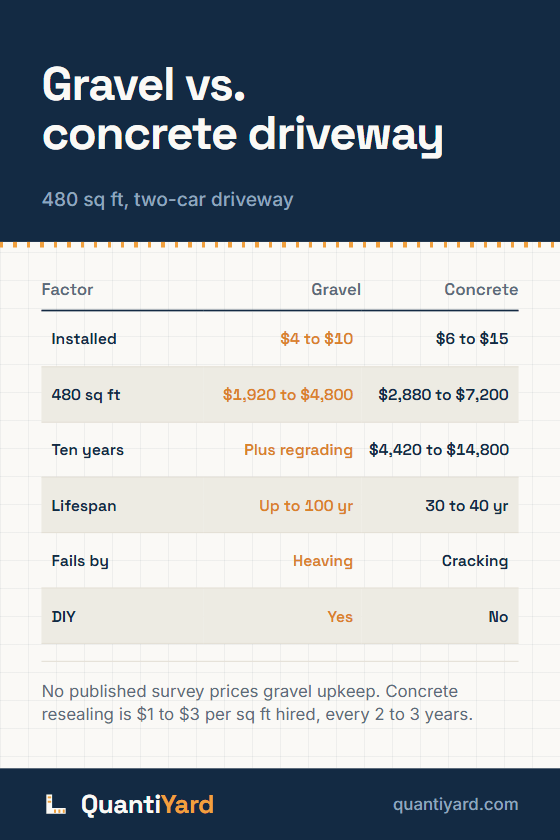
Save the driveway comparison#
Cost, ten-year total, lifespan, and how each surface fails, side by side. Save it before you take a driveway quote.
Save to PinterestOpens Pinterest with the chart and link ready to go.
Common questions#
Is a gravel driveway cheaper than concrete?#
Yes, and on published figures it stays cheaper. Gravel is $4 to $10 per square foot installed against $6 to $15 for concrete, so a 480 square foot driveway is $1,920 to $4,800 against $2,880 to $7,200. Over ten years concrete runs $4,420 to $14,800 with professional sealing and minor repairs, while gravel's regrading has no published rate. Concrete only catches up within its 30 to 40 year life if gravel upkeep tops about $190 to $800 a year.
How long does a gravel driveway last?#
Up to 100 years with a stable base and regular upkeep, on HomeGuide's figures. There is no surface to fail, so the driveway is only as good as its last regrade, and no published survey puts a rate on that. Concrete lasts 30 to 40 years and then needs replacing outright, which is the difference between a maintained surface and a wearing one.
Which is better in snow, gravel or concrete?#
Concrete, clearly. A plow blade lifts loose stone and scatters it into the lawn, so a gravel drive that gets plowed loses material every winter and needs raking back in every spring. Shovels and snow blowers have the same problem. If you clear snow mechanically, concrete is worth the extra cost for that reason alone.
Does a gravel driveway hurt resale value?#
It depends entirely on the street. On a rural or semi-rural property, gravel reads as normal and costs nothing at sale. In a suburb where every other driveway is poured, it reads as deferred maintenance and becomes a negotiating point. Appraisers rarely add value for concrete, but buyers do subtract for gravel that looks out of place.