Chain Link Fence Calculator
Enter your run, height and corners to get every part of the fence, including the tension bands and ties that are always the second trip to the store.
Updated September 7, 2026 · Estimates for planning, not a quote
How a chain link fence is counted
Two kinds of post, and the difference matters more than the count. Terminal posts are the ends, the corners and both sides of every gate opening: they take the full pull of the stretched fabric and are a larger diameter and heavier gauge. Line posts sit between them at up to 10 feet apart, carry almost no tension, and only hold the fabric up.
The line post count is one fewer than the number of bays the run divides into, because the bay ends are terminal posts. A 100 foot run at 10 foot spacing is 10 bays, so 9 line posts, plus whatever terminals the layout needs. With two ends, two corners and one gate, that is 6 terminals and 15 posts in total.
The fittings nobody counts
Fabric is stretched between terminal posts and held there by a tension bar, a flat bar woven vertically through the last row of diamonds, which is then clamped to the post with tension bands. One bar per terminal, and bands spaced roughly a foot apart up the post, so a 4 foot fence takes three bands per terminal. Each terminal also takes a rail end to receive the top rail.
Then ties: soft aluminium wire twisting the fabric to the frame, every 24 inches along the top rail and every 12 inches down each line post. On a 100 foot 4 foot fence that is about 77 ties. They cost almost nothing and running out of them stops the job.
Top rail and fabric come in fixed lengths
Top rail is sold in 21 foot sticks that sleeve into each other, so a 100 foot run takes 5. Fabric comes in 50 foot rolls, so the same run takes 2. Neither is cut per bay, which is what makes chain link quick to install compared with a panel fence.
What this does not size
Post depth and diameter. Those depend on the fence height, your soil and the local frost line, and they are the part worth checking against code rather than a chart. As a rule terminal posts go deeper and wider than line posts, and every post in a fence that has to resist wind loading on privacy slats goes deeper again.
For the concrete in the holes, our concrete calculator takes a hole diameter and depth and gives bags per hole. For what a finished fence costs across materials, the fence installation cost guide puts chain link next to wood, vinyl and aluminium per linear foot, and our fence calculator covers post and panel counts for board fences.
Method and sources
Where these figures come from: ASTM F567-23, Standard Practice for Installation of Chain-Link Fence. Clause 4.1 says to "space line posts equidistant at intervals not exceeding 10 ft", which is the default here and the reason it is a maximum rather than a target. Clause 4.2 sets terminal posts "at the beginning and end of each continuous length of fence and at abrupt changes in vertical and horizontal alignments", and names end, corner and gate posts as terminals, which is exactly how they are counted. The wording is unchanged from F567-14a (Reapproved 2019).
Terminal posts are heavier and separately priced, so the card splits them out rather than giving one post count. Line posts come to one fewer than the bays the run makes, because terminals stand at both ends. What is not in F567 and does not pretend to be: the 21 foot top rail sticks and 50 foot fabric rolls are supplier stock sizes, and the tie, band and rail end counts are installer practice.
QuantiYard writes its own formulas and states them in plain language on every page. How these numbers are made covers where the constants come from, how waste factors are chosen, what these calculators deliberately do not do, and how to report an error.
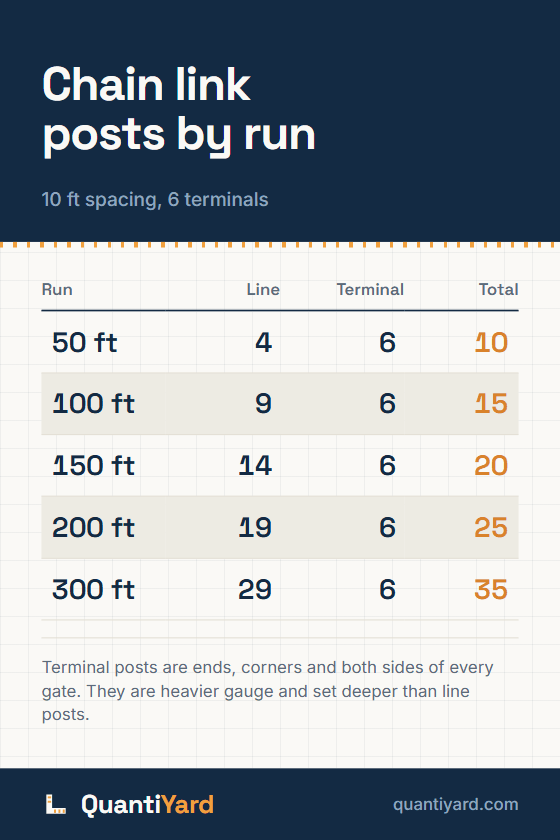
Save the post count chart
Line posts, terminal posts and the total for five fence runs at 10 ft spacing. Save it before you order, because terminal posts are a different and heavier part.
Save to PinterestOpens Pinterest with the chart and link ready to go.
Chain Link Fence Calculator FAQ
How far apart should chain link fence posts be?
Line posts go up to 10 feet apart, and 10 is the usual spacing. Closer spacing adds stiffness on a tall fence or one carrying privacy slats, which take wind load. Terminal posts are not on that spacing at all: they go wherever the fence ends, turns a corner or meets a gate, and the line posts fill in between them.
What is the difference between a line post and a terminal post?
Terminal posts are the ends, corners and gate posts, and they carry the full tension of the stretched fabric, so they are a larger diameter and a heavier gauge and set deeper. Line posts sit between them and only hold the fabric up. Using a line post at a corner is the most common chain link mistake, and it shows as a leaning corner inside a year.
How many tension bands do I need?
Roughly one per foot of fence height less one, on every terminal post. A 4 foot fence takes three bands per terminal, a 6 foot fence takes five. Each terminal also needs one tension bar and one rail end. With six terminal posts on a 4 foot fence that is 18 bands, 6 bars and 6 rail ends.
Cite this page
Built from this page's own title, URL and last-updated date, so a citation cannot drift from what it cites.