Driveway Sealer Calculator
Enter your driveway and how rough the surface is. Coverage swings by more than half between smooth and weathered asphalt, which is why one number off a label is not enough.
Updated September 7, 2026 · Estimates for planning, not a quote
How much sealer a driveway takes
Area times coats, divided by the coverage a pail gives on your surface, rounded up. The arithmetic is trivial. The variable that actually decides the answer is the surface, and it swings coverage from about 250 square feet a pail on rough porous asphalt to 400 on a drive sealed a couple of years ago. That is a 60 percent spread on the same product.
A 20 by 50 foot driveway is 1,000 square feet. Two coats on average asphalt is 2,000 square feet of coverage to apply, which at 300 square feet a pail is 7 pails and 35 gallons. On smooth asphalt the same job is 5 pails; on rough it is 8.
The first coat is the expensive one
Porous asphalt absorbs sealer rather than holding it on the surface, so a driveway that has never been sealed swallows the first coat and gives much better coverage on the second. Buying at the rough figure for both coats overbuys; buying at the smooth figure for both underbuys and leaves you short halfway through coat two. If the drive is unsealed, budget the rough number for coat one and something closer to average for coat two.
Preparation decides whether it lasts
Sealer bonds to clean asphalt and to nothing else. Oil and transmission fluid have to be degreased out or spot-primed, because sealer laid over an oil stain lifts off in a sheet the first hot week. Sweep the whole surface, pull any weeds out of the cracks, and fill cracks wider than about a quarter inch with crack filler and let it cure before sealing.
Weather matters as much. You want it above 50 degrees for a full 24 hours, no rain in the forecast for 48, and ideally not in direct midday sun, which skins the surface before the sealer underneath has cured. Overnight dew on a fresh coat is enough to ruin it.
How often
Every two to three years is the usual answer, and more often than that is actively bad: sealer built up too thick cracks and peels in sheets. A driveway that still beads water and shows no lightening of colour does not need doing yet. If you are weighing sealing against replacing, our driveway cost guide prices all four surfaces by size, and the gravel vs. concrete comparison runs the ten-year number.
Method and sources
Where these figures come from: Spread rate as stated on the pail, typically 400 square feet per 5 gallon pail on smooth asphalt, 300 on average and 250 on rough or porous.
Area times the number of coats, divided by that coverage. The surface, not the size of the drive, is what moves the count: the same drive takes five pails smooth and eight rough.
QuantiYard writes its own formulas and states them in plain language on every page. How these numbers are made covers where the constants come from, how waste factors are chosen, what these calculators deliberately do not do, and how to report an error.
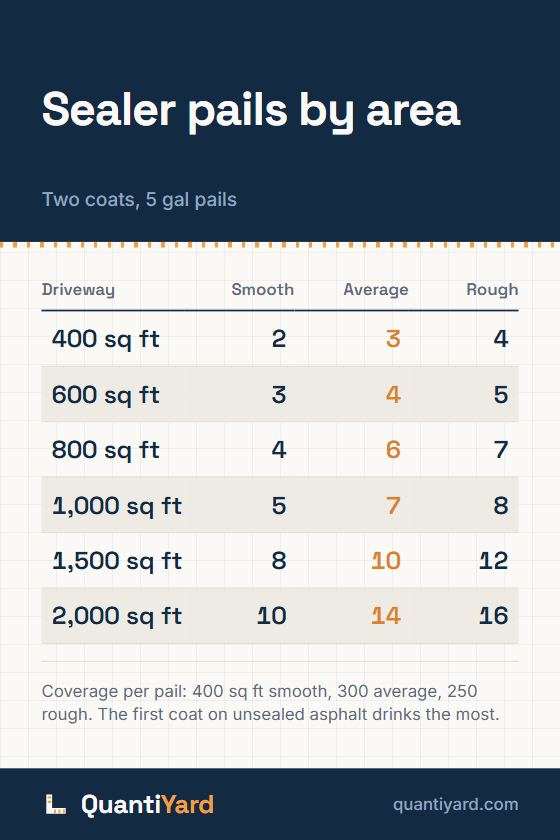
Save the sealer chart
Pails of 5 gal for six driveway sizes across all three surface conditions, two coats in. Save it before you buy, because a rough drive takes half again as much.
Save to PinterestOpens Pinterest with the chart and link ready to go.
Driveway Sealer Calculator FAQ
How many buckets of sealer do I need for my driveway?
For a 20 by 50 foot driveway, which is 1,000 square feet, two coats on average asphalt takes 7 pails of 5 gallons. The figure moves with the surface: about 400 square feet per pail on smooth recently sealed asphalt, 300 on average, and 250 on rough or never sealed, which is a 60 percent spread on the same product.
How many coats of driveway sealer do I need?
Two is standard. One coat on a previously sealed drive in good condition is defensible and will not last as long. Three is not better: sealer built up too thick cracks and peels off in sheets. On a driveway that has never been sealed, expect the first coat to absorb far more than the second, so buy at the rough coverage figure for coat one.
When is it too cold to seal a driveway?
Below about 50 degrees, and the temperature has to hold above that for a full 24 hours after application, not just while you are working. Give it 48 hours clear of rain as well. Overnight dew on a coat that has not cured is enough to ruin it, so late season sealing in a cool climate is a genuine risk however good the afternoon looks.
Cite this page
Built from this page's own title, URL and last-updated date, so a citation cannot drift from what it cites.