Wallpaper Calculator
Enter your room and roll size to get the rolls you need. This counts in strips, the way a paperhanger does, because square footage alone will short you every time there is a pattern.
Updated October 2, 2026 · Estimates for planning, not a quote
How to estimate wallpaper
Wallpaper is sold by the roll and hung in strips, and the two only line up if you count strips. A square footage estimate divides the wall area by the roll area and quietly assumes you can use every inch of every roll, which you cannot: each strip is cut to the ceiling height and whatever is left at the end of the roll is offcut.
The method here is the one a paperhanger uses. Divide the wall perimeter by the roll width to get the number of strips. Work out how long each strip has to be cut, then see how many of those fit in a roll, rounding down. Divide one by the other and round up.
Why the pattern repeat costs you rolls
A plain paper cuts to the ceiling height plus a few inches of trim. A patterned paper has to be cut longer, because each strip must start at the same point in the pattern as its neighbour, and getting there means sliding the strip up or down by as much as one full repeat. So the cut length is the wall height plus the repeat plus the trim.
On a 33 ft roll with an 8 ft ceiling, a plain paper gives three strips per roll with exactly 8 ft left over. Add a 21 inch repeat and the cut length goes to 10 ft 1 in, which still gives three strips but wastes nearly all the remainder. Push the ceiling to 9 ft with that repeat and you drop to two strips a roll, which is half as much paper again for the same wall. Repeat and ceiling height interact, and it is worth checking both before ordering.
Windows, doors and why we only subtract doorways
This calculator takes full-height doorways off the perimeter and nothing else. A window sits in the middle of a wall, so the strip above and below it still has to be cut full length and hung, and treating a window as missing wall is the standard way to end up short. A doorway is different: it runs floor to ceiling, so the wall genuinely is not there.
Order it all at once
Wallpaper is printed in batches and colour drifts between them. Buying one roll short and going back for it is how people end up with a visible seam in the middle of a finished wall. Work out the number, add a roll if the count came out close to a boundary, and buy them together with the same batch number on every label.
Painting the room instead, or as well? Our paint calculator works the wall area out the same way, minus doors and windows, and our cost to paint a room guide prices the job by room size.
Method and sources
Strips is the wall length divided by the roll width. Strips per roll is the roll length divided by the cut length, rounded down, because a strip two inches short is waste rather than a strip. Both are arithmetic over the roll dimensions printed on the label.
Counting strips rather than square feet is the only way a pattern repeat can be accounted for: every strip is cut to the wall height and the remainder of the roll is offcut, so square footage alone will short you. The cut length adds the repeat plus 2 inches of trim top and bottom. Only doorways come off the perimeter, because a strip over a window is still cut from a full drop.
QuantiYard writes its own formulas and states them in plain language on every page. How these numbers are made covers where the constants come from, how waste factors are chosen, what these calculators deliberately do not do, and how to report an error.
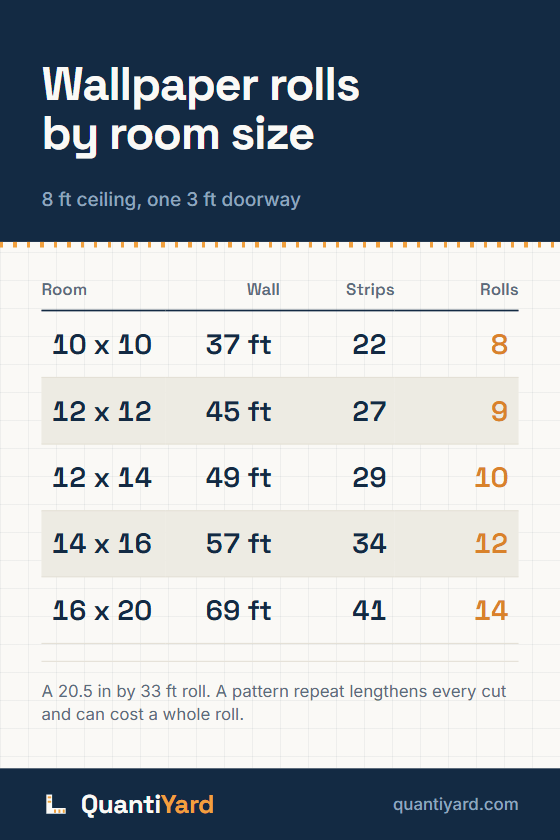
Save the wallpaper chart
Rolls for five room sizes at an 8 ft ceiling, counted in strips the way a paperhanger counts. Save it before you order, because square footage alone will short you.
Save to PinterestOpens Pinterest with the chart and link ready to go.
Wallpaper Calculator FAQ
How many rolls of wallpaper do I need for a 12 by 14 room?
Ten rolls for an 8 foot ceiling with a plain paper, one 3 foot doorway, and a standard 20.5 inch by 33 foot roll. That room has 52 feet of wall, 49 after the doorway, which is 29 strips. At 8 foot 4 inch cut length you get 3 strips from a roll, so 29 divided by 3 rounds up to 10.
Does the pattern repeat change how much wallpaper I need?
Yes, sometimes by a whole extra roll or more. Each strip has to be cut to the wall height plus one full repeat, so the pattern can be slid to line up with the strip beside it. A larger repeat means longer cuts, fewer strips per roll, and more rolls. It is the single biggest thing people leave out of a wallpaper estimate.
Should I subtract windows from the wall area?
No. A window sits in the middle of a wall, so the strips above and below it still have to be cut to full length and hung, and the offcut is rarely usable anywhere else. This calculator subtracts full-height doorways, where the wall genuinely is not there, and leaves windows in.
Cite this page
Built from this page's own title, URL and last-updated date, so a citation cannot drift from what it cites.