Pool Volume Calculator
Enter your pool shape and depths to get the volume in gallons. Every chemical dose you will ever add is based on this number, so it is worth getting right once.
Updated September 7, 2026 · Estimates for planning, not a quote
How to work out pool volume
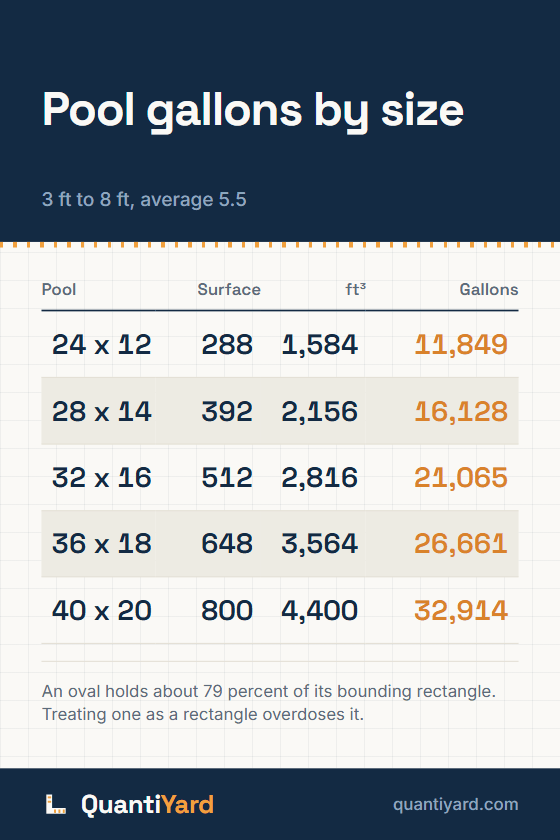
Surface area times average depth gives cubic feet, and a cubic foot of water is 7.48 gallons. That constant is the whole conversion. A 16 by 32 foot rectangular pool running from 3 feet to 8 feet has an average depth of 5.5 feet, so 2,816 cubic feet, so 21,065 gallons.
Shape only changes how the surface area is found. A rectangle is length times width. A round pool is pi times the radius squared. An oval is the ellipse inside its bounding box, which is pi over four of the rectangle, or about 79 percent of it, and treating an oval as a rectangle is a common way to overdose a pool by a fifth.
Average depth, and where it goes wrong
Averaging the shallow and deep ends assumes the floor slopes evenly between them, which is how most pools are built. Where it breaks down is a pool with a long flat shallow section and a sudden hopper at one end: that shape holds noticeably less water than the average of its two depths implies, because most of the floor area is at the shallow depth.
If that describes your pool, treat the figure here as an upper bound. For dosing, erring low is the safer direction: you can always add more chemical, and you cannot take it out.
Gallons per inch is the number you will actually use
Total volume gets used once. Gallons per inch of depth gets used every time you top up after a hot week, work out how much water an evaporation loss represents, or dose a partial fill. For that 16 by 32 pool it is 319 gallons an inch, so a two inch drop is 638 gallons of make-up water and a corresponding correction to the chemistry.
Turnover
The flow figure is what a pump would have to move to turn the whole volume over once in eight hours, which is the usual design target for residential pools. It is a sanity check on a pump rather than a specification: real head loss through the plumbing, filter and heater means the pump curve matters as much as the volume does.
Putting a patio or a surround around it? Our paver calculator handles pavers, base and sand by area, and the concrete calculator covers a poured deck.
Method and sources
Where these figures come from: 7.48052 US gallons per cubic foot, and 3.785412 litres per US gallon.
Area is by shape, an oval being the ellipse inscribed in its bounding rectangle. Average depth is the mean of the shallow and deep ends, which assumes the floor slopes evenly between them. Gallons per inch is the figure to use for topping up or dosing.
QuantiYard writes its own formulas and states them in plain language on every page. How these numbers are made covers where the constants come from, how waste factors are chosen, what these calculators deliberately do not do, and how to report an error.
Save the pool gallons chart
Gallons for five rectangular pool sizes at an average depth of 5.5 ft. Save it before you dose anything, since every chemical label is written per 10,000 gallons.
Save to PinterestOpens Pinterest with the chart and link ready to go.
Pool Volume Calculator FAQ
How many gallons is a 16 by 32 foot pool?
About 21,065 gallons if it runs from 3 feet at the shallow end to 8 feet at the deep end, giving an average depth of 5.5 feet. The arithmetic is 16 times 32 times 5.5, which is 2,816 cubic feet, times 7.48 gallons per cubic foot. Change the depths and the volume moves proportionally.
How do I calculate the volume of an oval pool?
Take pi times half the length times half the width to get the surface area, then multiply by the average depth and by 7.48 gallons per cubic foot. An oval holds about 79 percent of what its bounding rectangle would, so treating an oval as a rectangle overstates the volume by roughly a fifth and overdoses every chemical you add.
What is gallons per inch and why does it matter?
It is the water in one inch of depth across the pool's surface, and it is the figure you use every time you top up or dose a partial fill. For a 16 by 32 foot pool it is 319 gallons per inch, so a two inch drop after a hot week is 638 gallons. Total volume gets used once; this one gets used all season.
Cite this page
Built from this page's own title, URL and last-updated date, so a citation cannot drift from what it cites.