The quick answer#
Luxury vinyl plank costs $4 to $16 per square foot installed, laminate costs $4 to $14, and solid hardwood costs $11 to $25. LVP and laminate are close enough on price that the choice between them is water, not money. Hardwood costs 1.6 to 2.75 times as much and is the only one of the three you can refinish.
Luxury vinyl plank
$4–$16per sq ft installedLaminate
$4–$14per sq ft installedEngineered wood
$7–$20per sq ft installedSolid hardwood
$11–$25per sq ft installedEngineered wood sits in the middle and is worth keeping in the conversation, because it is real wood over a plywood core and it goes places solid hardwood cannot, including over a slab. Think of it as the hardwood option for anywhere below grade or over concrete.
Side by side#
| Factor | LVP | Laminate | Hardwood |
|---|---|---|---|
| Material only | $2.00 to $10.00 | $1.00 to $6.00 | $4.00 to $15.00 |
| Installed | $4.00 to $16.00 | $4.00 to $14.00 | $11.00 to $25.00 |
| Core | Solid vinyl or SPC | Compressed wood fiber | Solid wood |
| Standing water | Survives it | Swells permanently | Cups and stains |
| Durability rating | Wear layer, in mils | AC1 to AC5 | Janka hardness |
| Refinishable | No | No | 4 to 10 times |
| Lifespan | 10 to 25 years | 10 to 25 years | Generations, with refinishing |
| Underfoot | Softer, warmer, quieter | Hard and hollow without pad | Solid and warm |
| Over a slab | Yes | Only with a vapor barrier | No |
| Resale effect | Neutral | Slightly negative | The one buyers pay for |
Installed prices assume a flat, sound subfloor with the old floor already removed, and match the ones in our flooring cost guide. Subfloor replacement, where it is needed, adds $2.20 to $4.75 per square foot and appears in neither number.
Water is the real divide#
LVP and laminate look almost identical on a showroom floor, click together the same way, and cost within a dollar of each other. Then one of them meets a dishwasher leak.
Laminate's core is compressed wood fiber. It handles a wiped-up spill perfectly well, and it handles standing water not at all: once water gets through the seams the core swells, and swelling is permanent. The plank does not dry back down. A single overnight leak in a kitchen can mean replacing the run, and because laminate is installed as a floating field, replacing a plank in the middle usually means lifting everything from the nearest wall to get to it.
LVP's core is vinyl, either solid or a stone-plastic composite. Water does nothing to it. A sheet of LVP can sit in a puddle indefinitely and come out unchanged, which is why it has taken over basements, kitchens, mudrooms, and rental properties in the space of about a decade. What water can still do is get underneath it and sit on the subfloor, so LVP is waterproof rather than a waterproofing system, but the floor itself survives.
Hardwood is the most water-sensitive of the three and the most repairable. Boards cup when they take on moisture from below and stain when they take it from above, and both are visible. But a hardwood floor can be sanded and refinished, and individual boards can be cut out and woven in, so a water event is a repair rather than a replacement. That is a genuinely different relationship with damage.
Whichever you pick
Boxes and square footage with waste
Enter the room size and the box coverage to get the boxes you need, at 10 percent waste for a straight layout or 15 for a diagonal.
Durability ratings decoded#
Each of the three is rated on a different scale, which makes them impossible to compare directly and easy to be sold on. Here is what each scale actually measures.
| Floor | Scale | What to buy |
|---|---|---|
| LVP | Wear layer, in mils | Thicker for more traffic. No published standard sets a figure per room, so compare warranties. |
| Laminate | AC rating, AC1 to AC5 | Higher is more durable. NALFA certification names the use level a product passed. |
| Hardwood | Janka hardness | A harder species dents less. |
The LVP wear layer is the clear film over the print layer and it is the number that matters most on that product. Two planks with very different wear layers can look identical in a showroom and wear completely differently in a hallway.
The trap is that the cheapest version of each of these three is much worse than the mid version, and looks the same. A thin-wear-layer LVP, a low-AC laminate in a busy room, or a soft wood in an entry will all wear early, and none of that shows in the photograph. If a quote is at the bottom of the installed range, the wear layer or the AC rating is usually where it got there.
Refinishing and lifespan#
This is the whole argument for hardwood, and it is a strong one. Solid hardwood can be sanded and refinished 4 to 10 times, depending on its thickness and how often it has been done before, and HomeGuide suggests doing it every 7 to 10 years. A floor that looks finished can be brought back to new for $2 to $8 per square foot, against $4 to $25 to replace any of the three.
Engineered wood can be refinished fewer times than solid, and how many depends on the veneer. HomeGuide puts engineered veneers at 2 to 6 mm, says 4 to 6 mm allows multiple refinishes, and calls sanding anything under 2 mm risky. That single spec decides whether the floor can ever be brought back, and it is worth asking about before anything else on an engineered product.
LVP and laminate cannot be refinished at all. The visible surface is a printed image under a wear layer, and once that layer is through, the plank is done. This is not a flaw so much as a different model: they are cheap enough to replace, and replacing them is a weekend rather than a trade job. The case for hardwood is resale and the floor itself.
Underfoot feel and sound#
The least measurable category and the one people notice every day. Laminate is the hardest and the loudest: a rigid plank floating over a thin pad reads as hollow underfoot and clicks under hard shoes. A better underlayment helps a great deal and is the cheapest upgrade available on a laminate install.
LVP is softer, quieter, and warmer, because vinyl is a warmer material and most products have the pad attached. SPC cores are harder and more stable than flexible LVP but still quieter than laminate. Hardwood is solid, warm, and has the sound people associate with a real floor, which is part of what buyers respond to.
Whichever one goes down, the trim is coming off and going back on, and that is worth costing separately. A 15 by 20 room has 70 linear feet of baseboard around it, and the baseboard and trim calculator gives the piece count with the 15 percent miter allowance trim actually needs.
Resale effect#
Hardwood is the only one of the three that buyers and appraisers reliably pay for. In most markets, real wood floors are a line in the listing and a reason a house shows better. Engineered wood generally gets the same credit, since it is real wood on the surface and most people cannot tell without looking at an edge.
LVP is neutral and increasingly expected in basements, kitchens, and rentals, where it reads as the sensible choice rather than a compromise. Laminate is the one that can count against you, particularly the older, shinier, obviously-printed products. Modern laminate is much better and much harder to spot, but the category still carries a reputation, and a buyer who identifies it will mentally price a replacement.
None of that should override the water question. A hardwood floor in a basement that floods is worth less than an LVP floor that does not care, whatever the listing says.
Which one, by room#
The answer changes room to room, and it changes on water. Laminate is water-resistant, and not all of it is waterproof; vinyl is waterproof. Where there is no water, any of the three works and the choice is feel, budget and resale.
| Room | First choice | Why |
|---|---|---|
| Basement | LVP | Below grade, over a slab, and the one room that floods. |
| Kitchen | LVP | Standing water is a when, not an if, and vinyl is waterproof. |
| Bathroom | Tile | None of these three belongs in a full bath. |
| Entry and mudroom | Tile or LVP | Snowmelt and wet boots. |
| Bedroom | Any of the three | Low traffic, no water. Pick on feel and budget. |
| Living and dining | Any of the three | No water. Hardwood is the one with the resale credit. |
| Hallways and stairs | Any of the three | No water, so buy for traffic and check the warranty. |
| Rental property | LVP | Waterproof, so a tenant's spill or leak does not end the floor. |
Bathrooms are the one room where the answer is outside this comparison. A full bath sees standing water regularly and needs a floor with a waterproof substrate under it, which means tile.
That bathroom row is not a dodge. LVP will survive a bathroom, but the subfloor under it will not survive a slow leak that LVP hides, and a tiled bath on a proper waterproof substrate is the assembly that lasts. Work out the tile count and grout with the tile calculator, and the setting mortar with the thinset calculator, which sizes the bags from the trowel notch your tile actually needs.
For the wet rooms
Tiles, boxes, and grout
Enter the room and tile size to get the tile count, the box count, and an estimated grout weight with your waste factor.
One last practical note on ordering. All three of these are sold by the box and all three need a waste allowance, and running short on a discontinued run is a much worse outcome than an extra box in the garage. The flooring calculator defaults to 10 percent for a straight layout and 15 for a diagonal, and a room with a lot of jogs and closets wants the 15 even laid straight. Full prices for every material, including the subfloor prep nobody quotes up front, are in our flooring cost guide.
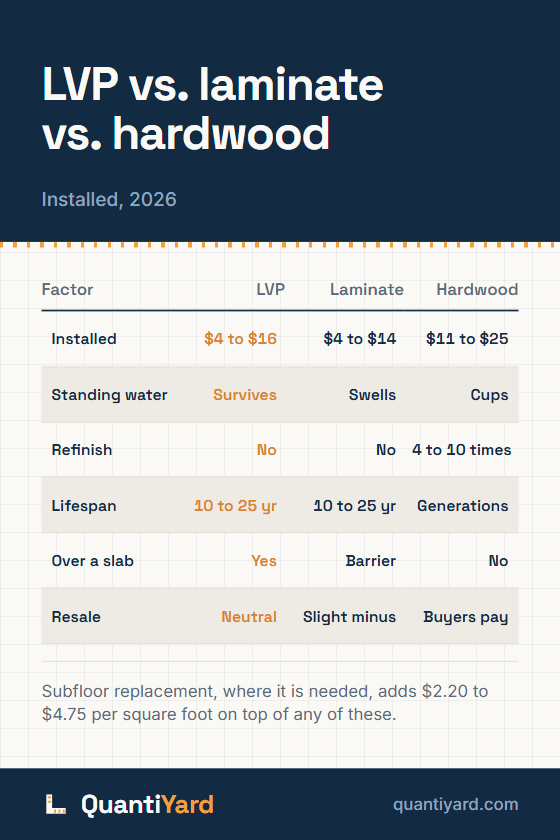
Save the three-way flooring chart#
Cost, water behavior, refinishability, lifespan, and resale for all three, side by side. Save it before the showroom conversation.
Save to PinterestOpens Pinterest with the chart and link ready to go.
Common questions#
Is LVP better than laminate?#
In any room that might see water, yes, and that is most of the reason it has taken over. LVP has a vinyl core that standing water does nothing to. Laminate has a compressed wood fiber core that swells permanently once water gets through the seams, and it does not dry back down. They start at the same $4 per square foot installed, at $4 to $16 and $4 to $14, so water is the deciding factor rather than price.
Is hardwood worth the extra cost?#
In living areas of a house you plan to keep or sell, usually yes. Solid hardwood is $11 to $25 per square foot installed against $4 to $16 for LVP, but it can be refinished 4 to 10 times at $2 to $8 per square foot, it can last for generations, and it is the only one of the three buyers and appraisers reliably pay for: HomeGuide cites a 118 percent return on new wood flooring from the National Association of Realtors. In a basement or a kitchen it is the wrong answer at any price.
Can you put LVP or laminate in a basement?#
LVP yes, laminate no. A basement is below grade and over a slab, which means moisture coming up through the concrete as well as any water event. LVP does not care about either. Laminate needs a vapor barrier at minimum and still fails permanently if it ever wets through. Solid hardwood does not belong over a slab at all; engineered wood does.
What wear layer should I look for in LVP?#
A thicker one for more traffic, and judge it by the warranty rather than the showroom sample. The wear layer is the clear film over the printed image and it decides how long the floor looks new. No published standard sets a thickness per room, so the residential warranty, and what it excludes for pets and rentals, is the firmest guide to what a plank is built for.