Carpet Calculator
Carpet is sold by the square yard off a fixed-width roll, so what you order is decided by how the drops fall, not by the area of the room. This works out both and shows you the difference.
Updated October 2, 2026 · Estimates for planning, not a quote
Why carpet is different from every other flooring
Tile, laminate, and vinyl plank come in boxes, so the box count is the area divided by the coverage and the only judgment call is the waste factor. Carpet comes off a roll of one fixed width, usually 12 feet, sometimes 15. You cannot buy 13 feet of width. You buy 12, and then you buy another 12.
Square feet and square yards
A square yard is 3 feet by 3 feet, so square yards = square feet ÷ 9. A 13 by 16 room is 208 square feet, which is 23.11 square yards. Rooms are measured in feet everywhere and carpet is priced in yards everywhere, and the factor of 9 is a big enough number that quotes are easy to misread. A price that looks like $25 a yard is $2.78 a square foot.
That conversion is not what you order, though, and it is why a per square yard price in our carpet cost guide has to be applied to the carpet off the roll, not to the floor.
Drops, and where the money goes
A drop is one length cut off the roll. The number of drops is the room dimension you are covering across, divided by the roll width, rounded up:
drops = across dimension ÷ roll width, rounded up
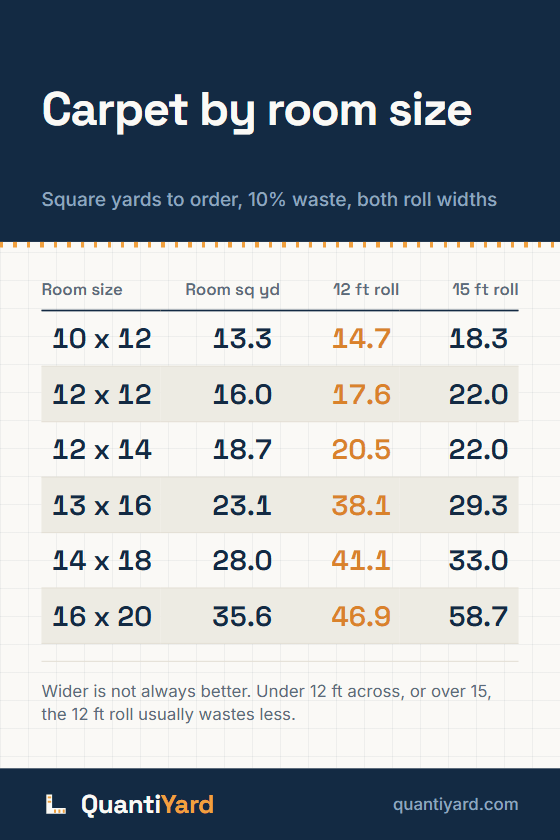
That 13 by 16 room on a 12 foot roll needs 2 drops, because the 16 feet it covers across does not fit on one 12 foot width. Each drop runs the 13 foot direction with a trim allowance, so 14.3 feet, and 2 of them is 28.6 linear feet off a 12 foot roll. That is 343.2 square feet of carpet, or 38.13 square yards, for a room that is 23.11 square yards.
You are paying for 15 square yards you will never walk on. There is nothing wrong with the arithmetic; that is simply what a 13 by 16 room costs on a 12 foot roll. Two 12 foot widths make 24 feet to cover 16, and the leftover strip, 8 feet wide and 14.3 feet long, is not big enough to be useful anywhere else in the room. The trim allowance on both drops makes up the rest.
Ask about the 15 foot roll
The same 13 by 16 room on a 15 foot roll is one drop, 17.6 linear feet, 264 square feet, or 29.33 square yards. That is 9 square yards less carpet and no seam at all. Not every style comes in 15 foot width, and it is not always cheaper per yard, but on any room between 12 and 15 feet across it is the first question to ask. This calculator shows you both.
It cuts the other way too. On a room 12 feet or narrower, or one over 15 feet, the 12 foot roll usually wastes less.
Which way the drops run
The calculator lays the drops whichever way wastes least, and reports that. An installer may choose differently, because seam placement matters: a seam running toward a window catches the light, and a seam across a doorway wears. Both are good reasons to run drops the more expensive way, and you should expect a professional quote to sometimes come in above this figure for exactly that reason.
Waste, and pattern repeats
10 percent covers the trim allowance on each drop, a few inches at each end so the carpet can be stretched and tucked. Patterned carpet is different: every drop has to start at the same point in the pattern so the seams line up, which means cutting each drop to a whole number of repeats and throwing the remainder away. 20 percent is the working figure, and a large repeat can push it higher. Ask what the repeat is before you commit.
Padding
Padding is figured off the room area rather than the roll, because it butts together instead of matching, so offcuts get used. 10 percent over the room area covers it. Padding comes in its own roll widths, usually 6 feet, and it is worth buying decent padding: it is most of what makes carpet feel good underfoot and it is what determines how long the carpet lasts.
If you are comparing against hard flooring
The flooring calculator does box counts for laminate, vinyl plank, and engineered wood, where the waste story is far simpler. Comparing the two, note that carpet's overage is not waste you can trim down with a better layout: it is set by the roll width and your room dimensions, and no amount of careful planning changes it.
Weighing carpet against a hard floor? Our flooring cost guide prices six materials side by side installed, and covers which ones belong in a basement, a kitchen, or a bathroom.
Method and sources
Where these figures come from: Nine square feet to the square yard, which is the unit carpet is quoted in.
Carpet comes off a fixed width roll, so the figure you pay for is roll feet times roll width, not the room's area. The page tries the layout both ways round and keeps the one that buys less. Padding is calculated off the room instead, because padding butts rather than matching.
QuantiYard writes its own formulas and states them in plain language on every page. How these numbers are made covers where the constants come from, how waste factors are chosen, what these calculators deliberately do not do, and how to report an error.
Save the carpet chart
What you order against what the room measures, for six room sizes on both roll widths. Save it and you can ask the right question at the showroom.
Save to PinterestOpens Pinterest with the chart and link ready to go.
Carpet calculator FAQ
How do you convert square feet to square yards for carpet?
Divide by 9, because a square yard is 3 feet by 3 feet. A 13 by 16 room is 208 square feet, which is 23.11 square yards. That conversion is not what you order, though: carpet comes off a fixed-width roll, so the yardage you buy is set by how the drops fall, not by the room's area.
Why does a 13 foot wide room need so much extra carpet?
Because neither side of the room fits on a 12 foot roll. The cheaper layout runs the drops along the 13 foot side, two 12 foot widths cover the 16 feet across it, and the second drop leaves a strip 8 feet wide that you paid for and cannot use anywhere. A 13 by 16 room takes 38.13 square yards off a 12 foot roll against a room area of 23.11. On a 15 foot roll the same room is 29.33 square yards and has no seam at all.
How much extra should I add for patterned carpet?
20 percent rather than the usual 10. Every drop has to start at the same point in the pattern for the seams to line up, so each one gets cut to a whole number of pattern repeats and the offcut is thrown away. The bigger the repeat, the more that costs.
Cite this page
Built from this page's own title, URL and last-updated date, so a citation cannot drift from what it cites.